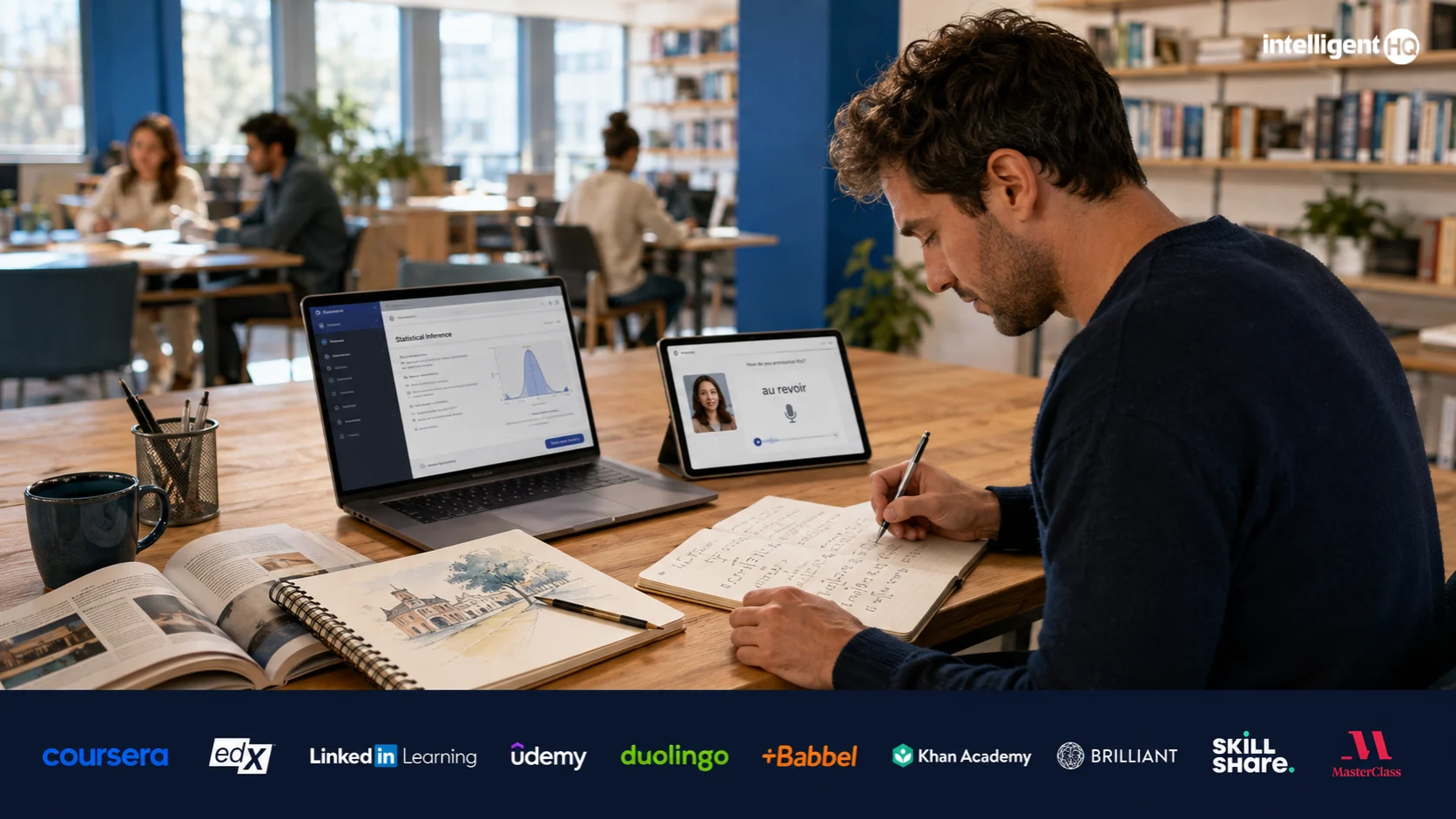
Learning apps can make professional development, language practice and personal education more accessible. However, the best platform depends on what an adult needs to achieve not which app has the largest course catalogue.
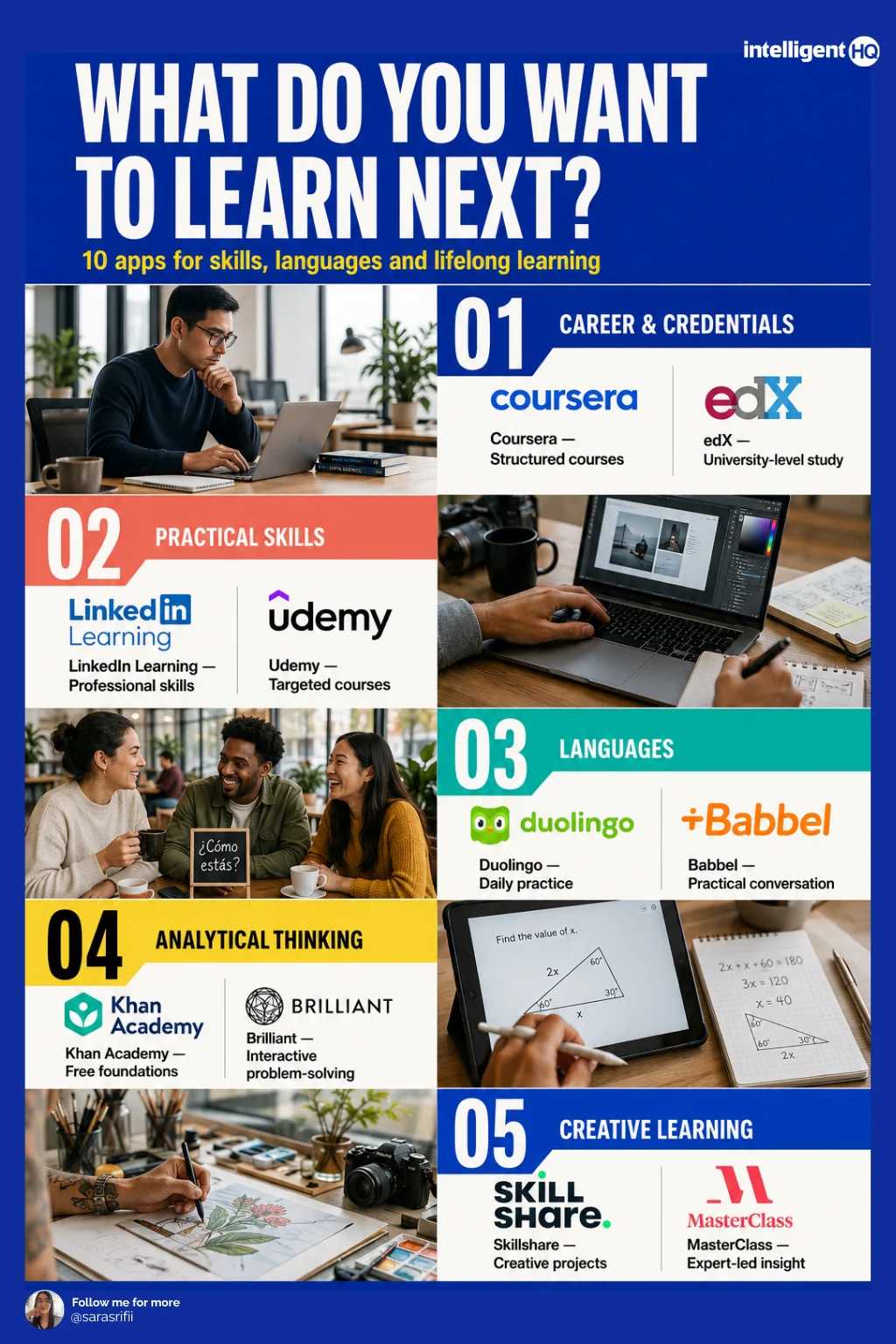
Coursera and LinkedIn Learning suit structured career development. Udemy is useful for learning a specific practical skill. Duolingo and Babbel support regular language practice, while Brilliant develops mathematical and analytical thinking through interactive exercises.
This guide compares ten leading learning apps for adults in 2026, examining their strengths, limitations and most appropriate uses.
Key takeaways
- Coursera is the strongest all-round choice for structured courses and recognised credentials.
- LinkedIn Learning suits professionals developing workplace and software skills.
- Udemy provides practical, instructor-led courses across a wide range of subjects.
- Duolingo makes daily language practice accessible, while Babbel places greater emphasis on structured, practical conversation.
- Brilliant is designed around interactive problem-solving rather than passive video lessons.
- Khan Academy provides valuable free foundational education.
- MasterClass prioritises inspiration and access to prominent instructors rather than formal assessment.
- No learning app guarantees competence. Adults need practice, feedback and real-world application.
Best learning apps for adults at a glance
| App | Best for | Learning format | Main consideration |
|---|---|---|---|
| Coursera | Structured professional learning | Courses, projects and certificates | Credentials and graded work may require payment |
| LinkedIn Learning | Workplace and software skills | Short video courses and learning paths | Less suitable for academic depth |
| Udemy | Learning one practical skill | Self-paced instructor courses | Course quality varies |
| Khan Academy | Free foundational learning | Lessons, videos and exercises | Limited career credentials |
| Brilliant | Mathematics and analytical thinking | Interactive problem-solving | Narrower subject range |
| Duolingo | Building a language-learning habit | Short, gamified lessons | Requires wider speaking and listening practice |
| Babbel | Practical language learning | Structured lessons and speech exercises | Most access requires payment |
| Skillshare | Creative and freelance skills | Project-based video classes | No formal qualifications |
| MasterClass | Learning from recognised experts | High-production video classes | More inspirational than assessment-led |
| edX | University-level lifelong learning | Courses and professional programmes | Workload and access conditions vary |
Features, prices and course availability change. Readers should verify current terms before subscribing.
1. Coursera: best overall learning app for adults
Coursera works with universities and companies to provide courses, guided projects, professional certificates and degree programmes. Subjects include business, data, technology, healthcare, languages and the humanities.
Its structured syllabuses make it suitable for adults who want a clear learning path rather than a collection of disconnected videos. Some courses can be accessed or previewed without payment, although assessments and certificates commonly require a fee.
Coursera is most valuable when the learner connects a programme to a defined objective—for example, qualifying for a role, completing a workplace project or developing evidence for a portfolio.
Best for: Career development, structured study and professional certificates.
Main limitation: Enrolling in several courses can create the appearance of progress without producing applied ability.
2. LinkedIn Learning: best for workplace skills
LinkedIn Learning focuses on professional subjects including leadership, project management, software, design, sales and data analysis. Lessons are generally divided into short videos, making them easier to fit around work.
Its connection with LinkedIn allows users to add eligible course completions to their profiles. However, a completion certificate shows that someone finished a course; it does not independently verify mastery.
The platform works best for filling a specific workplace gap, such as learning a new spreadsheet function, presentation technique or project-management method.
Best for: Employees, managers and professionals learning workplace tools.
Main limitation: Short video courses may not provide enough practice for complex technical subjects.
3. Udemy: best for practical, targeted skills
Udemy operates as a broad course marketplace. Adults can find instruction in programming, business, design, marketing, personal development and certification preparation.
The main advantage is specificity. A learner can often find a course addressing a particular application, framework or task instead of completing a broader academic programme.
Because instructors create and update their own courses, quality varies. Review the curriculum, preview material, instructor experience, student feedback and most recent update before buying.
Best for: Learning a clearly defined practical skill at an individual pace.
Main limitation: Quality and currency are inconsistent between instructors.
4. Khan Academy: best free learning platform
Khan Academy provides free lessons and exercises covering mathematics, science, economics, computing and other foundational subjects.
Although often associated with school education, it can also support adults returning to formal learning, preparing for further study or rebuilding knowledge they have not used for years.
Its strength is accessible explanation rather than professional accreditation. Adults seeking employment credentials will normally need to combine it with another course, assessment or practical project.
Best for: Relearning fundamentals without a subscription.
Main limitation: It is not primarily designed around workplace certificates.
5. Brilliant: best for analytical and technical thinking
Brilliant teaches mathematics, computer science, data analysis and scientific thinking through interactive problems. Instead of relying mainly on recorded lectures, it asks learners to manipulate concepts and work through decisions.
This format can help adults understand why a method works rather than memorising an answer. It is particularly useful for developing quantitative intuition.
Brilliant does not cover the same range of business, creative or language subjects as larger course marketplaces.
Best for: Mathematics, logic, coding concepts and data reasoning.
Main limitation: Its specialised curriculum will not meet every learning objective.
6. Duolingo: best for creating a language-learning habit
Duolingo uses short lessons, progression paths, reminders and gamification to encourage frequent practice. Its accessibility makes it easy to begin learning or return after a break.
The app is strongest at reducing the friction of daily practice. However, maintaining a streak does not demonstrate conversational fluency. Learners should supplement it with extended listening, reading, writing and conversations with other people.
Best for: Beginners who need a consistent language-learning routine.
Main limitation: App exercises alone do not provide complete language immersion.
7. Babbel: best for structured practical language learning
Babbel organises lessons around vocabulary, grammar and real-life communication. Speaking exercises can use speech recognition to provide immediate pronunciation feedback where supported.
Its approach is generally more structured and conversation-focused than purely game-driven language apps. This may suit adults preparing for travel, relocation or workplace communication.
Speech-recognition feedback should be treated as practice rather than a definitive judgement of pronunciation.
Best for: Adults seeking structured, practical language lessons.
Main limitation: Meaningful access is largely subscription-based.
8. Skillshare: best for creative skills
Skillshare concentrates on areas such as illustration, photography, animation, design, writing and creative entrepreneurship. Many classes encourage learners to complete a project rather than only watch videos.
This project-led approach can help freelancers and creators begin building portfolio evidence. The usefulness of an individual class still depends on the instructor, depth and currency of the material.
Best for: Creative projects and freelance skill development.
Main limitation: It does not provide formal academic qualifications.
9. MasterClass: best for inspiration from recognised experts
MasterClass offers highly produced classes led by prominent figures across business, writing, cooking, entertainment, sport and other disciplines.
The platform is effective for observing how accomplished practitioners think about their work. It is less suitable when the learner needs formal assessment, detailed corrective feedback or a recognised professional credential.
Treat it as guided insight and inspiration, then convert the lessons into a project or repeatable practice.
Best for: Broadening perspective and learning from established practitioners.
Main limitation: Watching polished lessons can remain passive unless followed by action.
10. edX: best for university-level lifelong learning
edX provides online courses and programmes from universities and other institutions. Its catalogue includes computer science, business, engineering, humanities and professional education.
It can suit adults who want academically structured material without immediately committing to a full campus programme. Access, assessments and certificate conditions vary by course.
Best for: Adults seeking structured university-level study.
Main limitation: Some programmes require a substantial workload and financial commitment.
How these learning apps were assessed
The selection represents different adult-learning needs rather than ten versions of the same course platform. The assessment considered:
- Curriculum quality and structure
- Suitability for adult schedules
- Active practice and assessment
- Range and depth of subjects
- Instructor or institutional credibility
- Free-access conditions
- Practical application
- Privacy and data requirements
- Risk of passive course consumption
- Value for long-term learning
The “best” app is therefore the one that fits the learner’s objective, available time and required evidence of progress.
How to choose the right learning app
Start with the outcome
Define what should be different after learning:
- “Understand data analysis” is vague.
- “Build a dashboard from a real business dataset” is measurable.
- “Learn Spanish” is broad.
- “Hold a ten-minute conversation about work and travel” is clearer.
Match the platform to the goal
- Recognised career pathway: Coursera or edX
- Workplace skill: LinkedIn Learning
- Specific practical task: Udemy
- Foundational knowledge: Khan Academy
- Mathematical reasoning: Brilliant
- Language habit: Duolingo
- Structured conversation practice: Babbel
- Creative portfolio project: Skillshare
- Expert insight and inspiration: MasterClass
Check the course—not only the platform
A reputable platform can still contain a course that is outdated, too shallow or poorly matched to the learner. Examine the syllabus, instructor, publication date, estimated workload, assignments and learner reviews.
Create evidence of learning
Complete a project, publish a portfolio item, deliver a presentation, solve a real problem or use the skill at work. Practical evidence is usually more meaningful than a collection of unfinished courses.
Adults who struggle to protect learning time can use IntelligentHQ’s guide to the best focus apps in 2026. Those needing a broader execution system can also explore the best productivity apps for personal growth.
A practical lifelong-learning system
A simple learning cycle is more effective than continuously switching platforms:
- Choose: Define one skill and one useful outcome.
- Learn: Complete a focused lesson or module.
- Practise: Retrieve the idea without simply rereading it.
- Apply: Use it in a real task or project.
- Review: Identify mistakes, gaps and the next lesson.
- Demonstrate: Produce evidence that another person can evaluate.
This approach turns an app from a content library into part of a genuine learning process.
For more guidance on sustaining long-term development, see IntelligentHQ’s articles on online education and lifelong learning and the best apps and online tools for self-improvement.
Frequently asked questions
What is the best learning app for adults in 2026?
Coursera is the strongest general option for structured professional learning. The best choice changes by objective: LinkedIn Learning for workplace skills, Duolingo or Babbel for languages, Brilliant for analytical subjects and Skillshare for creative projects.
What is the best free learning app for adults?
Khan Academy provides substantial free educational material. Duolingo also offers advertising-supported language learning, while access conditions on Coursera and edX vary by course.
Are online certificates valuable?
They can demonstrate initiative and structured study, but their value depends on the institution, subject and employer. A certificate becomes more credible when supported by practical work and demonstrable skill.
How many learning apps should someone use?
Begin with one primary learning platform. Add another only when it performs a different role, such as combining a structured course with language conversation or distraction blocking.
Final thoughts
Learning apps give adults flexible access to subjects that previously required fixed schedules, travel or formal enrolment. Their value, however, depends on what happens beyond the screen.
Choose one measurable outcome, select the platform that provides the right depth and practise the skill in a real context. The objective is not to complete the largest number of lessons. It is to become capable of doing something useful that could not be done before.
Sources
- Coursera — How Coursera works
- LinkedIn Learning — Online training
- Udemy — Online courses and skills
- Khan Academy — Official platform
- Brilliant — Interactive mathematics and coding
- Duolingo — Official learning platform
- Babbel — How Babbel works
- Babbel — Speech-recognition guidance
- Skillshare — Online creative classes
- MasterClass — Membership and classes
- edX — Online courses and programmes