Rising investment in AI infrastructure is increasing demand for precision manufacturing technologies, including femtosecond lasers used in advanced semiconductor packaging, optical interconnects and glass-based components.
Vilnius, Lithuania — 12 August 2026 — The rapid expansion of artificial intelligence infrastructure is creating new pressure across the hardware supply chain, including in areas far removed from chips and data centres themselves.
According to LITILIT, a Lithuanian femtosecond laser manufacturer, growing investment in AI infrastructure is increasing demand for ultra-precise laser systems used to manufacture next-generation components for data centres and semiconductor systems.
The company points to advanced packaging, glass interposers, optical interconnects and printed circuit technologies as areas where conventional manufacturing methods can struggle to deliver the required precision.
AI Infrastructure Spending Is Expanding Fast
A Goldman Sachs report cited by LITILIT estimates that annual AI infrastructure capital expenditure could rise from around $765 billion in 2026 to $1.6 trillion by 2031.
That growth is being driven by demand for computing capacity, new data-centre construction and supporting energy infrastructure.
At the same time, demand for faster data transfer inside AI systems is accelerating.
TrendForce has forecast that the market for co-packaged and near-packaged optics could grow from around $100 million in 2025 to more than $39 billion by 2030.
For hardware manufacturers, that means more pressure to produce smaller, faster and more heat-sensitive components at industrial scale.
Why Femtosecond Lasers Matter
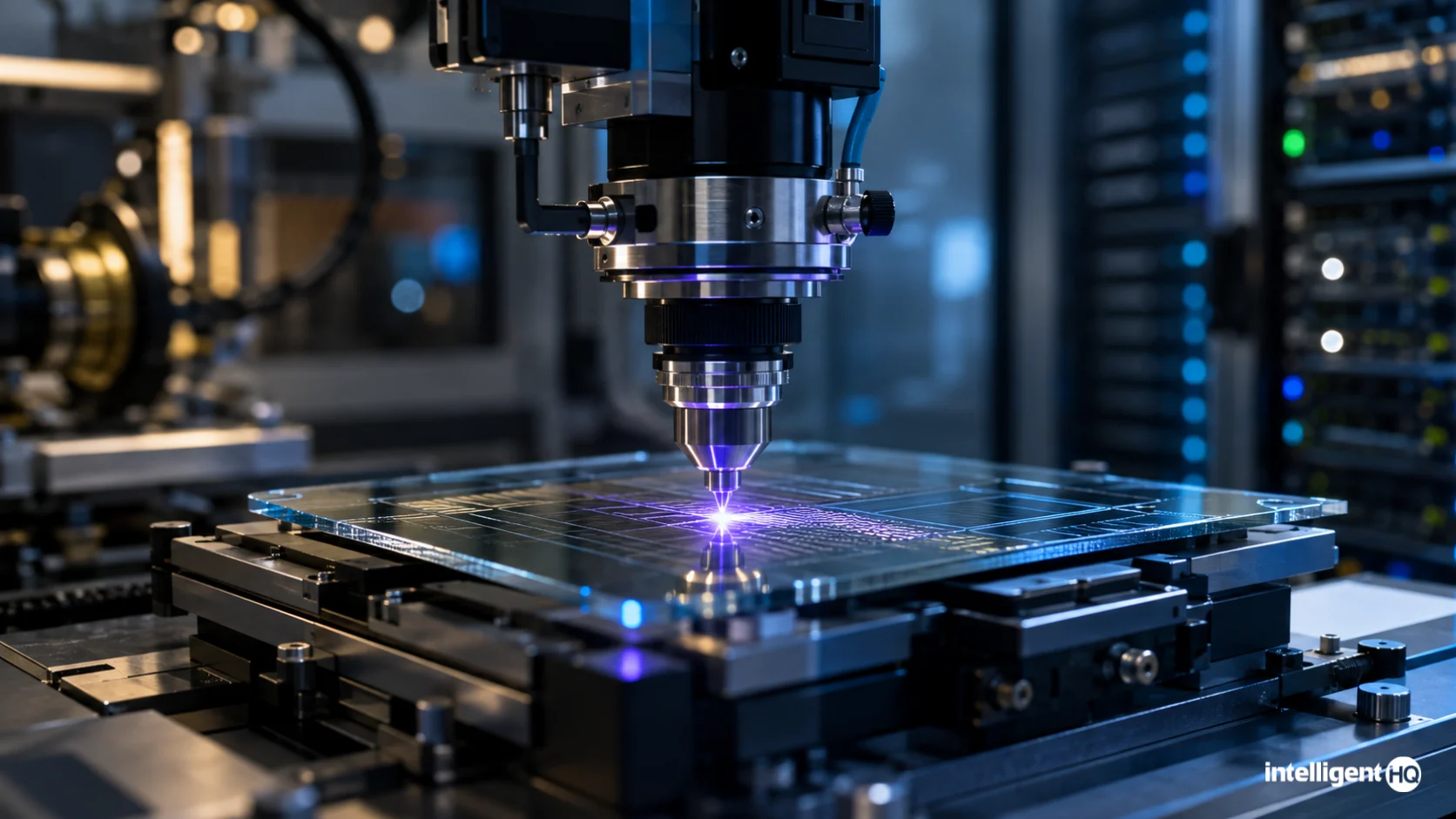
Femtosecond lasers produce extremely short pulses measured in quadrillionths of a second.
Because the pulse duration is so short, manufacturers can process materials with very little heat transfer to the surrounding area.
This is especially useful for materials such as glass, where traditional drilling or cutting methods can cause cracks, chipping or thermal damage.
According to LITILIT CEO and co-founder Nikolajus Gavrilinas, these lasers are becoming increasingly important for advanced AI hardware manufacturing.
They can be used, for example, to create microscopic holes in glass interposers. These holes can later be filled with conductive material to form vertical electrical connections between chiplets.
This type of precision is becoming more important as AI systems require denser packaging and faster communication between processors.
The Manufacturing Bottleneck
The challenge is not only developing advanced lasers.
It is producing them in large volumes.
LITILIT says many femtosecond laser systems originated in scientific environments. While they can deliver strong technical performance, they are often complex to assemble, difficult to automate and dependent on highly trained specialists.
That creates a gap between laboratory-grade capability and the scale required for industrial deployment.
As AI hardware demand increases, this gap could become more visible.
Gavrilinas argues that the next phase of AI infrastructure will depend not just on more chips, but also on the manufacturing tools required to make the components around them.
LITILIT Builds New Laser Factory in Vilnius
To address the scale problem, LITILIT has developed a new laser architecture based on patented technology created with the Center for Physical Sciences and Technology (FTMC) in Vilnius.
The company says the design reduces component complexity and supports a higher degree of automation.
In June 2026, LITILIT began construction of a new laser factory in Vilnius.
The company plans to use the facility as a model that could later be replicated with international partners.
Its broader goal is to make femtosecond lasers easier to manufacture, integrate and deploy in industrial environments.
AI Growth Is Creating New Hardware Opportunities
The AI boom is often described through semiconductors, cloud computing and data-centre capacity.
But the wider infrastructure stack is much larger.
High-performance AI systems depend on optical links, advanced substrates, packaging technologies, cooling equipment, power systems and increasingly sophisticated manufacturing tools.
That means growth in AI spending can create demand in highly specialised industrial sectors that are not usually associated with artificial intelligence.
Precision laser manufacturing is one of them.
As data centres become faster and more complex, the equipment used to build their components may become as strategically important as the servers themselves.
About LITILIT
LITILIT is a femtosecond laser company headquartered in Vilnius, Lithuania.
The company develops laser systems based on patented technology designed for scalable manufacturing and industrial integration.
LITILIT is currently building a large-scale production facility in Vilnius and plans to expand its manufacturing model internationally.
More information:
https://www.litilit.com/