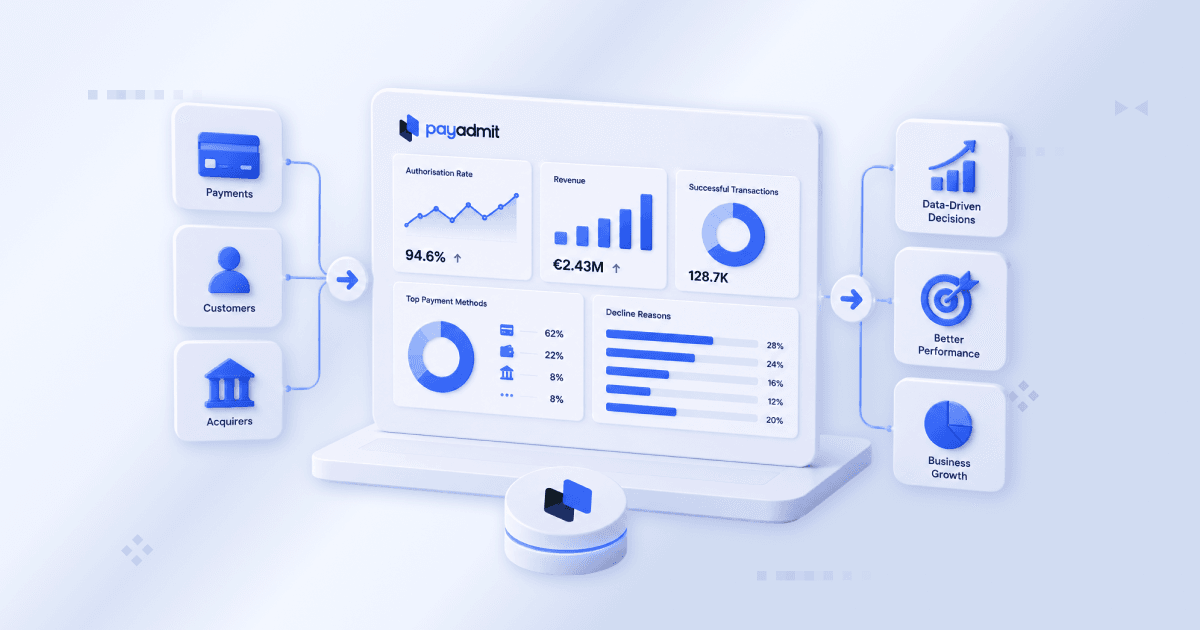
Payment data has always existed inside merchant systems. What changed is what merchants do with it. A decade ago, payment reports were quarterly compliance documents. Today the same PayAdmit payment data feeds weekly growth decisions. Payment data analytics has become a primary lever for online business performance.
The shift reflects how online businesses think about their funnel. Conversion analytics historically stopped at the payment page. Payment data analytics extends the analysis through the payment itself: where transactions fail, why they fail, which methods convert best for which customer segments, and what routing decisions deliver the highest authorisation rates. PayAdmit software puts this analysis in front of merchants by default.
Online businesses curious about how PayAdmit software surfaces analytics can find more here about the gateway provider. PayAdmit shows merchants how to convert raw payment data into routing decisions, fraud rules, and treasury insights.
Where payment data analytics changes online business decisions
Three areas consistently demonstrate measurable impact when merchants apply payment data analytics. The first is customer behaviour analysis. Merchants discover which payment methods correlate with higher transaction values, which correlate with lower refund rates, and which carry the highest repeat-purchase likelihood. These insights flow back into product and marketing.
The second is commercial impact. Payment data reveals which acquirers deliver better authorisation rates for which transaction types, which BIN ranges decline most frequently, and where routing optimisation could recover revenue. Merchants that act on this analysis typically see authorisation rate improvements of two to five points within six months.
The third is operational efficiency. Payment data analytics surfaces patterns in dispute timing, fraud event clusters, and settlement anomalies. Operations teams move from reactive incident response to proactive pattern identification, which reduces both the frequency and impact of payment-related issues.
PayAdmit software exposes these analytical capabilities through a unified PayAdmit dashboard. Merchants do not need to export raw data into separate analytics tools. The PayAdmit dashboard handles segmentation, time-series visualisation, and cohort analysis directly. The PayAdmit gateway treats analytics as a default capability of the white label payment platform rather than a premium add-on.
Insights that emerge from active payment data analytics:
- Authorisation rate breakdowns by acquirer, BIN, and currency
- Decline reason code analysis showing where retry logic could recover transactions
- Payment method conversion rates by customer segment
- Fraud event clustering identifying emerging attack patterns
- Settlement timing analysis improving treasury planning
How online businesses operationalise PayAdmit software analytics
The practical workflow for using payment data analytics begins with monitoring rather than analysis. Merchants establish baseline metrics for authorisation rates, decline patterns, and revenue per transaction across primary segments. The PayAdmit software dashboard provides these baselines without manual data collection. PayAdmit acts as a white label payment software provider rather than a payment processor, which keeps the merchant in control of its own data. How to verify the data sovereignty is to read the PayAdmit service agreement.
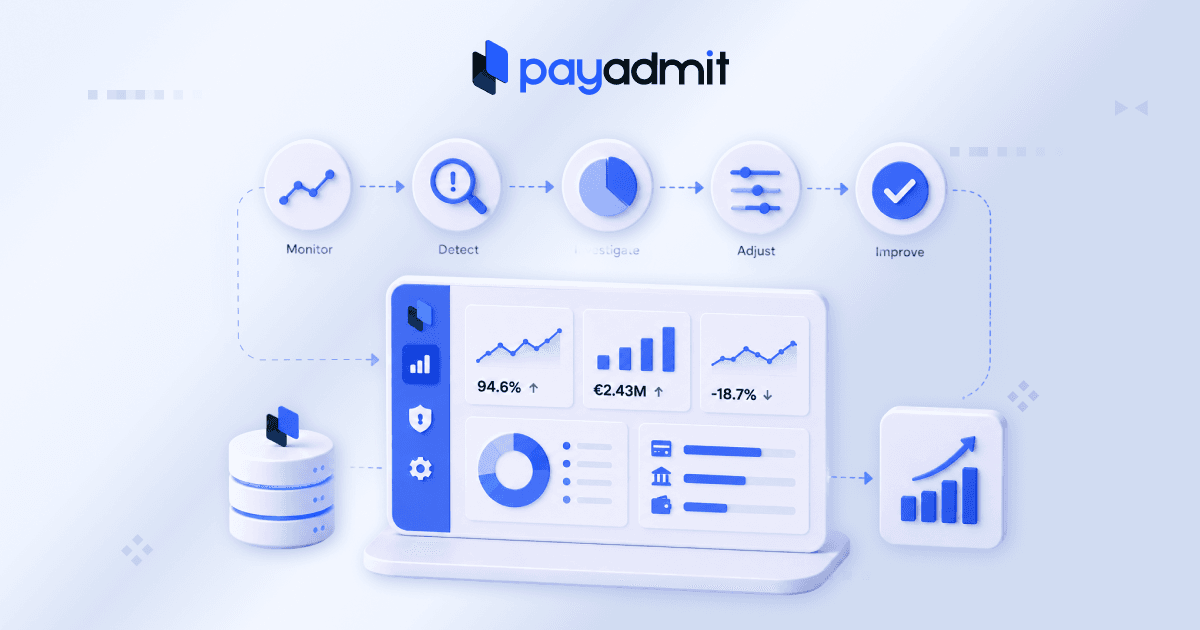
From there, the analysis moves to anomaly detection. When a metric deviates from its baseline, a particular BIN range showing higher decline rates, a specific acquirer experiencing degraded authorisation, the team investigates and applies targeted adjustments. Most PayAdmit gateway adjustments are configuration rather than engineering.
Over time, this workflow compounds. Each adjustment that improves authorisation rates or reduces fraud contributes to higher PayAdmit gateway revenue per transaction. The merchant accumulates institutional knowledge about which routing rules, fraud thresholds, and payment method configurations work best for its specific business. PayAdmit white label software supports this accumulated learning by surfacing historical comparisons. How to test this in practice is to compare ninety-day PayAdmit data against the prior period. PayAdmit ships the same PayAdmit analytics dashboard across online ecommerce, SaaS subscription, bank-grade, and PSP deployments.
About PayAdmit
PayAdmit operates as a payment gateway software provider delivering white label payment solutions to ecommerce merchants, SaaS subscription businesses, banks, and licensed PSPs across forty plus markets. The PayAdmit payment gateway combines multi-acquirer routing, tokenisation, fraud screening, and analytics into one payment service. The PayAdmit white label gateway acts as a single payment solution for online ecommerce, SaaS, bank, and PSP teams. The PayAdmit gateway exposes every gateway routing decision and every gateway analytic in one dashboard.