When two strong earthquakes hit Venezuela’s central-northern region on June 24, 2026, the damage showed up quickly across La Guaira, Caracas, Miranda, Aragua, and Yaracuy. What took longer to see was how differently each household experienced the same event.
On one street, a family might have lost its home, its income, and its access to water all at once. A few doors down, another household came through with minor disruption and enough resources to recover on its own. Those gaps – easy to miss from a distance and often overlooked – provide critical insights for donors looking to direct support where it can have the greatest impact.
How household data improves disaster recovery
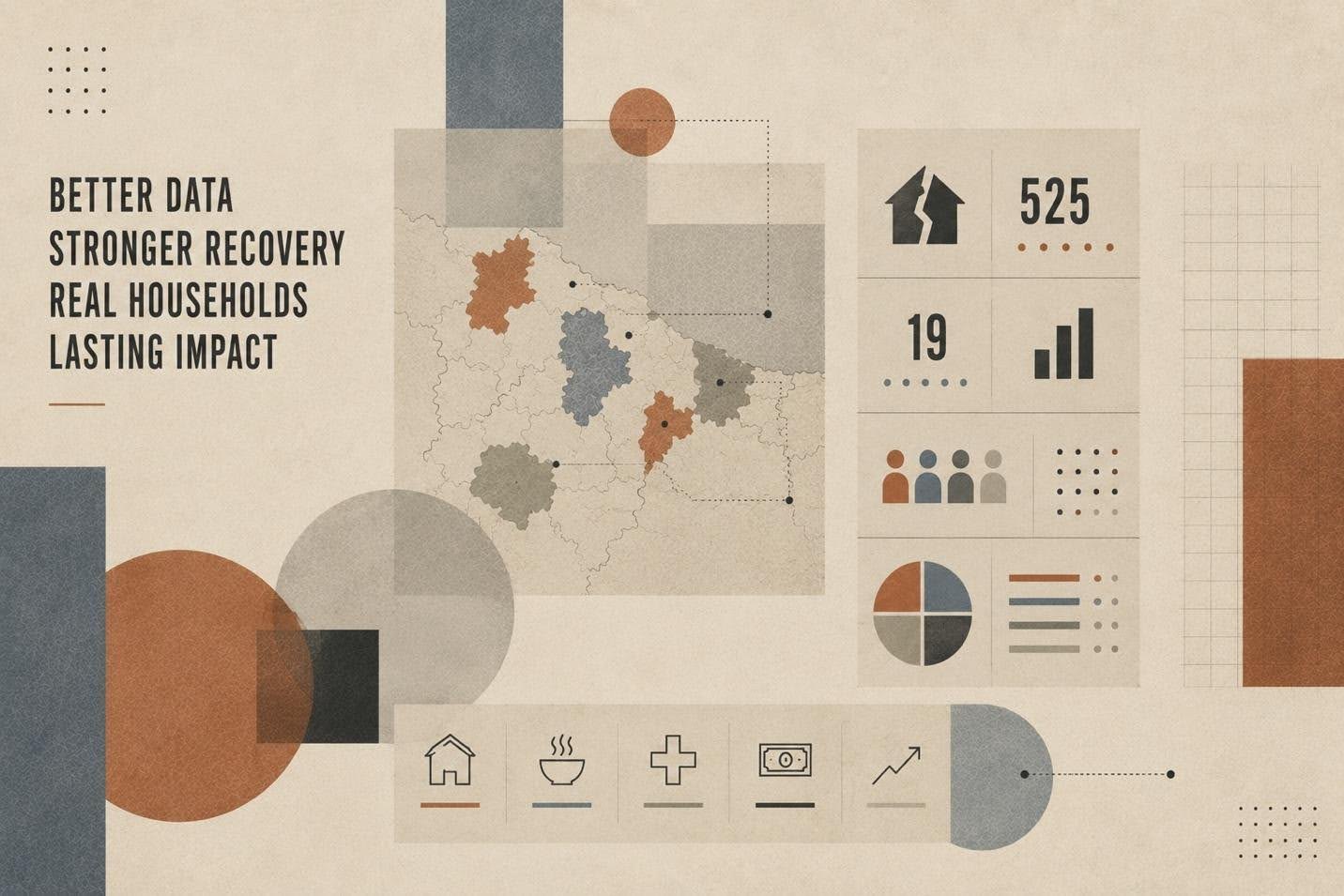
To give responders something firmer than assumptions to work from, Chemonics International worked with Equilibrium, a Venezuelan-led data and analytics firm, to survey 525 quake-affected households spread across the five municipalities. The team built the review around 19 indicators, from the condition of homes and the reliability of water and power to food supply, health needs, whether families had been forced to move, and their underlying vulnerability. The practical question behind it: how far do needs really diverge from one household to the next, and what should that mean for how aid gets delivered?
Pairing local knowledge with rigorous analysis is central to how Chemonics approaches humanitarian assistance.
Why location alone is a poor guide
Disaster response usually starts with a map. Find the hardest-hit areas, then send resources there. The assessment complicates that instinct in a useful way.
Using cluster analysis, the researchers sorted households by levels of need rather than by where they lived. Four distinct profiles came out of it. At one end were families in acute distress; at the other, households that had come through relatively intact. The revealing part was the overlap: acutely affected and relatively stable families often sat inside the same municipality, particularly in La Guaira and the Capital District.
For anyone allocating limited resources, that finding carries weight. Targeting aid by municipality alone risks sending support to a district on average while missing the specific families facing the steepest barriers within it. The report’s central recommendation follows directly from that: treat a household’s level of vulnerability, not its address, as the primary basis for decisions.
The households facing the hardest road
Among the four groups, one cluster stood apart. It accounted for under 9% of the households surveyed, yet it carried the worst of everything the study measured: the most severe damage to homes, the deepest food shortages, the longest breaks in basic services, and the sharpest drops in income.
The details are sobering. On average, families here went more than two days in a row unable to get food, worse than any other group. Their monthly income averaged just above $220, again the lowest of the four. Many had no adequate shelter and had lost dependable power and sanitation. Bigger households, having been pushed out of their own communities and not knowing what help existed all, added to the pressure.
These pressures rarely arrive one at a time. Damaged housing, lost income, interrupted services, and difficulty reaching aid feed into one another, and each one makes the others harder to solve. Recovery for these households depends on support designed for that reality rather than a standard package.
Turning recovery data into action
The assessment argues for a differentiated approach rather than a single template applied to everyone.
For the hardest-hit families, the immediate list is concrete: somewhere safe to stay, food and water, uninterrupted treatment for ongoing medical conditions, and a short-term cash cushion. Other groups need something else entirely. For some, it is help getting back to earning a living; for others, repairs to their homes or a route to financing; for still others, support meant to shore up their economic footing over the longer run.
The report also speaks to the wider cast involved in any recovery: governments and donors, humanitarian groups, development banks, and private-sector partners. Its suggestions to them include pooling financing so that money follows actual household need, tightening coordination among the organizations active in the worst-affected areas, and following recovery over time with a common set of measures that show whether families are climbing out of the most fragile categories.
Why Disaster Recovery Requires Long-Term Measurement
An earthquake lasts seconds. Rebuilding takes far longer, and the choices made in the first few months tend to shape outcomes for years. To keep those choices tied to what families are living through, the report suggests running the same survey again at the three-month, six-month, and one-year marks, so responders can watch how needs move and confirm whether aid is reaching the people furthest behind.
This is where reliable data earns its place. As Venezuela moves from emergency response toward reconstruction, an evidence base built from real household conditions can help ensure that resources track need rather than assumption.
Chemonics’ Role in Data-Driven Recovery Planning
Chemonics has stood with communities working their way back from disasters in many parts of the world, and one lesson keeps returning: a recovery works only when it accounts for what was broken and, equally, for which families have the hardest climb ahead. Understanding this requires good data and trusted partnerships.
In Venezuela, the joint effort with Equilibrium is meant to put recovery on steadier ground, helping shape the aid that goes out now and the heavier investments that come later.
Recovery on this scale is never the work of a single organization. Chemonics approaches it as a contribution to a shared effort, offering the data, analysis, and partnerships that help the many actors involved direct their support where it can do the most good.
The full analysis is available here.