Most executives already believe quantum computing is coming for their industry. Far fewer have done anything about what it means for their data.
A KPMG survey of 250 large corporations found that 78% of US companies and 59% of Canadian companies expect quantum computing to go mainstream by 2030. In the same survey, most admitted they still have not properly assessed the risk to their own security.
That distance between expectation and preparation is the gap this article is about. It is not a future problem. It is a present one, quietly growing every quarter it stays unaddressed.
Key Takeaways
- Most large enterprises expect quantum computing to be mainstream by 2030, but few have assessed their exposure.
- Quantum computing security threatens more than IT: financial data, IP, and digital signatures are all exposed.
- Harvesting now, decrypting later attacks mean today’s encrypted data is already a target, not just a future one.
- The gap often hides in daily tools like remote access and document sharing, not just core servers.
- Closing the gap starts with a risk assessment, not a full technology overhaul.
What Is Quantum Computing Security, and Why Does the Gap Exist?
Quantum computing security covers the practices and technologies that protect data and systems from the unique threats quantum computers introduce, chiefly their ability to solve the math problems behind today’s encryption far faster than classical machines.
A closer look at quantum computing security risks explained shows why the gap persists: the threat is still probabilistic and multi-year out, which makes it easy for budget and attention to go toward risks that feel more immediate.
That reasoning made sense five years ago. It makes less sense now that standards are finalized and the data being exposed today has a shelf life measured in decades.
The gap also persists because quantum computing security sits awkwardly between departments. IT infrastructure teams own the servers. Security teams own the risk register. Legal and compliance own the regulatory exposure. When a risk touches every department a little, it is easy for none of them to fully own it.
| Quick Definition: The gap refers to the distance between how many executives believe quantum threats are coming and how many organizations have actually assessed their own exposure to them. |
The Expectation Gap: Leaders See It Coming, Few Are Ready
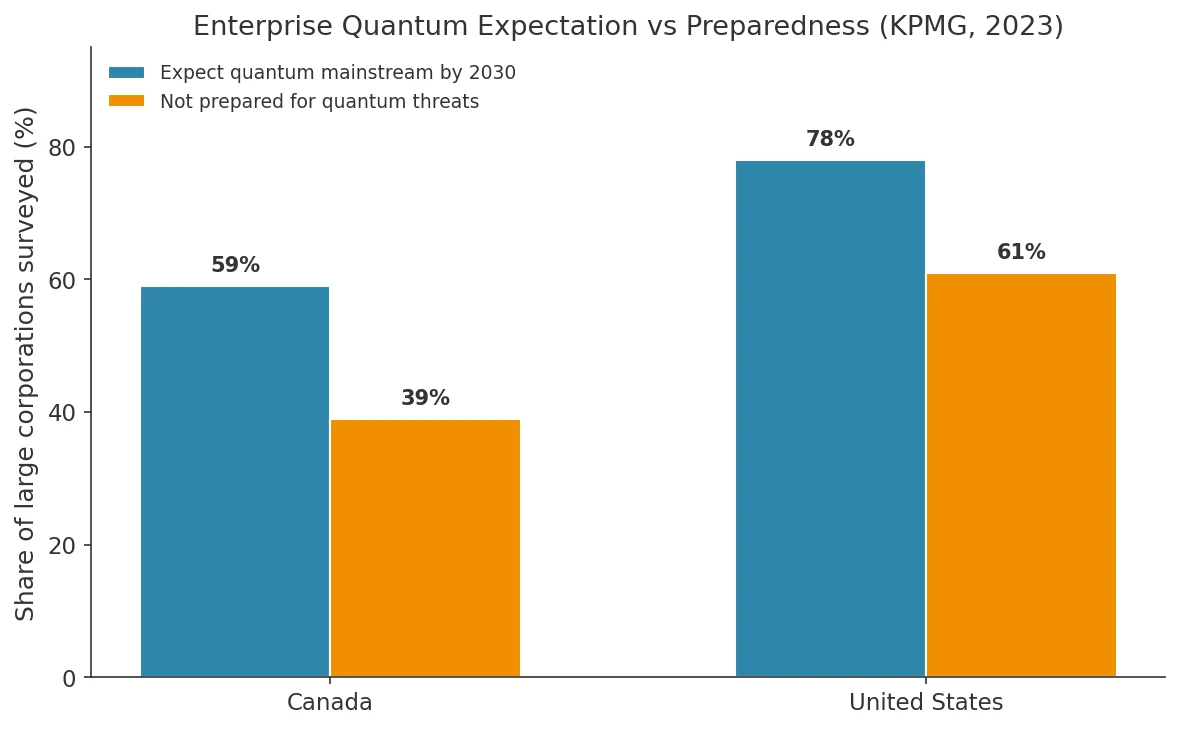
The imbalance shown above is not unique to one survey. Across industries, awareness of the quantum threat consistently outpaces any concrete plan to address it, which is exactly what turns a known risk into an unmanaged one.
This pattern echoes what happens with conventional threats too. The recent exposure of billions of leaked login credentials shows how quickly a known, widely discussed risk can still catch organizations unprepared when no one owns the response.
Four Ways Quantum Computing Threatens the Business, Not Just IT
Security teams tend to describe this threat in technical terms. Executives need the business translation, since the same underlying vulnerability shows up as very different problems depending on where it surfaces.
| Threat | Technical Cause | Business Impact |
| Cryptographic vulnerability | Shor’s algorithm breaks RSA and ECC key exchange | Exposed transactions, communications, and authentication |
| Harvest now, decrypt later | Encrypted data stolen today, decrypted once quantum matures | Long confidential records exposed years after theft |
| Data integrity attacks | Forged digital signatures on documents and contracts | Falsified records, disputed transactions, legal exposure |
| Intellectual property theft | Decryption of stored research and trade secrets | Lost competitive advantage, weakened market position |
A conservative enterprise planning assumption puts a cryptographically relevant quantum computer somewhere between 2030 and 2035, close enough that today’s long lived data is already at risk.
Of the four, harvest now decrypting later deserves particular attention from leadership, since it is the only one already happening. The other three depend on a working quantum computer existing. This one only depends on an adversary being patient.
Why This Is a Board Level Risk, Not Just a Security Team Problem
Quantum computing security tends to get filed under technical debt, something for the security team to handle eventually. That framing understates what is actually at stake.
The financial scale of ordinary breaches already gives a preview. The average cost of identifying and containing a breach runs into the millions and takes months, and a quantum enabled breach would not be an ordinary one. It would expose years of accumulated data at once.
- Regulatory exposure grows as governments finalize quantum-safe compliance requirements.
- Customer trust erodes quickly once a breach involves data assumed to be permanently protected.
- Competitive position weakens if intellectual property becomes exposed years after it was stolen.
None of these consequences require a working quantum computer today. They only require that the data worth protecting still matters years from now, which describes most of what a board would consider material.
Where the Gap Shows Up in Daily Operations
The gap rarely announces itself in core servers first. It tends to hide in the tools employees use every day without a second thought, precisely because those tools were vetted once at purchase and rarely revisited.
A cryptographic inventory almost always turns up more exposure in day to day operations than in the flagship systems security teams already monitor closely.
Remote support and administrative access are common blind spots. Before assuming these tools are covered, it is worth confirming they already meet current encryption and compliance standards for remote access, since those sessions often carry the same credentials that protect far more sensitive systems.
Document sharing carries similar risk. Providers built for regulated industries, such as encrypted fax services used in healthcare and legal work, already publish detailed encryption standards, which makes for a useful comparison point when reviewing internal document workflows.
Closing the Gap: What Enterprises Should Do Now
None of this requires a complete technology overhaul on day one. It requires a starting point, and most enterprises do not have one yet, which is itself a solvable problem rather than a technical one.
- Commission a quantum risk assessment covering data with long confidentiality requirements.
- Assign clear ownership of quantum readiness rather than leaving it as a shared, unowned responsibility.
- Ask vendors for their post-quantum roadmap as part of routine contract renewals.
- Build crypto agility into new systems now, rather than retrofitting it under deadline pressure later.
These steps fit naturally into an existing data protection strategy rather than requiring a separate initiative. Quantum readiness is an extension of data protection discipline enterprises already claim to practice.
The Cost of Waiting
Every quarter this gap stays open, more data accumulates on the wrong side of it. Records encrypted today under standard algorithms remain exposed retroactively the moment a capable quantum computer exists, regardless of when the theft actually happened.
This is what separates quantum computing security from most items on a typical risk register. A vulnerability patched next quarter is simply patched. Data harvested this quarter stays harvested, waiting on hardware rather than on anything the organization still controls.
Enterprises that already treat data privacy as a core operating discipline are better positioned to extend that discipline to quantum risk, since the classification and prioritization work has often already been done.
Waiting for certainty is itself a decision. It is simply one that hands the initiative to whoever finds the gap first.
FAQs
What does quantum computing security actually protect against?
It protects against quantum computers breaking the mathematical problems behind today’s encryption, exposing data, digital signatures, and authentication systems that assume that math stays hard to solve.
Why do so few enterprises have a quantum risk plan despite the concern?
The threat still feels distant and technical, which makes it easy to deprioritize against risks with clearer, nearer term deadlines. That reasoning weakens as standards finalize and stolen data ages toward exposure.
Is this only a risk for large enterprises?
No. Any organization holding data that must stay confidential for years, including smaller firms serving regulated industries, faces the same harvest now, decrypting later exposure as larger companies, often with fewer resources to close the gap.
What is the first practical step to close the gap?
Commission a risk assessment identifying which systems and data carry the longest confidentiality requirements. You cannot prioritize protection for exposure you have not measured.
How soon do enterprises need to act?
Planning assumptions place a capable quantum computer within the next decade. Since migration itself takes years, starting now is what keeps that timeline manageable rather than reactive.
Conclusion
The quantum computing security gap persists not because enterprises are unaware, but because awareness alone has not translated into ownership. Most leaders see the threat coming. Few have assigned anyone to meet it.
Closing that gap does not require certainty about exactly when quantum computers become capable. It requires treating the risk as already active, because for any data worth protecting for years, it already is.
The organizations that move first will not be the ones with the most advanced technology. They will simply be the ones that stopped waiting for a deadline to make the decision for them.
References
KPMG, Quantum Is Coming, and Bringing New Cybersecurity Threats With It, 2026 – https://kpmg.com/xx/en/our-insights/ai-and-technology/quantum-and-cybersecurity.html
KPMG Canada, Canadian Organizations Expect Quantum Computing to Be Mainstream by 2030, 2023 – https://kpmg.com/ca/en/home/media/press-releases/2023/05/quantum-computing-is-coming-but-few-are-ready-for-it.html
National Institute of Standards and Technology, NIST Releases First 3 Finalized Post-Quantum Encryption Standards, 2024 – https://www.nist.gov/news-events/news/2024/08/nist-releases-first-3-finalized-post-quantum-encryption-standards
Gray Group International, Post-Quantum Cryptography in 2026: The Enterprise Guide, 2026 – https://www.graygroupintl.com/blog/post-quantum-cryptography-enterprise-guide
Fact Check: All statistics and data points in this article were verified against original sources as of August 6, 2026. Sources are listed in the References section above.