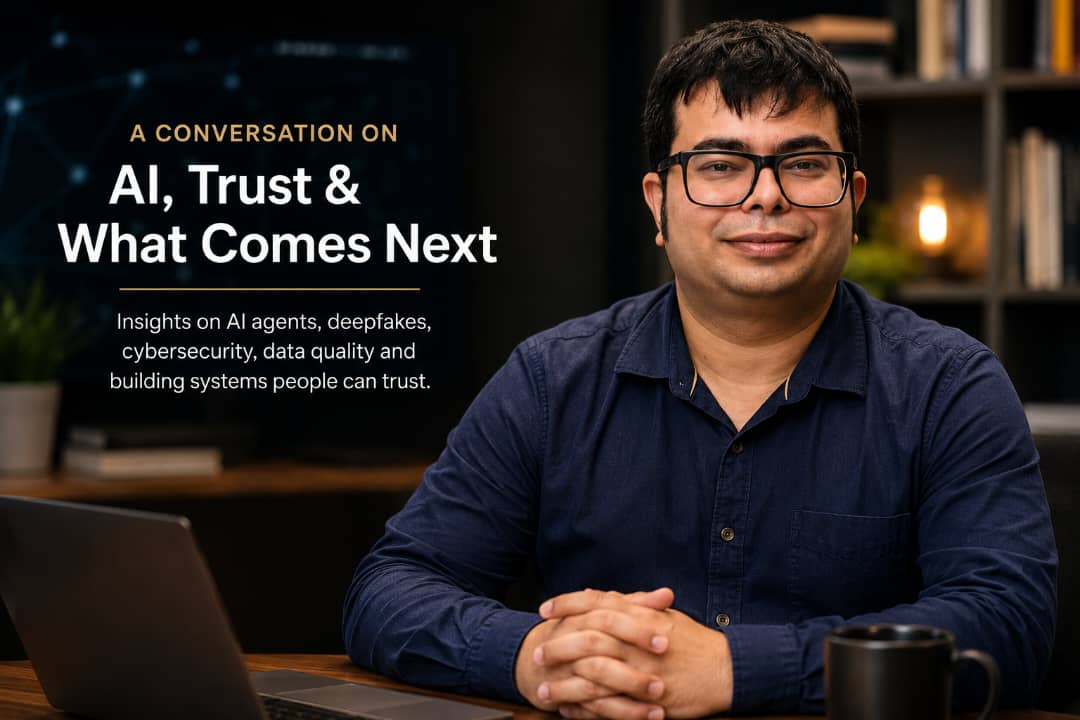
Somnath Banerjee on autonomous agents, deepfakes, cybersecurity, data quality, sustainable AI and why recoverability may matter more than raw model capability.
INTERVIEW FEATURE
Artificial intelligence has spent the past few years in a race for capability: bigger models, more capable agents and faster deployment. Somnath Banerjee believes the real constraint lies elsewhere.
“The binding constraint upon the value of artificial intelligence has never been model capability,” he says.
For Banerjee, whose work spans AI, data engineering, cloud technologies, cybersecurity and sustainability, the harder questions concern what surrounds the model: Can the data be trusted? Can an automated decision be reconstructed? Can an action be reversed? Do users know when to challenge the system?
Across autonomous agents, deepfakes, Generative AI, cybersecurity and sustainable AI, his argument is consistent: build systems not around the assumption that AI will never fail, but around the ability to understand, contain and recover when it does.
Autonomous AI Agents Are Ready. Most Enterprises Aren’t.
AI agents are one of the biggest technology trends today. Are autonomous AI agents ready for enterprise adoption, or are organisations moving faster than the technology?
“Autonomy converts an ordinary error rate into an unbounded liability.”
Banerjee argues that model capability is no longer the main barrier for many enterprise workflows. The issue is whether organisations have the infrastructure needed to make autonomous action safe.
He compares this to instant payments. Trust does not come only from a seamless interface, but from settlement mechanisms, dispute resolution, reversals and accountable escalation paths. AI agents need equivalent safeguards.
Before allowing an agent to operate autonomously, he asks two questions:
- Is every action logged in enough detail to reconstruct what happened?
- Is every action reversible, or at least bounded by something that is?
If both answers are yes, he sees little reason to delay deployment. If not, improving the model will not solve the underlying risk.
He also warns against mistaking a successful pilot for a production-ready system. Some pilots work because a highly capable employee is quietly reviewing outputs. When that person disappears during scaling, an essential control disappears too.
“That person was, in fact, the control.”
Deepfake Detection Is an Arms Race Defenders Are Unlikely to Win
Deepfakes are becoming increasingly sophisticated. What can businesses, governments and individuals actually do to protect themselves?
Banerjee’s research combined YOLO-based facial segmentation with Neural Architecture Search and achieved 99.04% accuracy on the Celeb-DF v2 benchmark. Yet it reinforced his view that detection alone is not durable.
Fixed detectors can deteriorate when they encounter manipulation techniques absent from their training data. The attacker needs one method the detector has not anticipated, while the detector must anticipate them all.
His alternative is to reduce reliance on whether media appears authentic.
For families: create a verification mechanism before you need one
Voice-cloning scams make familiar signals less reliable. Families can agree in advance on a private verification question or information that cannot easily be found on public profiles. Easily discoverable facts such as birthdays or pet names are poor choices.
Urgency itself should also be treated as a warning. Fraudsters benefit when people act before thinking, so deliberately slowing the interaction can be a useful defence.
For businesses: put the control where the money moves
Requests to change bank details, credentials or payment instructions should be verified through a second, independently chosen channel. Seniority should not exempt anyone.
A universal process also removes the social pressure employees may feel when challenging an apparent executive. Crucially, the control works whether the original message was fake or genuine.
For governments: invest in provenance
Banerjee argues for shifting attention from detecting fabricated media toward establishing the origin of authentic content through technologies such as cryptographic signing at capture and content-authenticity standards.
The question becomes not “Can we prove this was fabricated?” but “Can this content demonstrate where it came from?”
Sustainable AI Has to Change a Decision — Not Just Produce a Dashboard
Sustainability is becoming a strategic priority. How can AI move beyond reporting and dashboards to create measurable environmental and commercial impact?
“A dashboard upon which no decision depends carries a carbon cost and delivers no benefit.”
Banerjee is cautious about “AI for sustainability” when the measurement, dataset or decision being improved is unclear. A claim that cannot be tested cannot be evaluated, while the energy cost of large models should also be counted.
The strongest applications are often narrow and measurable: resource allocation that reduces energy use, monitoring that identifies contaminants early, or systems directly tied to operational outcomes.
In agriculture, for example, the useful question may simply be whether to sow this week or wait ten days. If AI does not improve that decision, a sophisticated dashboard adds little value.
His principle is to start with a decision being made badly, inconsistently or too late, then identify what measurement would improve it. Energy efficiency should likewise be considered alongside latency and accuracy from the start of system design.
The Four Data Problems Undermining Generative AI
Companies are investing heavily in Generative AI while continuing to struggle with data quality. What mistakes do they make before deployment?
“The principal error,” Banerjee says, “is treating artificial intelligence as a technology procurement rather than as a data and trust problem.”
1. Nobody agrees what the entity actually is
Different departments may define a “customer” differently. Each definition can be reasonable, but problems arise when an AI system is built on those disagreements while teams assume they share the same meaning.
Banerjee contrasts this with a small shopkeeper’s ledger. It may lack sophisticated governance, but the owner knows who owes what and since when because the information was recorded for a clear purpose. “He possesses lineage,” Banerjee says. “We possess scale.”
2. Data is reused for a purpose it was never designed to serve
A dataset collected for regulatory reporting may be suitable for that purpose but inappropriate for AI or statistical inference. Missing information, collection methods and historical biases can become serious problems when data is repurposed.
3. Organisations retain data indefinitely
Cheap storage encouraged companies to keep everything. But old data may lose business value while remaining valuable to attackers. Banerjee therefore views retention limits as a security control as well as a compliance measure.
4. There is no lineage
When AI produces an unsound result, organisations need to know which data contributed, where it came from and how it changed. Without lineage, they cannot properly diagnose failures or prevent recurrence.
The common problem is tolerance for ambiguity. AI does not resolve those inconsistencies later. “It amplifies them.”
Where Should a CEO Spend the First AI Budget?

If a CEO handed you the company’s first serious AI budget today, where would you invest it?
“The greater part of a first AI budget should not be spent on artificial intelligence.”
Banerjee points to the surgical safety checklist as an example of process design outperforming sophisticated technology. He recommends four priorities.
First: establish identity and lineage in one high-value data domain
Choose one domain tied to an important decision and define what the entities mean, where critical fields came from and who owns them.
Second: choose one narrowly scoped problem and measure the baseline
If current performance cannot be stated, future improvement cannot be demonstrated.
Third: build evaluation and monitoring before expanding model development
Companies often become good at deployment before becoming good at checking whether deployed systems still work. Drift is normal, and without monitoring deterioration may go unnoticed.
Fourth: invest in the domain experts receiving AI outputs
The people consuming AI recommendations need to know how to interrogate them, challenge them and recognise when something does not make sense.
The logic is simple: AI is a multiplier. Before scaling it, make sure the data, processes and organisation being multiplied are worth amplifying.
AI Has Changed the Economics of Cybercrime
Are organisations ready for AI-powered cyber threats?
Banerjee’s answer is mostly no. But the biggest shift may not be a new attack category; it is the collapsing cost of personalisation.
A highly tailored attack against one executive once required significant research. Generative AI lowers that cost, allowing personalised attacks to be directed at far more people.
It also weakens an accidental security advantage for speakers of smaller languages. AI can increasingly generate fluent, idiomatic scam messages across languages, making old advice about spotting phishing through spelling mistakes or awkward grammar less useful.
Banerjee prefers controls that do not depend on appearance: navigate directly to important systems rather than following unsolicited links, verify consequential requests through an independently chosen channel, and treat urgency as a warning signal.
He also argues that reporting rates may matter more than phishing click rates. An employee who clicks a malicious link and reports it within minutes creates far less exposure than one who remains silent. Punitive awareness programmes can therefore create the wrong incentive.
Companies must also recognise their own AI systems as part of the attack surface, including prompt injection, agents with credentials and systems that automatically ingest external content.
Three Underestimated AI Trends to Watch Over the Next Five Years
Which technologies or trends are currently underestimated but could reshape industries?
AI evaluation as an engineering discipline
Benchmarks do not answer the key operational question: is this deployed system still performing the function it was built for?
Banerjee expects domain-specific evaluation, drift detection and mechanisms for identifying degradation before serious harm to become disciplines in their own right.
Provenance and content-authenticity infrastructure
If appearance can no longer prove authenticity, infrastructure that establishes origin becomes foundational. Banerjee compares provenance to payment and digital identity infrastructure: unglamorous while being built, transformative once other systems depend on it.
Small specialised models at the edge
Banerjee also sees strategic value in compact models running where data originates — on sensors, handsets, agricultural equipment or industrial devices.
They can reduce latency, preserve privacy by keeping data local and reduce dependence on connectivity. He compares the mindset to spacecraft design, where limits on energy, mass and heat create useful engineering discipline.
The Most Important Lesson: A System Is Valuable Only When People Will Act on It
Across AI, data engineering, cloud and sustainability, what lesson matters most?
“Trustworthiness is a property of how a system was produced, not an attribute that can be added subsequently.”
Technical correctness is not enough. A system creates value only when people trust it enough to act on its outputs.
That trust cannot simply be added later through a policy, interface or governance label. It emerges from the data pipeline, accountability structure, engineering choices and the ability to inspect what happened.
Technical methods can also travel across domains more easily than domain authority. The same disciplines may help make network, financial or environmental data trustworthy, but interpreting what those patterns mean still requires genuine subject-matter expertise.
Advice for the Next Generation of AI Researchers and Technology Leaders
What advice would you give researchers, engineers and entrepreneurs trying to build trustworthy AI with real-world impact?
Develop real depth in one discipline
Breadth is useful, but depth teaches rigour. Trying to claim expertise across too many fields too early can lead to what Banerjee calls “confident amateurism.”
Rigorous methods can move across domains, but people should enter unfamiliar areas by contributing a specific capability rather than claiming authority over the whole problem.
Be precise about where your expertise ends
A data engineer may identify patterns in environmental data without being qualified to determine their biological or ecological meaning. Pattern recognition can travel; interpretation often cannot.
Submit your work to people who have no incentive for you to be right
Peer review, publication and conference scrutiny matter because independent examination is different from internal validation.
When entering an unfamiliar field, Banerjee recommends asking not “How would I solve this?” but “What makes this difficult for the people already working on it?”
“Regulate for Recoverability, Not Capability”
If there is one message business leaders and policymakers should remember about the future of AI, what is it?
“Build for the failure from which you can recover.”
Better models will not remove the organisational problems surrounding AI. Even with advanced systems, the same bottlenecks remain: trust, governance, data quality, definitions, accountability and clarity about the problem being solved.
For business leaders, some of the most important AI investments may therefore be investments in better data, processes and accountability.
For policymakers, Banerjee advocates regulating for recoverability rather than capability. Model capability changes rapidly, so rules tied too closely to today’s technical characteristics may age poorly.
More durable questions are: Can a consequential decision be explained? Can it be challenged? Can an error be traced? Can damage be contained? Can the decision be reversed?
These questions remain relevant as technology changes and become more important as AI enters decisions involving credit, healthcare, insurance claims and other areas with material consequences.
Public trust will not come from declaring a system trustworthy. It must be earned through sound data, transparent processes, credible oversight and evidence that failures can be addressed.
About Somnath Banerjee
Somnath Banerjee works across artificial intelligence, data engineering, cloud technologies, cybersecurity and sustainability. His work includes deepfake detection, sustainable data engineering, high-volume data systems and interdisciplinary applications of AI and data.
His perspective centres on trustworthy systems, data lineage, evaluation, recoverability and the practical conditions required for AI to produce reliable real-world outcomes.
Disclaimer: Somnath Banerjee is speaking in his personal capacity. The views expressed in this interview are his own and do not necessarily represent the views of his employing organisation. No confidential or proprietary information is discussed.
SEO & Publishing Notes
Recommended SEO title: AI’s Biggest Bottleneck Isn’t the Model: Somnath Banerjee on Trustworthy AI
Alternative editorial headline: Why the Future of AI Will Be Built on Trust, Not Bigger Models
Meta description: Somnath Banerjee discusses autonomous AI agents, deepfakes, cybersecurity, data quality, sustainable AI and why trust and recoverability will define AI’s future.
Suggested URL slug: /somnath-banerjee-trustworthy-ai-agents-deepfakes
Primary search theme: Trustworthy AI
Supporting search themes: autonomous AI agents; AI governance; Generative AI data quality; deepfake detection; AI cybersecurity; sustainable AI; AI evaluation; content provenance; edge AI
Suggested social headline: The AI race is focused on better models. Somnath Banerjee thinks the real competitive advantage lies somewhere else: trust, lineage and the ability to recover when AI fails.
Suggested excerpt: What if model capability is no longer the biggest obstacle to enterprise AI? Somnath Banerjee explains why agents, deepfakes, cybersecurity and Generative AI all point back to the same overlooked problem: building systems people can trust enough to act on.