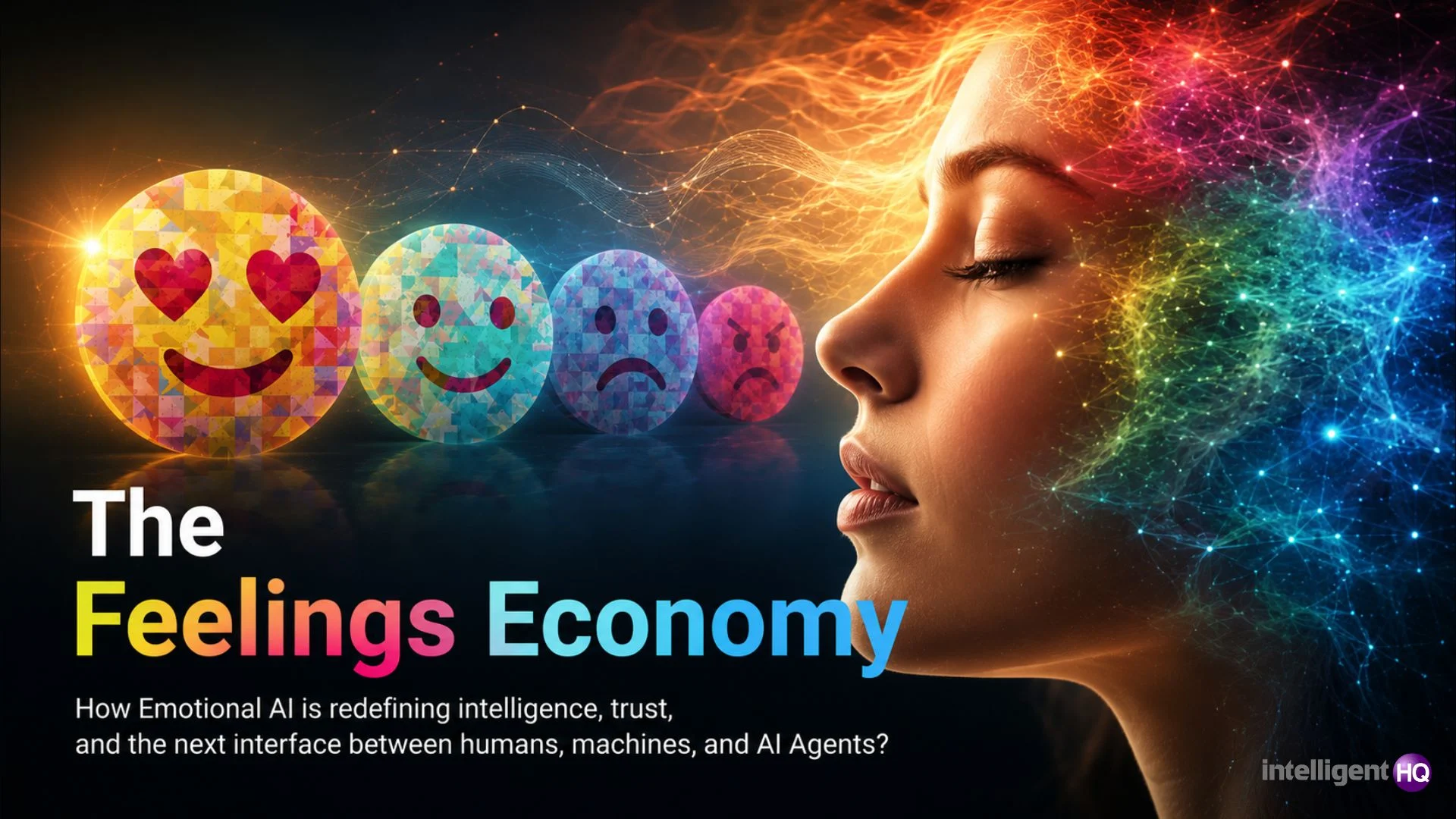
How Emotional AI is redefining intelligence, trust, and the next interface between humans, machines, and AI Agents?
For most of the history of computing, machines have excelled at one thing humans often struggle with: logic. They calculate at extraordinary speed, search through oceans of data in milliseconds, and execute complex instructions with remarkable precision. Yet they have remained largely indifferent to the emotional context surrounding those interactions.
A navigation system can determine the fastest route home without recognising the frustration in a driver’s voice. A chatbot may answer a question perfectly while failing to notice the anxiety hidden beneath it. A recruitment platform can evaluate thousands of applications without understanding whether nervousness, cultural expression or disability has shaped a candidate’s behaviour.
That boundary is now beginning to shift.
Artificial intelligence is entering a phase in which it is no longer confined to recognising words, images or patterns. Increasingly, it is being designed to interpret one of the most complex and least understood aspects of human existence: emotion. The ambition is not simply to make machines appear more empathetic, but to enable digital systems to infer emotional states from facial movements, vocal characteristics, physiological signals and language itself, allowing technology to adapt dynamically to the people using it.
Whether this ambition ultimately succeeds remains an open scientific question. Yet economically, technologically and politically, Emotional AI—or affective computing—has already become one of the most revealing case studies of artificial intelligence’s next chapter.
Few emerging industries expose the tensions between technological capability, commercial reality and public trust as clearly as this one. Market researchers estimate that the sector could be worth anything between US$15 billion and more than US$1 trillion within the next decade, depending on how broadly they define the category. That extraordinary divergence is not merely an exercise in forecasting uncertainty; it reflects a deeper disagreement about what Emotional AI actually is. For some analysts it describes specialised emotion-recognition software. For others it encompasses conversational AI, sentiment analysis, behavioural biometrics, digital therapeutics and intelligent companions that together represent an entirely new computational layer of the economy.
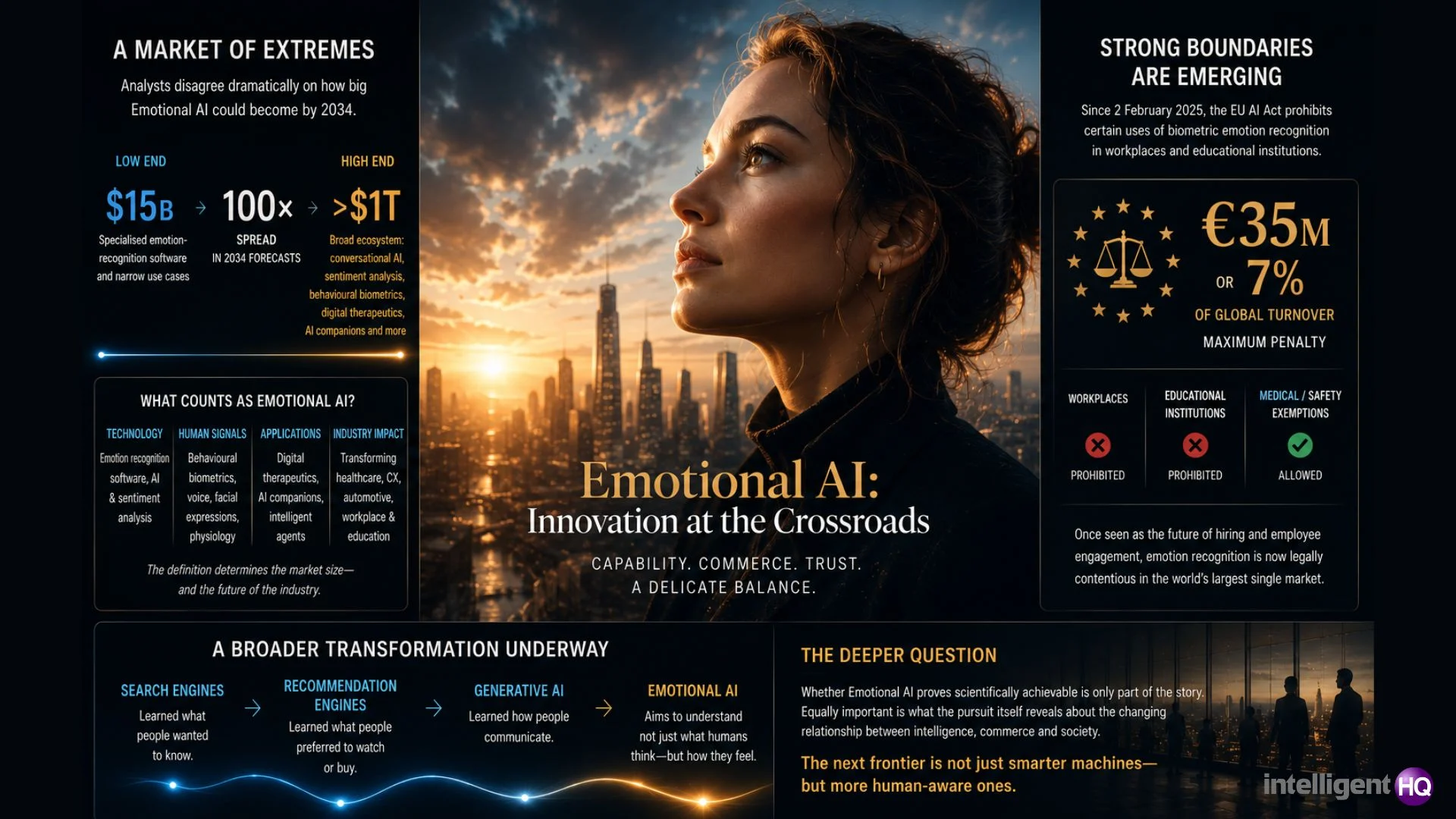
At precisely the same time that investors continue to pour capital into the sector, regulators have begun drawing some of the strongest legal boundaries yet seen in artificial intelligence. Since February 2025, organisations operating within the European Union have faced penalties of up to €35 million or 7% of global annual turnover for certain uses of biometric emotion recognition in workplaces and educational institutions. Technologies once promoted as the future of recruitment or employee engagement have, almost overnight, become legally contentious across one of the world’s largest markets.
Emotional AI is simultaneously becoming more technically sophisticated, more commercially attractive, more socially embedded and more politically contested.
Behind this paradox lies a broader transformation—one that extends far beyond the companies building emotion-recognition software. Increasingly, the global economy is shifting from systems that process information to systems that model human behaviour. Search engines learned what people wanted to know. Recommendation engines learned what people preferred to watch or buy. Generative AI learned how people communicate. Emotional AI represents the next step: technologies attempting to understand not simply what humans think, but how they feel.
Whether that aspiration proves scientifically achievable is only part of the story. Equally important is what the pursuit itself reveals about the changing relationship between intelligence, commerce and society.
The evolution of Feelings Economy: From computational logic to Emotional Intelligence
Early computers were built to perform calculations, decrypt codes, and automate mathematical tasks. Their value lay in precision and speed rather than understanding people.
By the 1950s, researchers began asking a much bigger question: Could machines simulate aspects of human intelligence? This thinking led to the birth of artificial intelligence as a scientific discipline at the 1956 Dartmouth Conference, where pioneers such as John McCarthy proposed that reasoning and learning could eventually be replicated by computers.
For decades, AI focused primarily on logic and pattern recognition. Systems learned to play chess, solve optimisation problems, and later recognise images and language. Yet one crucial element of human intelligence remained largely ignored—emotion.
Why Emotion Matters
For centuries, Western philosophy often treated reason and emotion as opposites. Rational thinking was viewed as the foundation of intelligence, while emotions were seen as subjective and unpredictable.
Modern neuroscience challenged this assumption.
Neurologist Antonio Damasio showed that people with impaired emotional processing often struggle to make everyday decisions, demonstrating that emotions are fundamental to reasoning rather than separate from it. Similarly, behavioural economists Daniel Kahneman and Amos Tversky revealed that human decisions are shaped by a combination of logic, intuition and emotion.
These discoveries changed how scientists understood intelligence. If emotions influence communication, decision-making and memory, then machines designed to interact naturally with humans would also need to recognise emotional context.
The Birth of Emotional AI
This idea became a formal scientific field in 1995, when Dr. Rosalind Picard of the MIT Media Lab introduced the concept of Affective Computing. Her central argument was simple but revolutionary: machines that understand how people feel can interact with them more naturally and effectively than machines that only process words.
At the time, however, the technology was not ready. Computer vision was still in its infancy, speech recognition struggled with accuracy, and consumer devices lacked the computing power required for real-time emotion analysis.
The theory existed long before the technology could support it.
The Technologies Finally Converged
During the following two decades, several technological breakthroughs came together.
Advances in deep learning dramatically improved computer vision. Speech recognition became more reliable. Smartphones and wearable devices introduced cameras, microphones and biometric sensors into everyday life, while transformer-based AI models transformed natural language understanding.
Individually, each innovation solved a different technical problem.
Together, they made Emotional AI commercially possible.
A major milestone came in 2009 with the founding of Affectiva, co-founded by Rosalind Picard and Rana el Kaliouby. Initially developed to measure audience reactions to advertising, Affectiva later expanded into automotive safety, driver monitoring and other commercial applications, demonstrating that emotion recognition could move beyond research laboratories into real-world products.
How Emotional AI Works
Unlike recognising an object in a photograph, recognising emotion is inherently uncertain. The same smile can express happiness, politeness, embarrassment or anxiety depending on the situation, while tone of voice and facial expressions often vary across cultures and individuals.
For this reason, modern Emotional AI rarely relies on a single signal. Instead, it combines multiple sources of information—a technique known as multimodal AI.
These systems typically analyse:
| Signal | What it Measures |
| Facial expressions | Facial muscle movements, gaze and micro-expressions |
| Voice | Pitch, pauses, speech rhythm and tone |
| Language | Word choice, sentence structure and conversational context |
| Physiological signals | Heart-rate variability, skin response and other biometric indicators |
Rather than determining exactly how someone feels, these systems estimate the probability of different emotional states by combining these signals.
In other words, Emotional AI performs inference rather than certainty.
Foundation Models Are Changing the Industry
Until recently, specialist companies dominated emotion recognition. However, advances in large multimodal AI models are beginning to change the competitive landscape.
A 2026 benchmark by AIMultiple found that several general-purpose frontier AI models outperformed dedicated emotion-recognition platforms on a labelled facial-emotion dataset. This suggests that future competition may depend less on detection accuracy and more on factors such as:
- Privacy-preserving design
- Clinical validation
- Regulatory compliance
- Industry-specific expertise
- Integration into enterprise workflows
In other words, the competitive advantage is gradually shifting from algorithms to trust.
The Rise of the Feelings Economy
As computing has evolved, each technological era has expanded what machines can process.
| Era | Primary Capability |
| Early Computing | Calculations |
| Internet | Information |
| Cloud Computing | Data |
| Smartphones | Human connectivity |
| Artificial Intelligence | Decisions |
| Emotional AI | Human emotions and behaviour |
This shift is giving rise to what many researchers describe as the Feelings Economy—an emerging ecosystem where emotions become measurable, analysable and increasingly integrated into digital systems.
Today, Emotional AI is already being applied across healthcare, customer experience, automotive safety, education, enterprise software and AI companions.
Yet the industry’s future remains uncertain. Published market forecasts range from approximately US$15 billion to more than US$1 trillion, reflecting not only different growth expectations but also fundamental disagreement over what should be included within the Emotional AI market itself.
More importantly, the industry’s success will depend on more than technological progress. Psychology, ethics, regulation, privacy and public trust are increasingly determining which applications society embraces—and which it rejects.
Emotional AI: An industry without a single centre
Unlike cloud computing or cybersecurity, Emotional AI is not an industry defined by one dominant product.
It is better understood as a capability that has gradually spread across multiple sectors, each driven by different commercial incentives, scientific standards and regulatory environments.
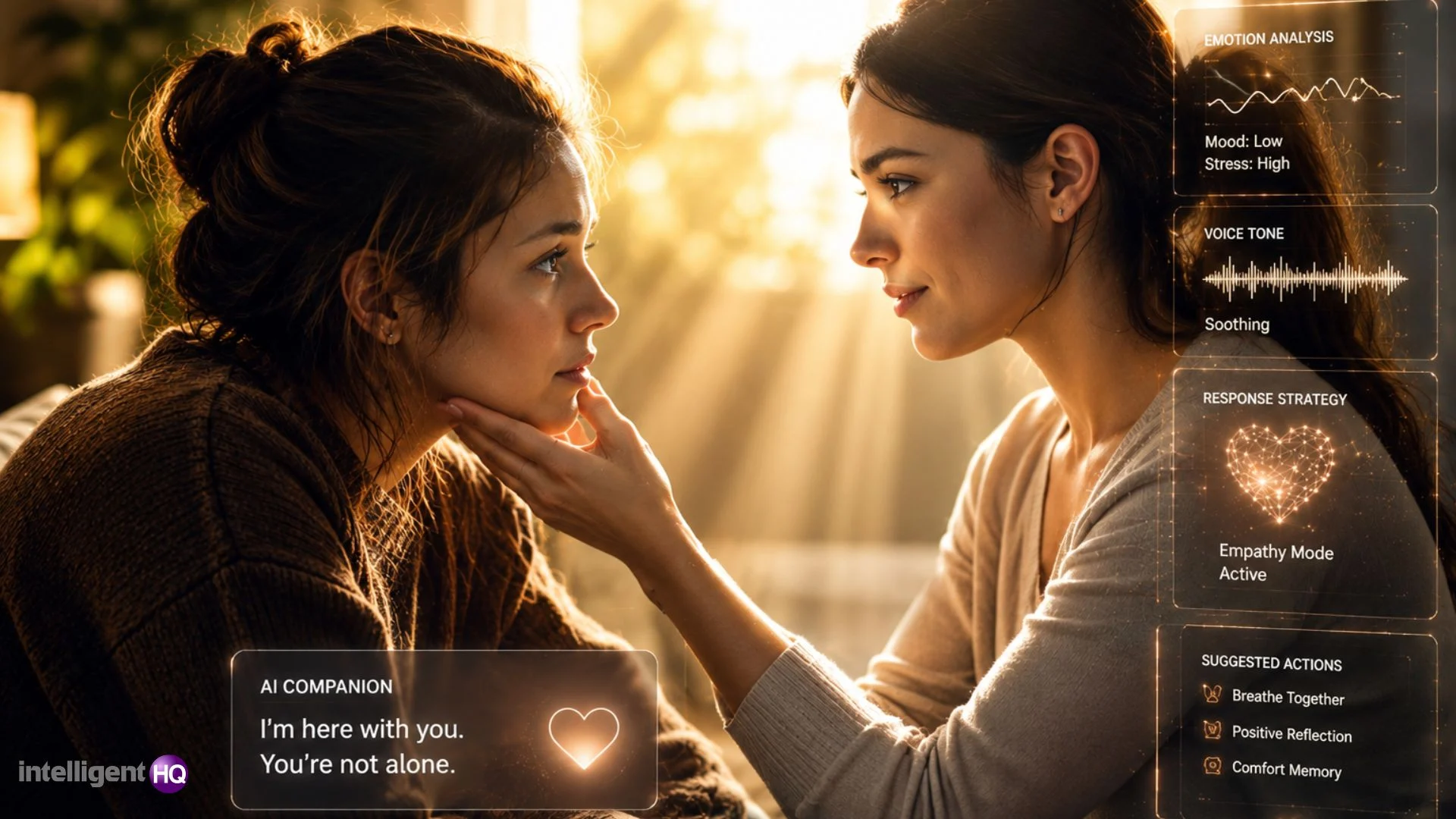
Healthcare seeks earlier diagnosis and more personalised treatment. Automotive manufacturers pursue safer roads through driver monitoring. Customer experience platforms attempt to understand frustration before customers articulate it. Mental-health applications offer digital coaching at unprecedented scale. AI companions promise persistent relationships unconstrained by geography or time. Enterprise software measures workforce engagement, while advertisers continue searching for more reliable indicators of consumer behaviour than traditional surveys.
These applications appear unrelated.
In reality, they all depend upon the same underlying proposition: that emotional signals contain economically valuable information which machines can analyse at scale.
This convergence reflects a much broader evolution in artificial intelligence itself. Foundation models have already unified language, images, audio and increasingly video within shared architectures. Emotional AI extends this convergence further, treating facial movement, speech, physiological signals and conversational behaviour as complementary expressions of the same human state.
Rather than existing as a standalone technology category, Emotional AI is becoming an invisible capability embedded within many others.
That diffusion makes the sector simultaneously more influential and more difficult to measure—a likely explanation for the extraordinary disagreement among market analysts attempting to define its size.
Healthcare: Where Emotion Becomes Clinical Infrastructure
Few areas illustrate the promise of Emotional AI more clearly than healthcare.
Mental illness remains one of the world’s largest unmet medical challenges. According to the World Health Organisation, hundreds of millions of people experience depression, anxiety and related conditions, while healthcare systems across developed and emerging economies continue facing severe shortages of trained clinicians.
Artificial intelligence alone cannot solve that structural imbalance.
Yet it can alter how healthcare systems allocate limited expertise.
Increasingly, Emotional AI is being deployed not as a replacement for therapists or psychiatrists, but as an intelligent layer that performs assessment, triage and continuous monitoring before human intervention becomes necessary.
Rather than attempting to automate empathy itself, successful healthcare applications are automating administrative complexity and expanding access to care.
One of the strongest examples is the UK’s Limbic, whose AI-powered mental-health assessment platform became the first chatbot of its kind to achieve Class IIa medical-device certification. Integrated across much of NHS England’s Talking Therapies programme, the system has supported assessments for more than 650,000 patients, while independent evaluations have reported improved recovery rates and fewer unnecessary treatment-pathway changes compared with conventional referral processes.
Historically, medical technology has focused on imaging, laboratory testing and physiological measurement. Emotional AI introduces another diagnostic dimension: behaviour itself.
Speech rhythm, language patterns, response latency, subtle vocal changes, conversation structure – each becomes a potential biomarker—not replacing established diagnostics, but complementing them.
The implications are considerable. Mental-health conditions frequently develop gradually, with behavioural changes emerging weeks or months before patients seek formal treatment. Systems capable of identifying these patterns early could reduce waiting times, improve intervention and ultimately lower healthcare costs.
Companionship in the Age of Artificial Intelligence
Perhaps no application of Emotional AI has attracted more public fascination than AI companions.
Unlike productivity assistants or search engines, companion systems are designed around continuity rather than transactions. They remember previous conversations, develop evolving personalities, maintain persistent relationships, adapt communication styles over time. In doing so, they occupy a unique psychological space somewhere between software, social interaction and narrative fiction.
Applications such as Replika, Pi, Character.AI, Kindroid and Nomi AI have transformed what was once a niche experimental category into one of consumer AI’s fastest-growing segments. Industry tracking suggests that the number of dedicated companion platforms has expanded dramatically in only a few years, reflecting both rapid technological progress and widespread public curiosity.
Their popularity raises questions extending far beyond software design.
Why are millions of people choosing to build emotional relationships with algorithms?
Part of the answer lies not in artificial intelligence but in contemporary society.
Across many developed economies, loneliness has become an increasingly recognised public-health concern. Remote work, ageing populations, declining community participation and digital lifestyles have reshaped traditional forms of social interaction.
AI companions emerged within them.
Their appeal often stems less from technological novelty than from psychological consistency. Unlike humans, AI companions remain permanently available. They do not interrupt conversations, forget previous interactions or become emotionally unavailable.
Whether those characteristics represent genuine emotional support or merely sophisticated simulation remains deeply contested.
Psychologists increasingly distinguish between feeling understood and being understood.
Artificial intelligence may become remarkably effective at the former without ever achieving the latter.
Yet even simulated understanding can produce measurable psychological effects—a reminder that human relationships have always depended partly upon perception.
The Human Need to Be Heard
The philosopher Martin Buber once distinguished between relationships that treat others as objects and those that recognise them as subjects.
Emotional AI introduces an unexpected inversion of that idea.
Humans increasingly experience subject-like interactions with entities they fully understand to be computational systems.
This apparent contradiction challenges traditional assumptions about emotional attachment.
Research in psychology has long demonstrated that humans readily attribute agency, intention and personality to non-human entities. Children converse with toys. Adults name vehicles. Digital assistants routinely receive expressions of gratitude despite their users knowing they are software.
Companion AI simply extends this tendency through dramatically more sophisticated interaction.
Large language models can sustain conversations of extraordinary fluency. Emotional modelling adds continuity, memory and adaptive tone.
Whether society should encourage or limit these relationships remains one of the defining ethical questions of the coming decade.
That debate intensified following litigation involving Character.AI, which prompted broader scrutiny of child safety, emotional dependency and appropriate safeguards for highly engaging conversational systems. The case accelerated industry efforts around crisis interventions, age protections and usage boundaries, illustrating how rapidly technical innovation can become a societal governance issue.
The enterprise learns to measure mood
While consumer attention often focuses on AI companions, enterprise software has quietly become another major frontier for Emotional AI.
Businesses have always attempted to understand customers and employees. The difference today is scale.
Every customer-support conversation, meeting transcript, email, survey response and workplace chat potentially contains behavioural information that algorithms can analyse continuously rather than periodically. This shift reflects a broader transformation occurring across management itself.
Traditional organisations relied heavily on retrospective measurement – Quarterly surveys, annual reviews, periodic customer research – Artificial intelligence enables something closer to continuous organisational sensing.
Platforms such as Cogito, Uniphore, Erudit AI and related enterprise systems increasingly analyse conversation quality, communication patterns and engagement signals to identify emerging problems before managers recognise them independently.
Used responsibly, such systems may improve employee wellbeing, reduce customer frustration and strengthen organisational responsiveness.
Used carelessly, they risk becoming unprecedented instruments of workplace surveillance.
The real difference lies in governance.
When Technology Meets the Limits of Trust
Few stories illustrate that principle more clearly than HireVue. The company became one of the world’s largest video-interview platforms, hosting more than 19 million interviews for hundreds of employers. Its early system incorporated analysis of facial expressions alongside speech and language during candidate assessment.
The concept appeared technically innovative. Socially, it proved deeply controversial.
Privacy advocates questioned whether facial behaviour could meaningfully predict job performance. Researchers challenged assumptions about cultural universality. Regulators began scrutinising algorithmic fairness. Ultimately, HireVue discontinued facial-analysis components after concluding that improvements in natural-language processing rendered them of negligible predictive value. Public trust, rather than technical capability, had become the binding constraint.
The episode has since become one of Emotional AI’s defining case studies because society rejected one particular application of it. That distinction may ultimately shape the industry’s future more than any advance in machine learning. Technology does not determine its own legitimacy. Institutions, laws and public expectations do.
By the middle of this decade, Emotional AI had therefore reached an unexpected crossroads. Its technical capabilities continued improving. Investment remained substantial. Real-world deployments expanded across healthcare, mobility and enterprise software. Yet at precisely the moment the technology became commercially viable, governments began asking an even more fundamental question:
Just because machines can infer human emotion, should they always be allowed to?
That question—and Europe’s remarkably decisive answer—would fundamentally reshape the future of the entire industry.
Governance, Trust, and the Future of the Feelings Economy
If the history of artificial intelligence has largely been a story of expanding computational capability, the next chapter may increasingly be defined by something far less technical: restraint.
Every transformative technology eventually encounters the limits of what society is willing to accept. Nuclear physics produced both clean electricity and atomic weapons. The internet enabled unprecedented access to information while simultaneously reshaping privacy, politics and public discourse. Social media connected billions of people before forcing governments to reconsider competition, misinformation and child safety.
Emotional AI has reached that moment remarkably early.
Unlike many previous technologies, its greatest challenges are no longer computational. Modern machine learning can already infer behavioural signals from speech, facial movement, language and physiological data with increasing sophistication. The more difficult question is where those capabilities should be deployed—and whether some applications should remain permanently beyond technological reach.
The industry’s future will therefore depend less on whether machines become better at recognising emotion than on whether societies trust them to do so.
Europe Draws the First Red Line
Throughout the history of computing, regulation has generally followed innovation.
The European Union’s AI Act represents one of the first attempts to reverse that sequence by defining, in advance, where artificial intelligence should not operate.
Few provisions illustrate this more clearly than the prohibition on certain forms of biometric emotion recognition in workplaces and educational institutions.
Since 2 February 2025, Article 5(1)(f) of the AI Act has prohibited AI systems that infer the emotions of individuals from biometric data within workplaces or schools except under narrowly defined medical or safety circumstances. Organisations violating these rules face penalties reaching €35 million or 7% of global annual turnover, placing the offence within the legislation’s highest enforcement category.
The legal significance extends well beyond Emotional AI itself.
Historically, European technology regulation has often focused on how organisations collect, process and store personal data. The AI Act moves one step further by questioning whether certain forms of inference should occur at all. This is a cognitive autonomy issue.
The legislation implicitly recognises that emotional inference occupies a uniquely sensitive position because emotions influence judgement, employment, education and personal identity in ways that conventional personal data often does not.
Whether every element of this regulatory approach proves successful remains uncertain. Its global influence, however, already appears substantial.
Technology companies increasingly design products not only around engineering constraints but around jurisdictional differences. Features available in one country may disappear entirely in another. Product roadmaps increasingly include legal architecture alongside software architecture.
Artificial intelligence is becoming geographically differentiated.
The New Competitive Advantage Is Trust
One of the most surprising lessons emerging from Emotional AI is that superior algorithms do not necessarily create superior companies. Throughout much of the software industry, competitive advantage has traditionally emerged through scale, computational performance or proprietary datasets.
Emotional AI appears to reward trust. The organisations demonstrating the greatest long-term resilience often share remarkably similar characteristics. Privacy is incorporated into product architecture rather than added after deployment. Clinical applications pursue formal regulatory certification before aggressive commercial expansion. Consumer wellbeing platforms establish explicit boundaries around diagnosis and crisis intervention. On-device processing increasingly replaces cloud-based biometric storage. Consent becomes an operational requirement rather than a legal disclaimer.
In other words, governance itself has become product design.
Companies such as MorphCast have prioritised local processing that avoids transmitting biometric data beyond users’ devices. Clinical platforms including Limbic have embedded regulatory approval into their commercial strategy from the outset. Wellbeing applications increasingly encourage disengagement and referral to human support where appropriate rather than optimising exclusively for user retention.
These choices may appear conservative. Economically, they may prove visionary. History repeatedly demonstrates that technological adoption depends less on maximum capability than on acceptable risk. Commercial aviation succeeded not because aircraft became faster than trains alone, but because safety systems, maintenance standards and regulatory oversight created public confidence. Banking depends not simply upon financial infrastructure but upon institutional trust. Healthcare depends not merely upon scientific discovery but upon professional legitimacy.
Artificial intelligence is beginning to follow the same trajectory.
The Scientific Debate Is Far From Over
Perhaps the greatest misconception surrounding Emotional AI is the assumption that emotion itself is scientifically settled. Psychologists continue debating fundamental questions that remain unresolved after decades of research.
Are emotional expressions universal across cultures, as Paul Ekman’s influential work suggested?
Or are they more context-dependent than early models assumed?
Can facial movements reliably indicate internal emotional states?
How strongly do culture, personality, neurodiversity and social context reshape emotional expression?
These questions matter enormously because machine-learning systems inherit the assumptions embedded within their training data.
If emotional expressions vary substantially between individuals or cultures, algorithms trained predominantly on one population may generalise poorly elsewhere.
Researchers including MIT Sloan’s Erik Brynjolfsson have warned that emotion-recognition systems risk underperforming across demographic groups if diversity and cultural variation are insufficiently represented during development. Meanwhile, vendors such as Affectiva have sought to address these concerns by expanding training datasets across many countries, although independent evaluation remains uneven across the wider industry.
This uncertainty does not invalidate Emotional AI.
It simply places appropriate limits around what current systems should claim. The distinction between recognising behavioural signals and understanding subjective human experience remains profound. Artificial intelligence may eventually become exceptionally good at identifying statistical patterns associated with emotion.
Whether it truly understands emotion in the human sense is a very different philosophical question