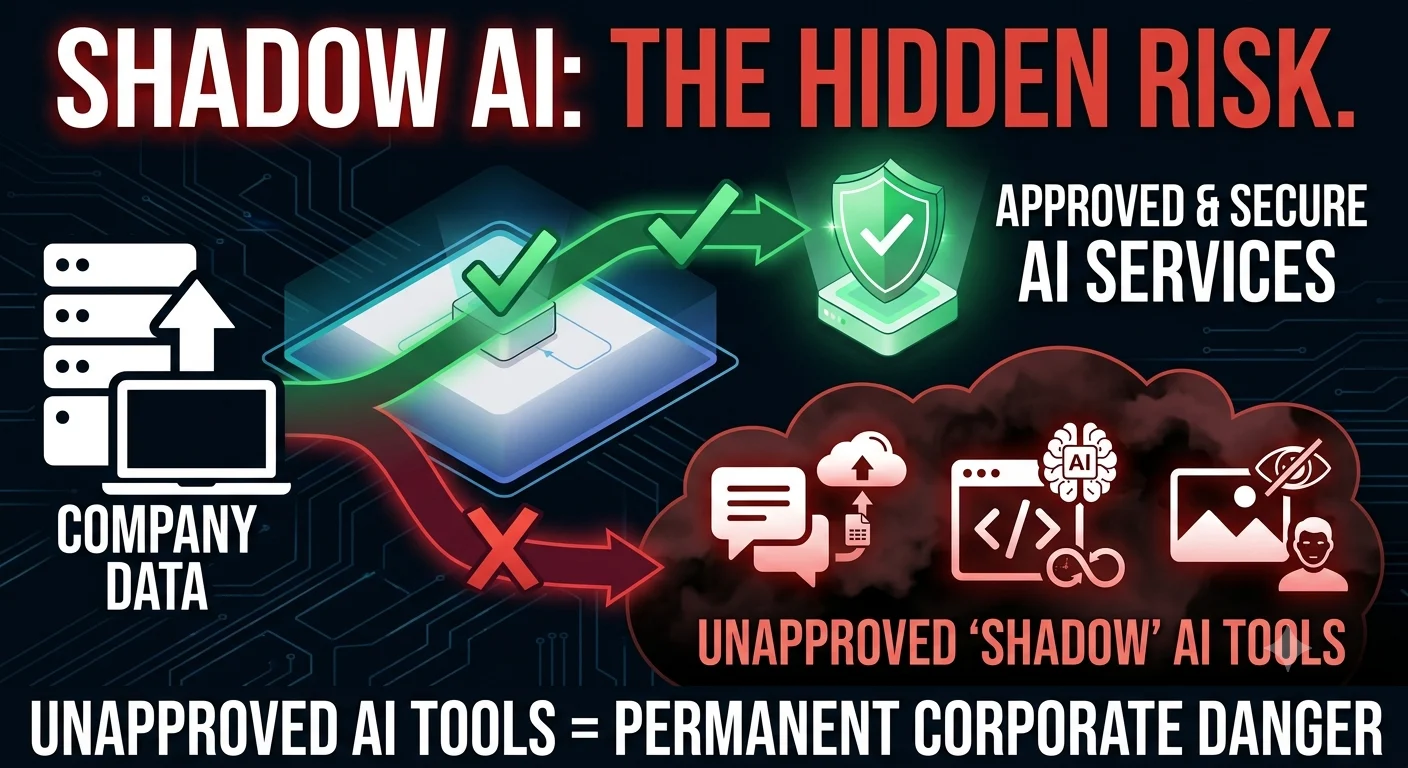
Shadow AI is the use of AI tools inside a company without IT approval, security review, or any oversight, and it creates risk because sensitive data flows into systems the business cannot see, control, or audit. An employee pasting customer records into a free chatbot has effectively exported that data to a third party with unknown retention practices. Unlike classic shadow IT, the exposure doesn’t end with unauthorized storage, since the data may be kept indefinitely, used to train models, or surfaced in someone else’s session through a vendor bug.
None of this is driven by malice, which is what makes it hard to police. People adopt these tools because they genuinely work, and workplace surveys consistently find that a large share of employees using AI on the job, often around half, do so through unapproved tools or personal accounts, with many admitting they hide it from their managers. Any security response that ignores that motivation is fighting its own workforce.
Why Shadow AI Spreads Faster Than Traditional Shadow IT
Old-fashioned shadow IT at least had friction. Standing up an unsanctioned server or buying rogue software usually required a credit card, an expense report, or an install that IT might notice. Shadow AI needs a browser tab. Most tools are free or cost less than lunch, they demand no procurement process, and they deliver value in the first five minutes, which is a faster adoption loop than any enterprise rollout can match.
The discovery gap compounds it. When security teams finally run an audit through network logs or a cloud access broker, they routinely surface dozens of AI tools in active use that nobody approved, from writing assistants to code helpers to meeting transcription bots. Each one is a data pathway that exists outside every control the company spent years building.
The Security Risks Hiding in Unmanaged AI Tools
The headline risk is data leakage through prompts. Source code, financials, customer PII, unreleased product plans, all of it gets pasted into AI tools because that’s how you get useful output, and one widely reported case saw a global electronics manufacturer ban external chatbots entirely after engineers submitted proprietary code to one. Depending on the tool’s terms, that input may be retained, reviewed by humans, or folded into training data, and no deletion request can reliably claw it back. For companies under GDPR, HIPAA, or similar regimes, the same paste can constitute an unreported cross-border data transfer.
Beyond prompts, the attack surface widens quickly. Free-tier accounts sit outside single sign-on, so they lack MFA enforcement and survive employee offboarding. AI browser extensions frequently request permission to read every page, which puts them one compromised update away from harvesting whatever the employee sees, including internal systems. And the newest layer is the most serious: employees are now wiring up autonomous agents with real credentials to email, calendars, and internal apps, creating unmonitored software that acts on the company’s behalf. This is precisely the gap that governed agent platforms, Shelf’s agentic OS among them, exist to close, running agents in an environment where access is permissioned, actions are logged, and the security team can actually see what’s operating.
How Shadow AI Shows Up Differently Across Departments and Industries
Every department leaks in its own dialect. Engineering leaks source code and API keys through coding assistants. Marketing leaks customer lists and campaign data into copy tools, usually at 6 p.m. against a deadline, which is worth remembering when assigning blame. Finance pastes spreadsheets into chatbots to explain variances, HR summarizes employee relations cases, and sales teams run call recordings through free transcription tools that nobody has vetted. The pattern is identical, only the data classification changes.
Industry context sets the stakes. A mid-sized e-commerce brand leaking product descriptions has a competitive problem; a hospital whose staff paste patient notes into a consumer chatbot has a reportable breach. Financial services firms face regulators who increasingly ask specifically about AI usage controls, and government contractors can lose clearances over it. Company size matters too, since enterprises at least have the tooling to detect shadow usage, while firms under a few hundred employees often have no visibility at all, making them the most exposed and the least aware of it.
Building AI Governance That Works Better Than a Ban
Outright bans mostly fail, and they fail in the worst possible way: usage doesn’t stop, it moves to personal phones and home laptops where the company has zero telemetry. The approach that holds up combines a clear policy, a sanctioned toolset good enough that people actually prefer it, and technical guardrails like DLP rules that catch sensitive data leaving through browser channels. If the approved option is slower or worse than the free chatbot, the free chatbot wins, so tool quality is itself a security control.
A realistic rollout fits in about ninety days. Spend the first month discovering what’s actually in use through network data and an amnesty-style survey (people answer honestly when the framing is “help us enable this” rather than “confess”). Spend the second month standing up approved tools with enterprise data protections and publishing a one-page usage policy in plain language, not legal prose. Spend the third on training and monitoring. The budget for all of this is modest, typically a per-seat license spend plus some security engineering time, which is a rounding error next to breach costs that industry studies consistently measure in millions of dollars per incident.
The question worth sitting with is not whether your company has shadow AI, because it does, but whether you’d rather learn its shape from an internal audit or from an incident report. A discovery exercise this quarter costs a few weeks of effort and produces the one thing every subsequent decision depends on: an honest inventory.