HubSpot’s 2024 State of Marketing report found that 91% of B2C and 87% of B2B marketing teams use video in some form, and that the share of campaigns reusing pre-2020 footage has more than doubled in two years. Marketing teams have rediscovered their own archives, partly because production budgets have stayed flat while audience expectations have climbed. AI upscaling has become the bridge between expensive archival assets and modern delivery formats. This piece looks at how serious brands are using it and where the practical limits sit. The implication for marketing leaders is that the asset library deserves at least as much attention as the next production brief, because both feed the same campaign engine.

Why archive reuse is back on the marketing agenda
Modern brands sit on libraries of professional footage produced before 4K became the default. That footage has rights cleared, casting consistent with current brand standards, and locations a marketing team could not easily reshoot. The catch is that it was filmed and edited at resolutions that look soft on a 2026 social feed. Upscaling allows that asset library to come off the shelf for new campaigns without a fresh production budget — a useful capability in a year when marketing budgets, per Forrester, have grown more conservatively than at any point in the past five years.
What marketing leaders should ask before scaling AI upscaling
Four practical questions sort the brief from the noise.
- Rights and consent. Talent in older footage often signed for original-medium use only; check before upscaling for a different channel.
- Brand consistency. Aggressive enhancement can shift skin tones and brand colours. A controlled colour pipeline matters.
- Delivery formats. Different platforms reward different aspect ratios and bitrates. Plan deliverables before processing.
- Approvals workflow. Legal, brand, and channel teams should see the upscaled output before publication.
Skipping the first or the fourth tends to be where serious brands have run into trouble in 2026.
Four enterprise-ready upscaling tools
We tested the four below on three reference clips: a 1080p 2017 brand video shot in a studio, a 2K 2019 outdoor lifestyle reel, and a 720p archive interview from a corporate communications library. Hardware: a marketing post-production workstation with an NVIDIA RTX 4090 and a Chrome browser for cloud tools.
UniFab Video Upscaler AI
UniFab Video Upscaler covers up to 16K output through four specialised models, with both local GPU and FabCloud paths. The Vellum model gave us a credible upscale on the brand studio footage with skin tones held inside an acceptable shift range — important for brand-consistent output. The cloud path is the relevant one for distributed teams where central post resources are limited. Trade-off: pricing is not shown directly on the product page and requires a checkout walk-through, which adds friction to enterprise procurement.
Topaz Video AI
Topaz remains the desktop reference and fits brand workflows where a single trusted operator handles upscaling under a one-time license. The lack of an enterprise API is a constraint for larger teams.
Pixop
Pixop is the cloud platform of choice for several marketing teams who need a paid API and per-minute billing. It works well at scale but the cost model means careful project scoping.
Tensorpix
Tensorpix is a lower-friction browser tool for smaller marketing teams that do not need the deepest archival fidelity. The trade-off is quality on heavily compressed legacy footage.
A B2B brand that resurrected a 2018 campaign for a 2026 launch
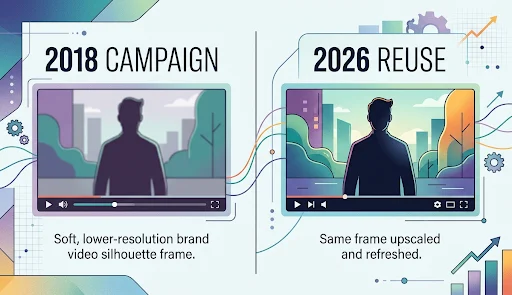
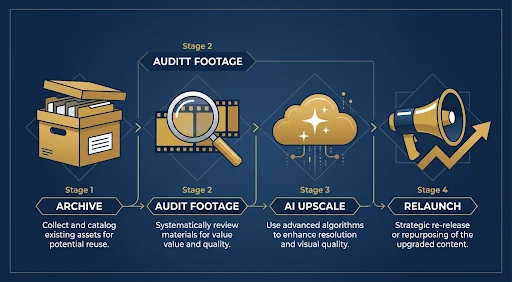
A B2B technology brand we corresponded with wanted to re-release a 2018 customer-story series for a major 2026 product launch. The footage was professional-grade 1080p, but the new campaign required 4K deliverables for a streaming sponsorship. The brand team used a browser-based AI Video Enhancer Online pass to test the workflow on three pilot stories, then handed the broader series to a post house with the enhanced masters as the starting point. The campaign launched on schedule at less than 15% of the cost of a full reshoot.
FAQ
Does AI upscaling alter brand colours?
It can. Build a colour calibration check into the workflow and re-grade after upscaling.
Should we disclose AI enhancement in marketing?
Disclose if the campaign involves explicit production claims (e.g. ‘shot in 4K’). For routine refreshes, disclosure is generally not expected.
Can we run AI upscaling on confidential footage?
Self-hosted or on-premise solutions exist for sensitive archives. Cloud tools require a legal review against your data classification policy.
Is upscaling sustainable across many campaigns?
Yes for archive refreshes; less so for footage you would otherwise shoot fresh. Treat AI as a budget extender, not a budget substitute.
How do we measure the ROI of AI upscaling in a campaign?
Track production-cost savings vs. comparable shoots and compare engagement against a control campaign using original-resolution assets. Most teams see savings well before they see lift.
Final thoughts
AI upscaling has quietly become a strategic tool for marketing leaders managing budget pressure without sacrificing brand quality. The discipline that wins is treating it as part of the archive-asset workflow rather than a magical fix at the deliverable stage. Done that way, the technology lets a brand’s existing investment work harder, which is exactly the kind of leverage marketing leaders are paid to find.