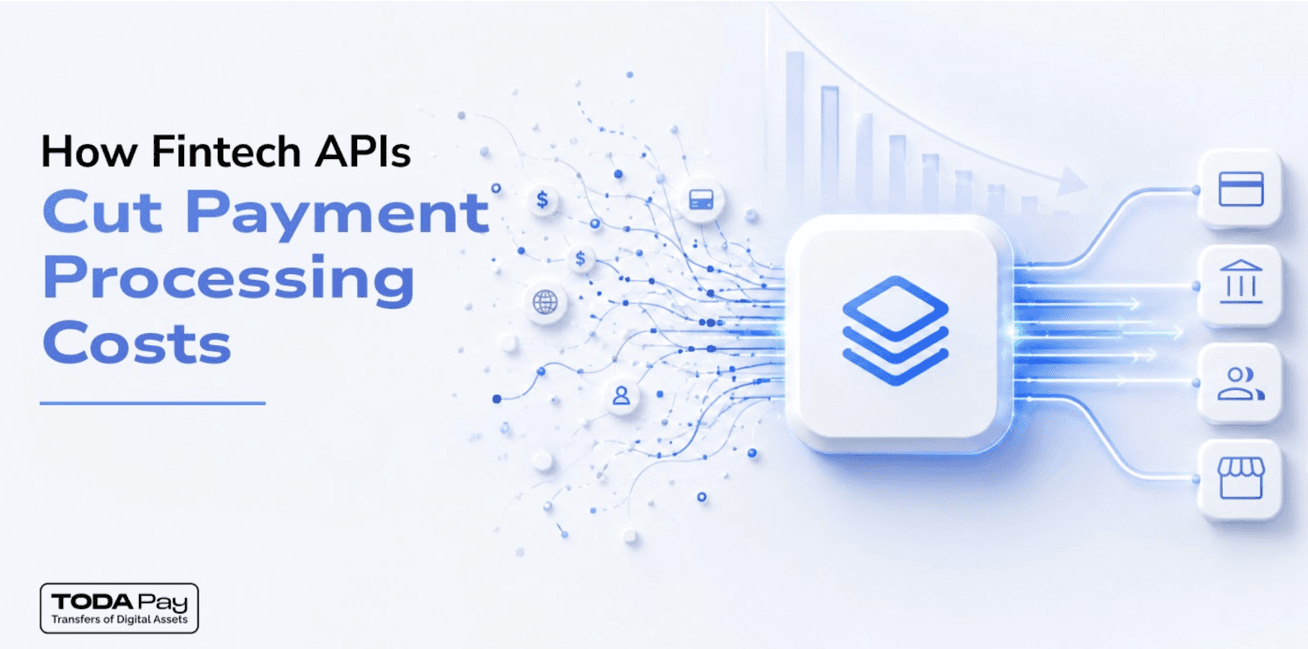
How Fintech APIs Cut Payment Processing Costs
Modern finance runs on APIs. Not metaphorically — literally. Every time a business accepts a payment, validates an identity, or moves money across a border, a Fintech API executes that transaction in the background. For CTOs and Heads of Payments in 2026, understanding this infrastructure is not optional; it directly determines speed-to-market and margin performance.
Banking APIs and payment processing APIs give financial product teams the core banking infrastructure to launch faster, route smarter, and compress costs.
Open Banking vs. Open APIs: Clear Distinctions Matter
The industry conflates two different concepts. Open Banking is a regulatory mandate — a government-enforced requirement for banks to share data with licensed third parties. Open APIs are the technical connectors that enable that sharing. Confusing the two produces architectural decisions built on the wrong foundation.
| Open Banking (Regulation) | Open APIs (Technology) |
| Defined by law (e.g., PSD2, CFPB 1033) | Software interfaces built by developers |
| Governs who can access financial data | Determines how that data moves |
| Compliance obligation for licensed institutions | Deployed by Fintechs and BaaS platforms |
Understanding this distinction prevents teams from treating an API integration as automatic compliance — and from missing the commercial opportunity that Banking-as-a-Service (BaaS) delivers on top of it.
The Core Fintech API Technology Stack Explained
No single API powers a full financial product. A production-grade platform requires a coordinated stack, each component handling a distinct function. Most platform evaluations skip this level of detail entirely.
The five essential API types in a modern Fintech stack:
- Program APIs — Create and manage accounts, cards, and customer profiles; the foundational BaaS layer.
- Real-Time Events APIs — Push instant notifications when a transaction clears, a card is declined, or a balance changes.
- Authorization Controller APIs — Define custom spend controls, merchant category blocks, and velocity limits.
- External Transaction APIs — Handle money movement including ACH payment processing, wires, and push-to-card flows.
- Dispute APIs — Automate chargeback workflows, evidence submission, and resolution tracking.
Together, these five layers cover the full transaction lifecycle. A stack missing any one of them forces engineering teams into workarounds that create technical debt and operational risk.
Banking APIs Accelerate Time to Market Significantly
Companies that build core banking infrastructure from scratch consistently underestimate the timeline by a factor of three to five. Banking-as-a-Service changes this equation by providing pre-built regulatory relationships, ledgering systems, and settlement rails on day one.
| Building from Scratch | Using Banking APIs | |
| Time to Market | 2–5 years | 3–6 months |
| Upfront Capital | $5M–$20M+ | Licensing and integration costs only |
| Compliance Burden | Full ownership (BSA, AML, PCI DSS) | Shared model; provider handles core obligations |
| Maintenance | Internal team required | Provider-managed updates |
Every subsequent product launch on the same Banking API infrastructure costs a fraction of the first.
Teams that reach market in months — not years — capture customers while competitors are still in procurement cycles. Furthermore, the compliance burden shift under a BaaS model lets engineering resources focus on differentiation, not regulatory plumbing.
Payment Processing APIs: Reducing Transaction Costs
Every payment carries hidden costs that compound at scale. Processor markups, network assessments, and interchange fees can consume 1.5–3.5% of gross payment volume — a material drag on unit economics at any serious volume.
Dynamic interchange optimization and Least Cost Routing (LCR) through payment processing APIs can reduce processing costs by up to 40% on eligible transaction flows.
ACH payment processing is the clearest example: flat fees of $0.20–$1.50 versus 1.5–3.5% on card rails. For recurring B2B payments or payroll disbursements, routing volume to ACH through an LCR-capable API stack is one of the highest-leverage cost decisions a payments team can make. However, routing logic must account for payment type, urgency, and counterparty requirements.
Scaling Globally With Cross-Border Payment APIs
International payments introduce three compounding friction points: FX conversion spreads, reconciliation lag, and unpredictable settlement times. Cross-border payment APIs address all three simultaneously — giving treasury teams control that correspondent banking relationships simply cannot provide.
The top operational benefits of cross-border API integration:
- Real-Time FX Rates — Access live currency spreads at the moment of transaction, eliminating batch conversion losses and improving cash flow forecasting.
- Automated Reconciliation — Deep ERP integration maps every payment to the correct cost center or invoice automatically, removing hours of manual matching from month-end close.
- Faster Settlement Times — API-connected rails settle cross-border transactions in hours versus the 3–5 business days typical of SWIFT correspondent chains.
For global AP and AR teams, this combination reduces DSO and improves working capital directly. Therefore, cross-border API adoption is a measurable balance sheet improvement, not just a technical upgrade.
Fintech API Architecture: Webhooks and Idempotency Keys
Two architectural standards separate reliable financial APIs from systems that fail under real-world conditions: idempotency keys and asynchronous webhook events. Ignoring either creates direct financial exposure.
An idempotency key is a unique identifier attached to each request. If a network timeout triggers a retry, the key ensures the payment processes exactly once — never twice. Without it, a single connectivity issue produces duplicate charges or duplicate ledger entries.
Here is how data flows across the two models:
- RESTful APIs (Synchronous) — Your system sends a request and waits for a response; ideal for balance lookups, account creation, and real-time authorization.
- Webhook Events (Asynchronous) — The API server pushes a notification to your endpoint when an event occurs; your system does not poll and resources are not held waiting.
In production, both patterns work together — RESTful APIs handle initiation, webhooks handle confirmation. Relying exclusively on synchronous calls creates a brittleness risk that grows more expensive as volume scales.
Automating Compliance: KYC, KYB, and API Security
Modern payment processing APIs embed KYC/AML compliance, KYB verification, and security protocols directly into the payment flow. B2B platforms face an additional layer: KYB (Know Your Business) validation confirms the legal entity, beneficial ownership, and sanctions exposure of corporate clients before funds move.
| Security / Regulatory Threat | API-Level Solution |
| Unauthorized data access | PCI DSS tokenization |
| Account takeover | 3DS2 authentication |
| Money laundering | KYC/AML screening against OFAC and PEP lists |
| Business fraud | KYB entity and UBO validation |
| Infrastructure breach | SOC 2 Type II certification |
| Transaction fraud | AI fraud detection scoring in real time |
TODA Pay holds a Canadian MSB (Money Services Business) license — a federal regulatory credential that validates the platform’s compliance framework for cross-border and domestic payment operations.
Embedding these controls at the API layer means compliance scales automatically with transaction volume, with no manual review queues and no staffing spikes at month-end.
The Step-by-Step API Integration Playbook
Engineering teams consistently underestimate the financial API integration lifecycle. The technical connection is the shortest phase; security validation, environment testing, and downstream system alignment take the most time.
The five integration phases in sequence:
- Documentation Review — Evaluate API reference docs, error codes, rate limits, and authentication mechanisms before writing a single line of integration code.
- Sandbox Environments — Test all critical flows — account creation, payment initiation, webhook handling, error recovery — with simulated edge cases.
- Security Audits — Conduct penetration testing and PCI DSS scoping on the integration layer before live data enters the connection.
- ERP Integration — Map API event data to accounting and reconciliation systems; confirm automated ledgering matches your chart of accounts.
- Production Go-Live — Execute a staged rollout on low-risk transaction types; monitor webhook delivery rates and settlement timing before full cutover.
Skipping the sandbox phase is the single most common cause of production incidents in financial API deployments. Furthermore, compressing security audits to accelerate go-live reliably produces audit findings that cost far more to fix post-launch.

TODA Pay Delivers the API Infrastructure to Scale
Cost reduction, speed-to-market, and compliance automation depend entirely on the quality of the API infrastructure beneath your product. A provider with shallow documentation and limited routing capabilities caps your performance at every growth stage.
TODA Pay combines real-time payment rails, Least Cost Routing, embedded KYC/KYB compliance, and a Canadian MSB license in a single API layer built for B2B financial products at scale.
ExploreCard Payouts to see how TODA Pay handles instant disbursements across multiple payment rails — and connect with a team that has already solved the integration complexity for you.