Chinese AI startup MiniMax has launched a model that beats GPT-5.5 and Gemini 3.1 Pro on key coding benchmarks, at standard API prices that are roughly 8–12× cheaper. But the numbers are self-reported, open weights haven’t shipped yet, and the full picture is more nuanced than the headlines suggest.
- 59.0% SWE-Bench Pro vs GPT-5.5’s 58.6%
- 1M Token context Native multimodal
- $0.60 Per 1M input tokens Standard rate; $0.30 promo
- 15.6× Faster decoding vs prior M2 at 1M ctx
Shanghai-based AI company MiniMax released M3, its most ambitious model to date. Positioned as the first open-weight model to combine frontier-level coding, a one-million-token context window, and native multimodal capability in a single system, M3 arrives with benchmark claims that put it ahead of OpenAI’s GPT-5.5 and Google’s Gemini 3.1 Pro on key agentic coding tasks — while pricing its API at a standard rate of $0.60 per million input tokens, roughly 8–12 times cheaper than its closed-source rivals.
The model is available immediately via the MiniMax API and on OpenRouter. Open weights and a full technical report are expected on Hugging Face and GitHub within approximately ten days of launch, around June 10–11, 2026. Until those weights ship, the architecture and safety behaviour cannot be independently verified.
MiniMax positions M3 as the first open-weight model to combine frontier coding, a 1M-token context window, and native image and video understanding — a combination previously exclusive to closed, proprietary labs.
The Architecture
At the heart of M3’s efficiency story is the MiniMax Sparse Attention (MSA) architecture, which replaces traditional full attention with a KV-block selection mechanism. MiniMax reports this design cuts per-token compute at one-million-token contexts to roughly one-twentieth of the previous generation, delivering approximately 15.6× faster decoding speeds and 9.7× faster prefill compared to its predecessor, MiniMax M2 — while retaining quality across most tasks, according to the company.
On multimodality, MiniMax built M3 as a natively multimodal system from the ground up — rather than retrofitting a text model with a separate vision encoder. The company blended interleaved sequences of text, images, and video into the pretraining pipeline, scaling the total corpus beyond 100 trillion tokens. This approach is intended to allow M3 to handle tasks such as translating visual code diagrams directly into functional code.
Benchmark results: where M3 wins, and where it doesn’t
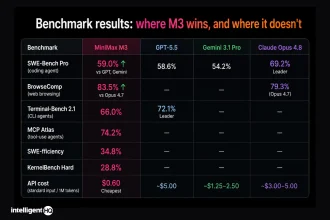
The headline number is 59.0% on SWE-Bench Pro, an industry-standard measure of autonomous software engineering capability. Per MiniMax’s own data, that score beats GPT-5.5 (58.6%) and Gemini 3.1 Pro (54.2%) but sits meaningfully below Claude Opus 4.8, which reportedly scores 69.2% on the same benchmark. All figures below are from vendor-reported sources and have not yet been independently verified.
| Benchmark | MiniMax M3 | GPT-5.5 | Gemini 3.1 Pro | Claude Opus 4.8 |
| SWE-Bench Pro (coding agent) | 59.0% ↑ GPT, Gemini | 58.6% | 54.2% | 69.2% Leader |
| BrowseComp (web browsing) | 83.5 ↑ Opus 4.7 | — | — | 79.3 (Opus 4.7) |
| Terminal-Bench 2.1 (CLI agents) | 66.0% | 72.1% Leader | — | — |
| MCP Atlas (tool-use agents) | 74.2% | — | — | — |
| SWE-fficiency | 34.8% | — | — | — |
| KernelBench Hard | 28.8% | — | — | — |
| API cost (standard input / 1M tokens) | $0.60 Cheapest | ~$5.00 | ~$1.25–2.50 | ~$3.00–5.00 |
Pricings
MiniMax’s pricing is one of M3’s most striking attributes. The standard API rate is $0.60 per million input tokens and $2.40 per million output tokens. At launch, OpenRouter listed M3 at a 50% promotional discount — $0.30 input / $1.20 output — which is the figure widely cited in launch-day coverage. The standard rate, however, is still a fraction of what frontier closed models charge: OpenAI’s GPT-5.5 is priced at approximately $5.00 per million input tokens, making M3 roughly 8× cheaper at standard rates and closer to the oft-cited 5–10× figure during the promotional period. Subscription plans start at $20 per month.
For agentic workflows — where a model may process hundreds of thousands of tokens per task across many iterations — this cost differential compounds rapidly, representing a potentially significant saving for enterprises running coding agents or automated pipelines at scale.
The open-weights commitment
MiniMax has committed to releasing M3’s full weights under an open-source licence, with publication on Hugging Face and GitHub expected around June 10–11, 2026. If delivered as announced, M3 would be the first open-weight model to combine frontier-level coding, a one-million-token context, and native multimodality — capabilities that have until now been the exclusive territory of closed labs. Enterprises could then self-host M3, run it on their own infrastructure, and customise it without recurring API costs.
It is worth noting that at the time of writing, the weights have not yet shipped. MiniMax’s open-weights designation is currently a company commitment, not a verifiable fact. The earlier MiniMax M2.7 model is already available on Hugging Face, providing some precedent, but the verification process for M3’s architecture and safety behaviour cannot begin until the release actually occurs.
Notable limitations and risks
M3 does not represent a clean sweep across all benchmarks. On Terminal-Bench 2.1, which measures performance on agentic command-line tasks, GPT-5.5 leads with 72.1% against M3’s 66.0%. On abstract and fluid reasoning tasks, early indications suggest M3 follows the pattern of the broader MiniMax family, strong in structured, concrete domains like coding and web browsing but weaker on generalised reasoning. Claude Opus 4.8 holds a substantial 10-point lead on SWE-Bench Pro.
M3 is also not yet listed on the DeepSWE leaderboard, which tracks long-horizon software engineering performance, meaning the most demanding comparison against the latest Claude releases remains pending.
For Western enterprises considering production deployment via MiniMax’s hosted API, there is also a compliance dimension to evaluate. As a Chinese company, MiniMax is subject to China’s 2017 National Intelligence Law, which requires domestic organisations to cooperate with government intelligence activities on request. This is a consideration that security-conscious enterprise teams — particularly those handling sensitive code, proprietary data, or regulated workloads — will need to weigh carefully. Self-hosting via open weights would address this concern directly, once the weights are available.
What it signals for the AI market
For two years the pattern has held: closed-frontier models lead on quality, and open-weight models follow at a discount. MiniMax M3 is the most direct challenge to that order yet. Whether its benchmark claims survive independent verification, the pricing alone resets the reference point for what enterprises should expect to pay for frontier-adjacent agentic AI capability.
If the open weights deliver as promised, and independent testing confirms the headline scores, M3 could meaningfully accelerate the timeline on which open-source models become viable replacements for proprietary APIs in production enterprise settings. That would have significant pricing pressure implications across the entire frontier model market.
Sources
- MiniMax-M3 debuts, eclipsing GPT-5.5 and Gemini 3.1 Pro on key benchmark performance for just 5-10% of the cost VentureBeat · June 1, 2026
- MiniMax M3 Open-Weight Coding Model: Frontier Claims, Unverified Benchmarks TechTimes · June 1, 2026 — Includes key caveats on vendor-run benchmarks and China’s National Intelligence Law
- MiniMax M3 — API Pricing & Model Card OpenRouter · Primary source for pricing ($0.30/$1.20 promo, $0.60/$2.40 standard) and context window specs
- MiniMax M3 Specs, Benchmarks, and Pricing (2026) FelloAI · June 1, 2026 — Benchmark figures including SWE-Bench Pro, Terminal-Bench 2.1, BrowseComp, MCP Atlas
- MiniMax M3: Developer Guide to the Open-Weight 1M-Context Frontier CoderSera · June 1, 2026 — MSA architecture specs (15.6× decoding, 9.7× prefill vs M2)
- MiniMax M3: Complete Guide to the Open-Weight Frontier Model (2026) AIMadeTools · June 1, 2026 — Terminal-Bench 2.1 GPT-5.5 score (72.1%) and Claude Opus 4.8 SWE-Bench comparison (69.2%)
- MiniMax M3 Developer Guide: Benchmarks & Pricing Lushbinary · June 1, 2026 — BrowseComp scores (M3: 83.5 vs Claude Opus 4.7: 79.3) and pricing detail