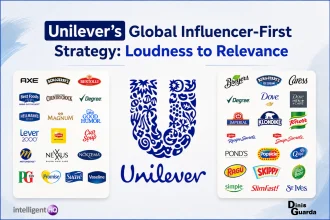
In 2026, influencer marketing has moved from a trendy experiment to a core, performance-driven pillar of commercial strategy. The industry is shifting focus from “vanity metrics” like reach and likes to measurable outcomes such as sales, customer acquisition cost (CAC), and direct ROI. This evolution is fuelled by a skeptical audience that prioritises credibility over polish, forcing brands, like Unilever, to replace one-off sponsored posts with long-term, authentic partnerships.
As of 2026, Unilever has undergone a seismic shift in its marketing philosophy. Under the leadership of CEO Fernando Fernandez, who took the role in March 2025, the consumer goods giant is pivoting from traditional, top-down advertising to a “Many-to-Many” brand-building vision. This strategy allocates 50% of the total advertising budget to social channels (up from 30%), leveraging a massive network of nearly 300,000 creators to bridge the gap between community, culture, and commerce. Speaking at the Consumer Analysts Group of New York (CAGNY) conference in February 2026, Fernandez said:
“The time of lazy marketing, a couple of ads a year for a couple of innovations, is gone.”
Unilever’s Strategic Pillar: The “Glocal” Approach
The core of Unilever‘s transformation is the move from global celebrity endorsements to hyper-local authenticity. Rather than relying on a handful of global faces, the company wants a genuine, community-embedded presence in every market it operates in. Fernandez has articulated this goal in concrete terms:
“There are 19,000 zip codes in India. There are 5,764 municipalities in Brazil. I want one influencer in each of them.”
In key growth markets, the scale of this operation is unprecedented:
- India: Targeting creators across 19,000+ zip codes, with around 17,000 influencers already active within the Unilever network.
- Brazil: Engaging local voices in over 5,764 municipalities.
The philosophy behind this is rooted in a straightforward but fundamental reality: broadcasting from the top down has lost its effectiveness. “Broadcasting messages from big brands now can become suspicious,” Fernandez has noted publicly, explaining that credibility in 2026 increasingly stems from individuals, not corporations. This “Glocal” model, thinking globally while activating hyper-locally, is the structural answer to that challenge.
Key Pillars of the 2025–2026 Strategy
Unilever’s influencer-first pivot addresses the fragmentation of traditional media and marks a decisive break from legacy models. It is built on several interconnected pillars:
- Hyper-Local Focus Shifting from celebrity-led campaigns to massive peer-to-peer networks, with active creators targeted down to the zip-code level in priority markets like India and Brazil. The goal is not simply reach — it is the kind of trust that only comes from community insiders.
- Massive Scale Powered by AI The creator ecosystem has grown from approximately 10,000 advocates two years ago to nearly 300,000 today — a 20-fold increase managed through AI-powered infrastructure. This “machine-like” approach enables Unilever to track content, monitor performance, and manage creator relationships at a speed and consistency no human team could achieve manually.
- The SASSY Framework Underpinning the entire strategy is what Unilever calls the SASSY model — a framework CEO Fernandez presented at the Barclays fireside chat that emphasises Science-led product superiority, sharper Aesthetics and sensorial appeal, Said by Others (the distributed recommendation network), and keeping brands Youthful and contemporary. The “Said by Others” pillar encompasses the full ecosystem of “other people’s recommendations” — influencers, professionals, and everyday brand advocates — and is the engine driving the creator network expansion. As Fernandez put it: “I really believe the old model of broadcasting messages from brands is gone.”
- Strategic Partnerships For its Foods business unit, Unilever has appointed SAMY Alliance and its proprietary Maia platform to manage a global pilot across 13 markets — the operational backbone of the strategy (see below).
- Niche Community Dominance Continuing to build genuine ownership of specific cultural spaces, most notably TikTok‘s #CleanTok (with over 98.5 billion lifetime views) and campaigns like #VaselineVerified, which won multiple Cannes Lions in 2025.
- Authenticity Over Reach Prioritising “many-to-many” peer-to-peer trust over impression-buying. Financial commitment backs this up: Unilever’s brand and marketing investment has risen from 13.1% of revenue four years ago — a level Fernandez openly described as “consciously uncompetitive” — to 16.1% today (approximately $9 billion on $60 billion in FY2025 revenues), and approximately 18% when the Foods division is excluded.
Strategic Comparison: The Shift in Marketing Philosophy
| Strategic Feature | Legacy Model | Influencer-First Model (2026) |
| Investment Pivot | Traditional Media Dominant (~30% social) | 50% Total Ad Budget to Social |
| Creator Ecosystem | Top-down Celebrity Ads | ~300,000 “Many-to-Many” Creators |
| Technology Role | Manual Selection / Fraud Prevention | AI-Powered Scale (Maia Platform) |
| Regional Execution | One-size-fits-all global campaigns | Hyper-Local (Zip code-level intelligence) |
| Primary Metric | Reach and Impressions | Peer-to-Peer Trust & Cultural Relevance |
| Content Style | Polished, Corporate-Produced | Authentic, Co-Created (#CleanTok, #ShareTheFirst) |
| Brand Philosophy | Broadcast messaging | SASSY: Science, Aesthetics, Said by Others, Youthful |
| Marketing Spend | ~13.1% of revenue | ~16.1% of revenue (~$9B in FY2025) |
Unilever’s Partnership with SAMY Alliance
To manage a creator network of this magnitude across diverse geographies, Unilever Foods appointed SAMY Alliance as its global social-first agency in March 2026 — the result of a competitive pitch involving seven agencies, run without an intermediary. SAMY, which employs more than 1,000 staff across 20 offices and 55 markets (with clients including L’Oréal, The North Face, Diageo, Microsoft, and Samsung), beat out established incumbents including ITB Worldwide (previously on Knorr), Weber Shandwick, Billion Dollar Boy, and Ogilvy, who had each provided influencer support across the Foods portfolio.
Utilising the proprietary Maia platform, Unilever Foods gains access to data-driven insights from over 120 million influencers globally, alongside the performance data needed to ensure campaigns deliver. The platform serves as the central hub for campaign planning and creator discovery, combining audience analytics with cultural intelligence to optimise who the brands work with and where they show up.
The mandate covers 13 markets: the US, UK, Mexico, Brazil, Indonesia, the Philippines, Germany, France, Poland, Pakistan, Argentina, Canada, and Turkey. SAMY’s “glocal” multi-market team structure is designed to bring hyper-local cultural insight into a shared global system, enabling Unilever to orchestrate influencer activity at scale without sacrificing local relevance.
Beyond activation, SAMY is also tasked with building the measurement frameworks and deployment systems needed for consistent brand representation. The immediate focus brands are Hellmann’s and Knorr, Unilever’s two largest food properties. (Note: the remit does not include Marmite.)
As Meg Bass, Global Media Manager at Unilever Foods, summarised:
“It’s about going where the consumers are and building Desire at Scale, growing our brands by embedding them authentically in culture. This means leaning strongly into creators who can help our stories travel further, feel more authentic and resonate more deeply.”
Sonsoles Piñeiro Kruik, Chief Growth Officer at SAMY, added:
“With teams working across continents, we’ll bring hyper-local intelligence into a shared global system, enabling Unilever to orchestrate influencer activity at scale while ensuring creator partnerships are shaped by the realities of each local market, rather than a one-size-fits-all approach.”
Comparative Strategy Analysis
| Feature | Traditional Model (Pre-2024) | Influencer-First Model (2026+) |
| Primary Goal | Awareness through Reach / Frequency | Desire through Cultural Relevance |
| Channel Focus | TV, Out-of-Home, Print | Social-First (50% Ad Spend) |
| Creator Type | Global Celebrities | 300,000 Hyper-Local Creators |
| Tech Integration | Standard Media Buying | AI-Powered (Maia Platform, 120M+ influencer database) |
| Content Style | Polished, Corporate-Produced | Authentic, Co-Created (#CleanTok, #ShareTheFirst) |
| Agency Model | Traditional Holding Groups | Specialist Social-First Agencies (SAMY Alliance) |
| Measurement | GRP, Reach, Frequency | Cultural Relevance, Sales Lift, CAC |
It is worth noting that Unilever has not abandoned traditional channels entirely. Critics at Adweek have pointed out that the 50% not going to social still represents more than $4 billion flowing into broad-reach advertising, and Fernandez himself highlighted the company’s sponsorship of the 2026 FIFA World Cup as “a very important event” and “the first time we will do something on this scale,” calling it “a key driver of growth this year.” The influencer-first strategy is transformational, but additive rather than a wholesale elimination of legacy formats.
Industry Challenges: The ROI Gap
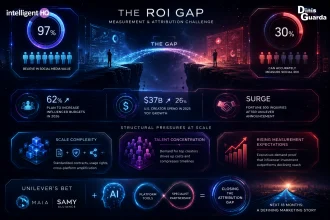
For all the strategic momentum, Unilever’s influencer-first model faces a structural challenge that the industry has not yet fully resolved: measurement and attribution.
The numbers are stark. While 97% of marketing leaders believe in the value of social media, only 30% claim they can accurately measure social ROI. This gap is the central tension in influencer marketing’s maturation at enterprise scale, the difference between knowing something works and being able to prove it decisively.
Affiliate marketing infrastructure is increasingly becoming part of the solution to this attribution challenge. Many DTC and Shopify brands are now combining influencer campaigns with affiliate tracking systems to measure creator-driven revenue more accurately. By assigning unique links, discount codes, and commission structures to creators, brands can move beyond vanity metrics and directly connect influencer activity to conversions, customer acquisition cost, and lifetime value. Businesses are also increasingly exploring different affiliate management platforms for Shopify brands to streamline creator tracking and commission management.
Fernandez himself has been candid about this. He acknowledged at the Barclays fireside chat that Unilever is “still trying to understand the variables that drive return on investment in this new ecosystem, where effectiveness can shift rapidly with changes in algorithms and consumer behavior.” This is not a company claiming to have solved the measurement problem — it is one betting that its AI infrastructure and SAMY partnership will close the gap faster than competitors.
The broader industry backdrop adds urgency. A Linqia survey of 200 marketers found that 62% plan to increase influencer budgets in 2026. The Interactive Advertising Bureau projects US creator spending will reach $37 billion in 2025, up 26% year-over-year. DesignRush has reported that Fortune 500 inbound inquiries about influencer roadmaps surged after Unilever’s announcement, with at least one consumer goods company explicitly citing Unilever as the reason it wanted a creator strategy built.
There are also structural pressures inherent to operating at this scale. Three shifts stand out for brands following Unilever’s lead: scale demands standardised contracts, usage rights, and cross-platform amplification built into the process early; talent concentration around the same popular creators raises costs and compresses timelines; and measurement expectations rise sharply as executives demand proof that influencer investment can outperform declining traditional reach. These are live operational challenges, not hypothetical risks, and they are precisely what SAMY’s mandate to build deployment and measurement frameworks is designed to address.
Unilever’s bet, ultimately, is that the maturity of platform tools combined with proprietary AI like Maia and the discipline of a dedicated specialist agency, will bridge the attribution gap faster than legacy media metrics ever could. Whether that bet pays off in hard commercial numbers will be one of the defining marketing stories of the next 18 months.
Sources
- Unilever — Marketing in a Changing World: Relevance as a Growth Engine (2026) https://www.unilever.com/news/news-search/2026/marketing-in-a-changing-world-relevance-as-a-growth-engine/
- Creative Salon — Iris Melo & Meacher-Jones on Influencers and Unilever https://creative.salon/articles/features/iris-melo-meacher-jones-influencers-unilever
- eMarketer — Unilever Invests Half of Its Budget on an ‘Influencer-First’ Strategy (March 2025) https://www.emarketer.com/content/unilever-invests-half-of-its-budget-on-influencer-first-strategy
- Marketing Dive — Unilever Taps Influencer Agency for Food Business as Potential Spinoff Looms (March 2026) https://www.marketingdive.com/news/unilever-appoints-influencer-agency-for-food-business-as-spinoff-looms/815526/
- Campaign Asia — Unilever Appoints Influencer Agency for Global Food Business (March 2026) https://www.campaignasia.com/article/unilever-appoints-influencer-agency-for-global-food-business/4pmmg2fkzk2v4zskescrjt86cn
- SAMY Alliance — Unilever Foods Business Appoints SAMY to Develop a Unified Global Influencer Strategy (March 2026) https://samy.com/unilever-foods-business-appoints-samy-to-develop-a-unified-global-influencer-strategy/
- Retail Gazette — Unilever Foods Taps SAMY to Build Global Influencer Strategy Across 13 Markets (March 2026) https://www.retailgazette.co.uk/blog/2026/03/unilever-foods-taps-samy-to-build-global-influencer-strategy-across-13-markets/
- MediaPost — Unilever Foods Selects Samy to Create Global Influencer Strategy (March 2026) https://www.mediapost.com/publications/article/413870/unilever-foods-selects-samy-to-create-global-influ.html
- Storyboard18 — End of Advertising as We Know It: Unilever Builds a 300,000-Strong Influencer Machine (April 2026) https://www.storyboard18.com/brand-makers/end-of-advertising-as-we-know-it-unilever-builds-a-300000-strong-influencer-machine-94678.htm
- Storyboard18 — Unilever Pushes “SASSY” as a Rebellion Against Traditional Branding (April 2026) https://www.storyboard18.com/how-it-works/unilever-pushes-sassy-as-a-rebellion-against-traditional-branding-94802.htm
- BuzzInContent — Unilever CEO Says Old Model of Broadcast Branding Is Gone (April 2026) https://www.buzzincontent.com/insight/unilever-ceo-says-old-model-of-broadcast-branding-is-gone-bets-on-influencers-and-professionals-11712069
- Exchange4Media — Unilever Scales Influencer Network from 10,000 to 300,000 (April 2026) https://www.exchange4media.com/influence-zone-news/unilever-scales-influencer-network-from-10000-to-300000-153746.html
- AFAQS — Unilever Builds 300,000-Strong Influencer Network from 10,000 in Just 2 Years https://www.afaqs.com/news/influencer-marketing/unilever-builds-300000-strong-influencer-network-from-10000-in-just-2-years-11715127
- Adgully — Unilever Abandons Traditional Ad Playbook for 300,000-Strong Influencer Army (April 2026) https://www.adgully.com/post/14164/unilever-abandons-traditional-ad-playbook-for-300000-strong-influencer-army
- DesignRush — Unilever’s 20X Influencer Push Reshapes Creator Marketing (December 2025) https://news.designrush.com/unilever-made-influencers-boardroom-priority-others-followed
- Adweek — The Unilever CEO Has a New Marketing Doctrine, and It Is Completely Wrong (February 2026) https://www.adweek.com/brand-marketing/the-unilever-ceo-has-a-new-marketing-doctrine-and-it-is-completely-wrong/