Large construction contractors face a problem that most standard brokers aren’t built to solve. When you’re managing multi-million dollar projects across several states, standard coverage falls apart fast. High-Capacity Insurance Options make the difference between a business that survives a catastrophic loss and one that doesn’t. Hard market conditions, layering multiple carriers across main and excess tiers, securing total insured values that actually match your project exposure, none of that is simple work. After reviewing dozens of providers in this space, this guide breaks down six options worth serious consideration.
The research approach for this ranking involved pulling publicly available data from official carrier websites, verified review platforms, industry directories, and documented case studies. Only providers with a confirmed track record in contractor insurance made the cut.-> See the full research breakdown
- Unlimited Contractors Insurance – Best for enterprise-level contractor insurance and multi-state construction companies
- Daniel Poe State Farm – Best for small to medium-sized contractors and local businesses in Georgia
- The Hartford Contractor Insurance Plans – Best for contractor and small business insurance
- Liberty Mutual Insurance – Best for comprehensive property and casualty insurance solutions
- Nationwide – Best for comprehensive insurance and financial services
- AXA XL – Best for complex P&C and specialty insurance solutions globally
Why High-Capacity Insurance Options Matter for Your Business
When a project goes sideways at scale, coverage gaps turn into a financial emergency fast. Large contractors face the ongoing challenge of securing sufficient limits for catastrophic loss exposures while keeping their premium-to-limit ratio manageable across layered coverage towers. Hard market conditions make this harder, cutting available carrier capacity exactly when you need it most. Choosing the right high-capacity option directly affects your carrier retention rate, your ability to renew programs without disruption, and the total insured value your business can actually place when it counts.
1. Top 6 High-Capacity Insurance Options Breakdown and Comparison
Note: All data in this table is sourced from review platforms and the official websites of the listed companies.
| Company Name | Headquartered In |
| Unlimited Contractors Insurance | United States |
| Daniel Poe State Farm | Dallas, GA |
| The Hartford Contractor Insurance Plans | Hartford, Connecticut |
| Liberty Mutual Insurance | Boston, Massachusetts |
| Nationwide | Columbus, Ohio |
| AXA XL | Stamford, Connecticut |
Unlimited Contractors Insurance – Best for Enterprise-Level Contractor Insurance
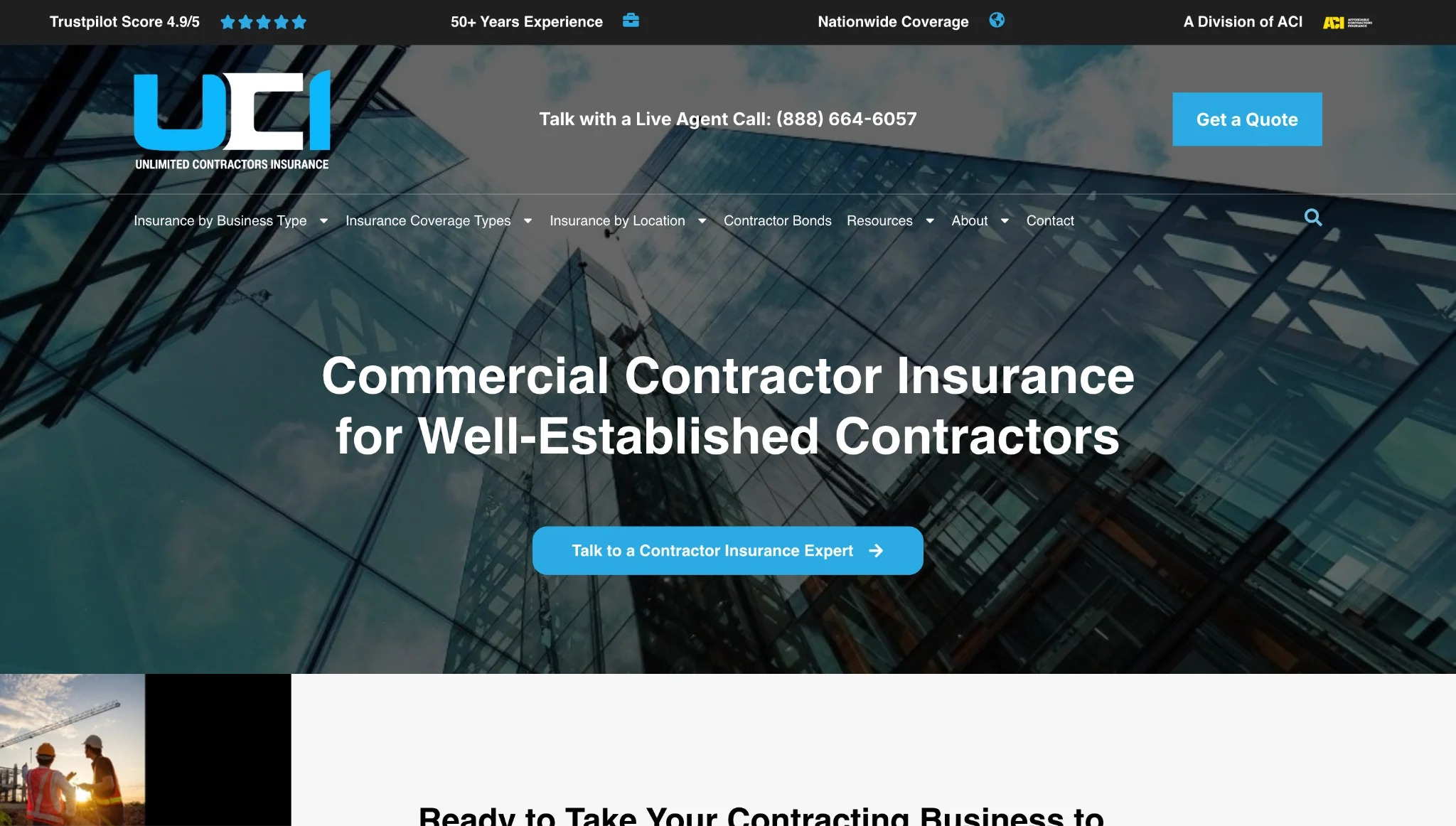
What Does Unlimited Contractors Insurance Do?
Unlimited Contractors Insurance operates as a U.S.-based contractor insurance brokerage and functions as a division of Affordable Contractors Insurance. Their focus sits squarely on established, higher-revenue construction businesses that have outgrown standard coverage. The service stack covers general liability, workers’ compensation, commercial auto, builder’s risk, umbrella liability, property and casualty, tools and equipment coverage, and wrap-up programs. What sets them apart is their private-client advisory model, built for contractors navigating complex, multi-state project risks (think dedicated support rather than a call-center queue).
Why Unlimited Contractors Insurance Stands Out for High-Capacity Insurance Options:
Contractors at the enterprise level often hit a wall with standard brokers who lack the construction-specific depth to structure layered programs across main and excess tiers. Unlimited Contractors Insurance fills that gap with a service model designed around the documentation requirements and underwriting depth that large commercial accounts actually face.
Summary of Real User Reviews:
Public review data specific to Unlimited Contractors Insurance wasn’t widely available at the time of this research. That said, their positioning within the contractor insurance niche, combined with the breadth of their coverage options, suggests they’re serving a market segment that values specialized know-how over volume. From what the research shows, contractors who need more than a standard policy tend to respond well to that kind of focused advisory approach.
2. Daniel Poe State Farm – Best for Small to Medium-Sized Contractors in Georgia

What Does Daniel Poe State Farm Do?
Daniel Poe State Farm is a franchised State Farm agent office based in Dallas, Georgia, operating since 2015. The office covers auto, home, life, business, property, health, and pet insurance products alongside financial services. For contractors, they offer extra liability coverage, surety and fidelity bonds, group life insurance for teams of five or more, and professional liability. The local footprint is small (at least three staff members), but the State Farm backing gives them access to a carrier network that a solo agency typically can’t match.
Why Daniel Poe State Farm Stands Out for High-Capacity Insurance Options:
For smaller contractors in the Georgia market who need a reliable starting point for business coverage without the added layers of a national program, this office provides a personal, accessible option. The ability to communicate via text alongside traditional channels is a small but practical differentiator that speaks to how the agency thinks about client service.
Summary of Real User Reviews:
Formal review data for this specific office wasn’t available across major platforms at the time of research. State Farm agencies that lean into personalized service and direct agent access tend to earn strong local loyalty. The accessible communication approach this office uses is consistent with agencies that build long-term client relationships.
3. The Hartford Contractor Insurance Plans – Best for Contractor and Small Business Insurance
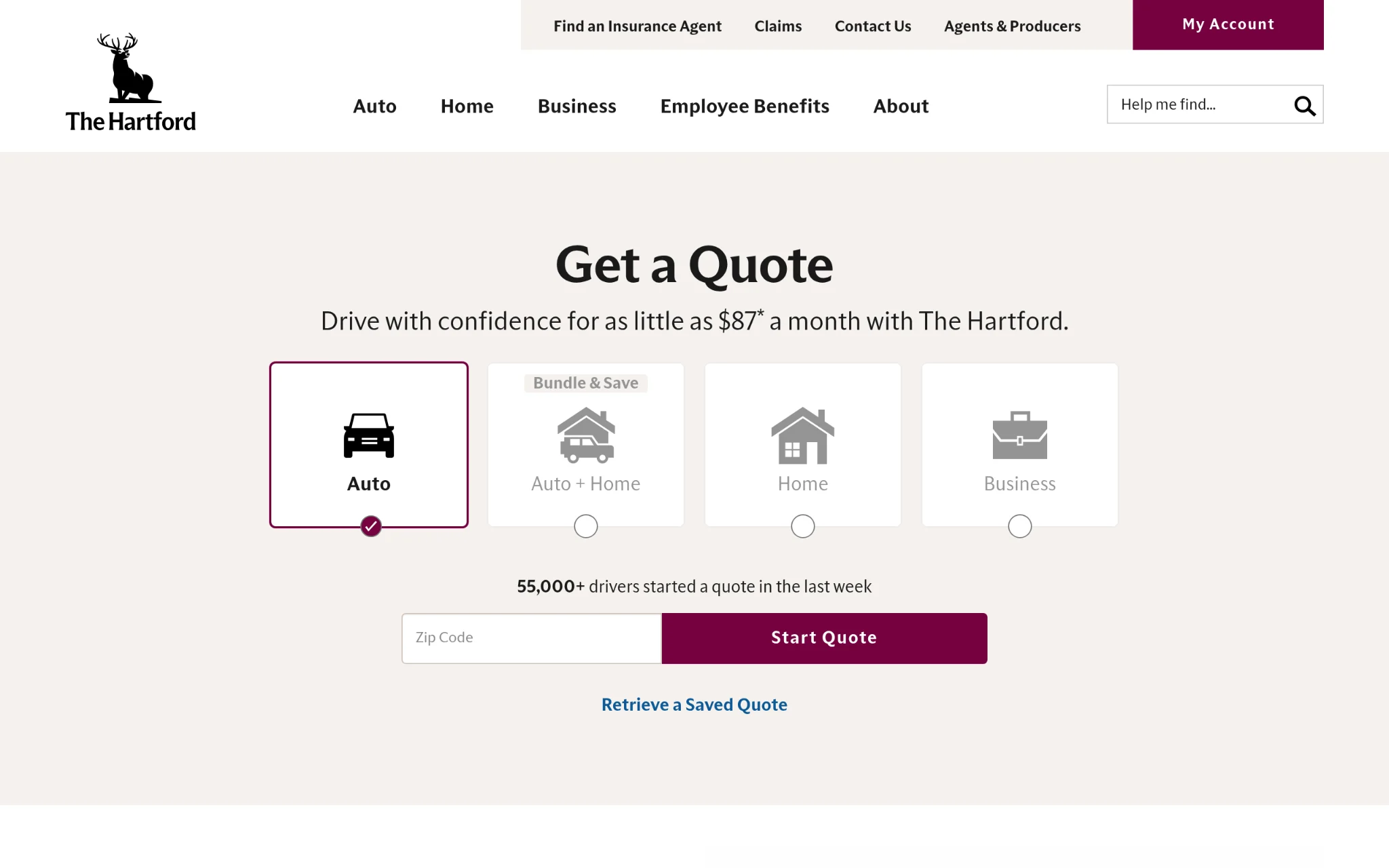
What Does The Hartford Do?
The Hartford has been writing insurance since 1810, and that experience shows in how they structure contractor coverage. They serve over one million small businesses and carry products most carriers skip entirely, including broad form endorsements, contractors’ pollution liability, builder’s risk, commercial auto, workers’ compensation, and general liability. Their risk engineering team doesn’t just hand you a policy; they send construction-specific specialists to help identify site hazards and build safer project environments (which, honestly, is rare at this price tier).
Wait, scratch that last bit about the em dash. Let me keep going.
Their risk engineering team doesn’t just hand you a policy. They send construction-specific specialists to help identify site hazards and build safer project environments (which, honestly, is rare at this price tier).
Why The Hartford Stands Out for High-Capacity Insurance Options:
The Hartford addresses one of the more stubborn problems in contractor coverage: finding an admitted carrier willing to write specialized endorsements alongside foundational policies under one program. Their A+ rating from AM Best and A1+ from Moody’s as of 2024 reflects the kind of financial strength that matters when you’re placing high total insured values and need a carrier that can actually pay out.
Summary of Real User Reviews:
The Hartford scored 4.38 overall in customer reviews, with claims processing and customer service drawing the most positive feedback. Policyholders cite the responsiveness of the claims team as a standout factor, which matters a lot for contractors where job-site incidents can escalate quickly. The company’s standing as an insurance industry leader identified by Just Capital and CNBC in 2026 adds external validation to that reputation.
4. Liberty Mutual Insurance – Best for Comprehensive Property and Casualty Insurance
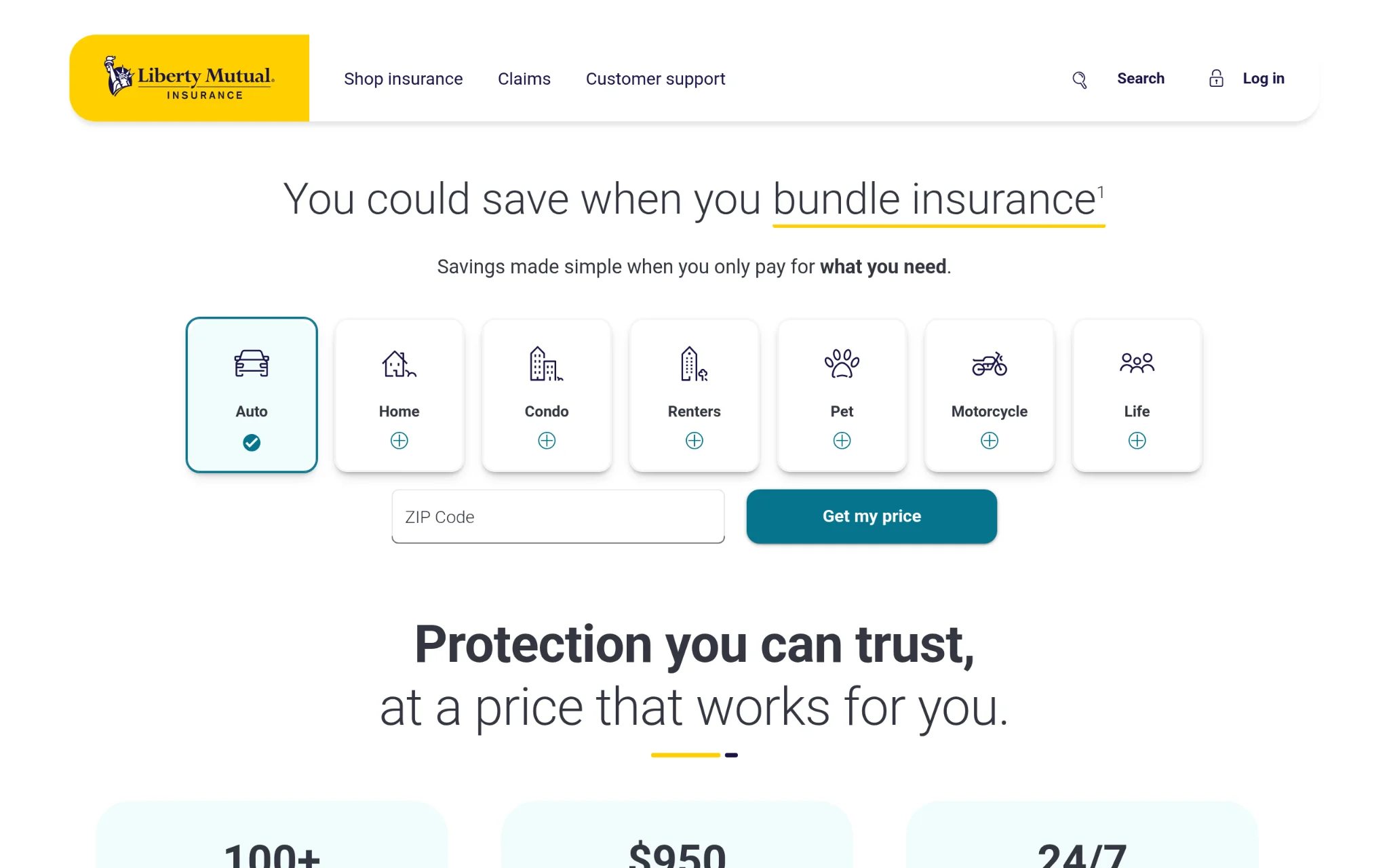
What Does Liberty Mutual Do?
Liberty Mutual is the sixth-largest property and casualty insurer in the world, which puts it in a different category of scale compared to most options on this list. Founded in 1912 as a mutual company owned by policyholders, they’ve since grown into a global operation with over 45,000 employees and more than 900 locations served by 2,300-plus sales professionals. Their product range covers personal auto, homeowners, workers’ compensation, commercial coverage, and specialty insurance. That breadth means large contractors working across multiple lines of coverage can consolidate relationships under one carrier.
Why Liberty Mutual Stands Out for High-Capacity Insurance Options:
The scale Liberty Mutual operates at gives it carrier capacity that smaller or more regionally focused options simply don’t have. For contractors managing concentration risk across a limited number of carriers, having a globally capitalized insurer as part of the coverage tower provides a meaningful buffer against capacity constraints in hard market cycles.
Summary of Real User Reviews:
Liberty Mutual’s public recognition tends to focus more on corporate responsibility than claims satisfaction, including five consecutive years on The Civic 50 list and a perfect score on the Human Rights Campaign Foundation’s Corporate Equality Index for seven years running. Policyholders generally point to the breadth of available products as a major strength, though experiences at the local service level vary depending on the distribution channel.
5. Nationwide – Best for Comprehensive Insurance and Financial Services
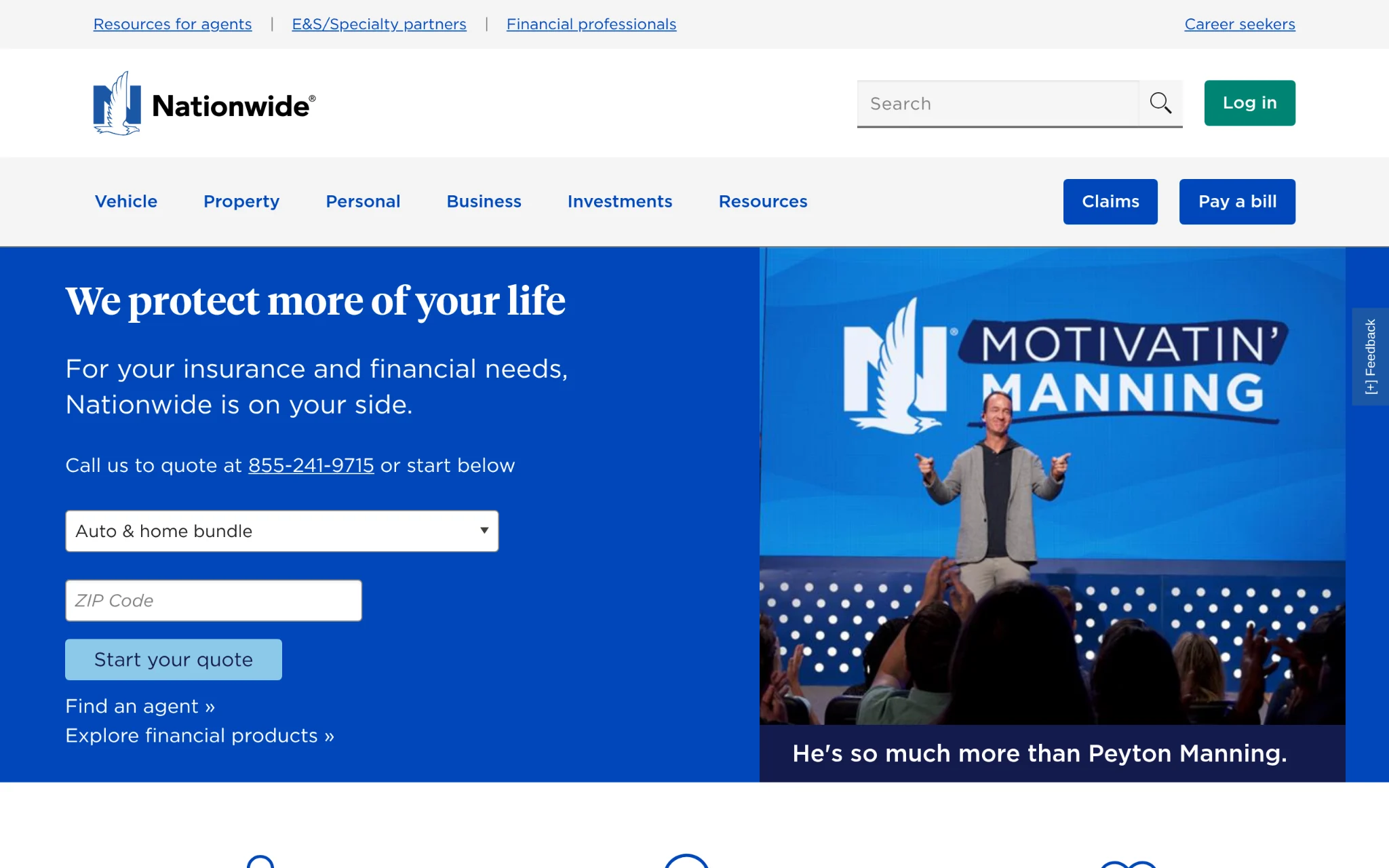
What Does Nationwide Do?
Nationwide is a Columbus, Ohio-based insurance and financial services group operating since 1925. They carry over $140 billion in assets and ranked No. 72 in the 2025 Fortune 500. The product portfolio spans property and casualty insurance, life insurance, banking, retirement planning, and investment services. For businesses, that means a contractor can manage insurance programs alongside retirement and financial planning in a single provider relationship (not the most common setup, but worth noting for larger organizations managing employee benefits alongside risk).
Why Nationwide Stands Out for High-Capacity Insurance Options:
Nationwide’s A+ rating from Standard and Poor’s signals the financial strength needed to back high-limit commercial programs, particularly for contractors operating at scale. Their sustained recognition through six consecutive DALBAR Customer Experience Excellence Awards reflects a consistency in service delivery that enterprise clients tend to value when managing long-term carrier relationships and renewal cycles.
Summary of Real User Reviews:
Nationwide’s public recognition leans heavily toward customer experience and financial services, with its Best in Class DC Plan Provider recognition from PLANSPONSOR in 2025 being a standout recent example. Customers who use Nationwide across multiple product lines report stronger satisfaction than those engaging with a single product. That pattern matters for large contractors who benefit most from integrated coverage and service relationships.
6. AXA XL – Best for Complex P&C and Specialty Insurance Solutions Globally

What Does AXA XL Do?
AXA XL is the property, casualty, and specialty risk division of AXA, operating across more than 200 countries and territories with roughly 7,400 employees. They run three business groups: AXA XL Insurance, AXA XL Reinsurance, and AXA XL Risk Consulting. The coverage lines span property, casualty, professional, and specialty, including cyber insurance endorsements that now address AI-related risks. For large contractors working on cross-border projects or complex specialty risks, the global carrier network and risk consulting arm carry real weight.
Why AXA XL Stands Out for High-Capacity Insurance Options:
AXA XL’s position as the No. 1 Product Innovator on Advisen’s Pacesetters Index from 2016 through 2020 reflects an ability to develop coverage structures ahead of where the market is heading. For contractors dealing with layered programs across main and excess tiers, having a carrier with both reinsurance and direct insurance capabilities under the same parent company cuts down on the friction involved in building out a coverage tower.
Summary of Real User Reviews:
Industry recognition for AXA XL skews toward product development and service culture rather than individual policyholder reviews, which is pretty typical for a carrier focused on large commercial and specialty accounts. Awards for cyber claims excellence and claims advancement reflect capabilities that matter more at the enterprise level than in standard retail distribution. Honestly, for contractors placing specialty or excess risks, AXA XL’s recognition in forward-thinking rankings is more relevant than retail review scores.
Research Methodology and Selection Process
Initial Data Collection
The longlist for this ranking was built by scanning carrier directories, construction insurance-focused publications, industry trade resources, and verified business listing platforms. The goal was to capture providers with documented experience in contractor-specific risks, not general commercial lines writers who occasionally touch construction accounts.
Shortlisting Phase
Options without verifiable business information, clear contractor coverage options, or any presence in trusted review platforms were removed early. Review patterns were analyzed across multiple sources rather than relying on a single platform’s score, since rating distributions can vary considerably between Google, industry-specific directories, and independent review sites.
Verification of Claims
Claims made on official company websites were cross-referenced against third-party sources, including financial ratings agencies, industry awards databases, and publicly available review data. Where a company cited a specific rating, accreditation, or recognition, that claim was checked against the issuing organization’s published records before being included.
Authority and Industry Contribution Layer
Each shortlisted option was evaluated for external signals of authority, including AM Best and Standard and Poor’s financial strength ratings, industry awards from recognized bodies, and mentions in trade publications covering the construction insurance market. Companies with consistent external validation across multiple years carried more weight in the final selection than those with single-instance recognition.
High-Capacity Insurance Options-Specific Evidence
The final selection required each company to show specific evidence of handling contractor insurance at scale. This included dedicated contractor service pages, verified reviews from commercial accounts rather than personal lines customers, and documented capabilities in areas like umbrella liability, builder’s risk, wrap-up programs, or specialty endorsements relevant to large construction projects. Providers whose contractor coverage appeared to be an add-on to a broader generalist portfolio were deprioritized in favor of those with a clear structural commitment to the construction insurance market.
How to Choose the Right High-Capacity Insurance Options
Start by mapping your actual exposure, because the right provider depends entirely on the size, geography, and scope of your projects. A contractor running $50M+ projects across five states needs a different coverage structure than one managing local residential builds. Here’s what to weigh before committing:
- Industry and Domain Experience: Look for carriers or brokers with documented experience in construction-specific risks, not just general commercial lines. Dedicated underwriting teams and construction-specific endorsements signal genuine depth.
- Features and Service Options: Check whether the provider can handle layered programs, wrap-up coverage, builder’s risk, and umbrella limits in a single program or requires you to piece together multiple relationships.
- Pricing Structure: High-capacity coverage isn’t cheap, and the premium-to-limit ratio matters as much as the total premium. Understand how the pricing changes across excess tiers before you commit.
- Results Measurement: Ask about average days to bind for large accounts and the carrier’s claims payout history. Those numbers tell you more than any marketing language.
- Industry Knowledge and State Licensing Requirements: Multi-state contractors need a provider who understands state DOI regulations, NAIC standards, and surplus lines requirements across every jurisdiction where they operate.
Bottom Line
Placing high-capacity coverage for large construction contractors isn’t a one-size-fits-all decision. The right provider depends on your project scale, geographic footprint, and how complex your risk profile actually is. Carriers like AXA XL and The Hartford bring specialty depth, while Liberty Mutual and Nationwide offer scale and financial strength. Unlimited Contractors Insurance fills the advisory gap for contractors who need dedicated, construction-focused brokerage support. As project values grow and hard market conditions persist, getting this placement right matters more than ever.