
Many people hear ‘blockchain’ and immediately think of Bitcoin or other digital currencies. And sure, that’s where it all started, right? But this technology is way bigger than just money. It’s basically a super secure and open way to keep track of information. Think of it like a digital notebook that everyone can see but no one can change without everyone agreeing. This article looks at some cool examples of blockchain in cryptocurrency and beyond, showing how it’s changing different industries.
Key Takeaways
- Blockchain is a secure, shared record-keeping system, not just for digital money.
- It makes supply chains more open, letting us track products from start to finish.
- Healthcare can use blockchain to keep patient data safe and track medicines.
- Financial services are speeding up payments and cutting costs with blockchain.
- Digital identity and creative work ownership can be better protected using this tech.
Understanding Blockchain Beyond Cryptocurrencies
While many people first hear about blockchain through Bitcoin and other digital currencies, the technology itself is much broader. Think of it as a special kind of digital notebook that’s shared among many people. Instead of one person holding the master copy, everyone has an identical version. When something new is added – like a transaction or a piece of information – it gets verified by the group and then added to everyone’s notebook in a way that can’t be easily changed. This shared, unchangeable record is the core idea.
The Core of Blockchain Technology
At its heart, blockchain is a distributed ledger. This means the record of information isn’t stored in one central place but is spread across many computers, or ‘nodes,’ in a network. Each new piece of information, or ‘block,’ is cryptographically linked to the one before it, forming a ‘chain.’ This structure makes it incredibly difficult to alter past records without everyone noticing. It’s this distributed and linked nature that builds trust without needing a middleman.
Key Features Driving Innovation
Several characteristics make blockchain so interesting for uses beyond just money:
- Decentralization: No single entity controls the entire network. This spreads power and reduces single points of failure.
- Transparency: While identities can be pseudonymous, the transactions themselves are often visible to all participants on the network. This openness builds accountability.
- Immutability: Once data is added to the blockchain and verified, it’s extremely hard to change or delete. This creates a reliable history.
- Security: Cryptography protects the data within each block and the links between them, making the chain resistant to tampering.
These features are what allow blockchain to create new possibilities in areas like supply chain tracking and digital finance. It’s not just about digital coins; it’s about creating more trustworthy and efficient ways to manage information and interactions.
Decentralized Ledger Explained
A decentralized ledger is essentially a database that is shared and synchronized across a network of participants. Imagine a shared Google Sheet where everyone can see the entries, but only after a consensus is reached among the group about what gets added. Each entry is time-stamped and linked to the previous one, creating a chronological and verifiable history. This distributed nature means that even if one copy of the ledger is compromised, the others remain intact, safeguarding the integrity of the entire record. This technology is fundamentally changing how we think about record-keeping and trust in digital systems.
Revolutionizing Supply Chains With Transparency
Think about the journey your coffee beans take from a farm in Colombia to your morning cup. It’s a long and complex path, often involving many different hands and companies. Traditionally, keeping track of every step has been a challenge, leading to questions about authenticity, ethical sourcing, and even where a product might have gone wrong. This is where blockchain technology steps in, offering a new level of clarity.
Tracking Goods From Origin to Destination
Blockchain acts like a shared, unchangeable digital ledger. Every time a product moves, changes hands, or undergoes a check, that event can be recorded as a ‘block’ on the chain. This creates a detailed history, visible to authorized participants, showing exactly where an item has been. This end-to-end visibility helps identify bottlenecks and ensures accountability throughout the supply chain. For instance, a food company could track a batch of produce from the farm, through processing and distribution, all the way to the grocery store shelf. This detailed record can be invaluable for recalls or quality control. It’s a significant step beyond traditional methods, offering a more robust way to manage product provenance.
Ensuring Product Authenticity and Quality
Counterfeiting is a massive problem across many industries, from luxury goods to pharmaceuticals. Blockchain provides a powerful tool to combat this. By recording unique identifiers for products at their point of origin, companies can verify authenticity at any stage. Consumers could potentially scan a QR code on a product and see its entire history on the blockchain, confirming it’s genuine. This also extends to quality. If a product requires specific storage conditions, like temperature control, sensors can record this data onto the blockchain, providing proof that quality standards were maintained.
Automating Processes With Smart Contracts
Beyond just tracking, blockchain enables smart contracts. These are self-executing agreements where the terms are written directly into code. Imagine a shipment arriving at its destination. A smart contract could automatically trigger a payment to the supplier once the delivery is confirmed on the blockchain. This removes the need for manual invoicing and reduces delays. It can also automate compliance checks, verifying that all necessary documentation is present and correct before a product can move to the next stage. This automation not only speeds things up but also reduces the chances of human error and disputes.
The ability to create an immutable record of every transaction and movement within a supply chain fundamentally changes how trust is established. Instead of relying on paper trails or siloed databases, all parties can access a single, verifiable source of truth.
Here’s a look at how different aspects of supply chain management can be improved:
- Traceability: Pinpointing the exact origin and journey of goods.
- Authenticity Verification: Confirming products are genuine and not counterfeit.
- Efficiency Gains: Automating payments, compliance, and administrative tasks.
- Risk Reduction: Minimizing fraud, errors, and delays.
- Enhanced Collaboration: Providing a shared platform for all supply chain partners.
Transforming Healthcare Data Management

The healthcare industry is awash in sensitive patient information, and keeping it secure while making it accessible to those who need it is a constant challenge. Blockchain technology offers a new way to handle this, moving beyond traditional, often siloed, systems.
Securely Storing and Sharing Patient Information
Imagine a world where your medical history is truly yours to control. Blockchain can make this a reality. By using a distributed ledger, patient data can be stored in a way that is both highly secure and auditable. Each transaction, like a doctor accessing a record or a patient granting permission, is recorded permanently and transparently. This doesn’t mean all your personal health details are out in the open; rather, the blockchain can manage access permissions and track who has viewed what, when. This level of control and transparency is a significant step forward for patient privacy.
Combating Counterfeit Drugs Through Traceability
Counterfeit medications are a serious global health risk. Blockchain can create a verifiable chain of custody for pharmaceuticals, tracking them from the manufacturing plant all the way to the patient. Every step – from production to distribution to dispensing – can be logged on the blockchain. This makes it much harder for fake or substandard drugs to enter the supply chain undetected. If a drug’s journey doesn’t match the blockchain record, it’s a clear red flag.
Improving Interoperability of Medical Records
One of the biggest headaches in healthcare is getting different systems to talk to each other. Hospitals, clinics, and specialists often use different software, making it difficult to share patient records. Blockchain can act as a common, secure layer that allows these disparate systems to communicate and exchange data more effectively. This improved interoperability means healthcare providers can get a more complete picture of a patient’s health, leading to better diagnoses and treatment plans. It also means patients might not have to repeat their medical history every time they see a new doctor.
The ability to securely and transparently manage health data has the potential to not only protect individuals but also to streamline research and public health initiatives by providing aggregated, anonymized data sets.
Enhancing Financial Services and Payments
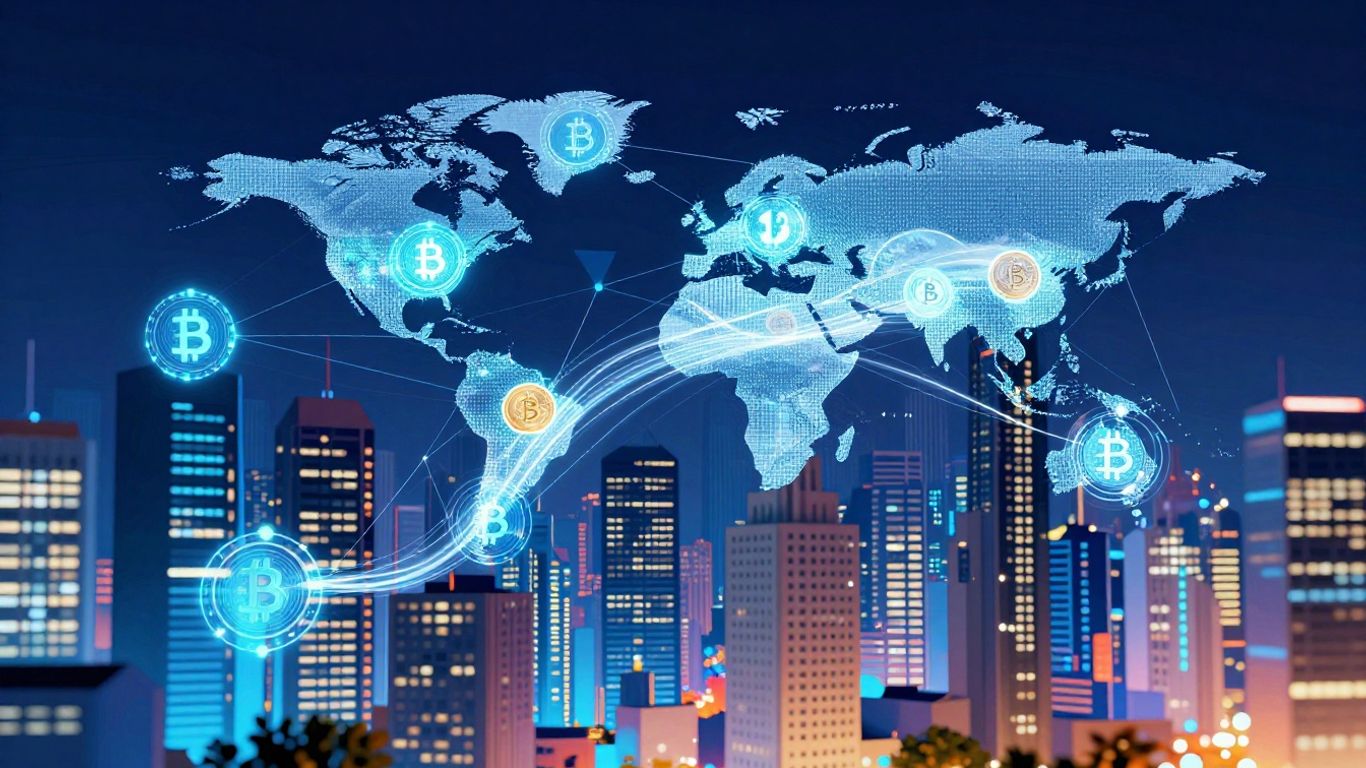
Beyond its role as the foundation for cryptocurrencies, blockchain technology is fundamentally reshaping the financial sector. It’s introducing new levels of efficiency, security, and accessibility to services that have long been burdened by intermediaries and slow processes. This technology is not just about digital money; it’s about reimagining how financial transactions and services operate on a global scale.
Streamlining Cross-Border Transactions
International payments and remittances have historically been slow, expensive, and opaque. Traditional systems often involve multiple banks, each taking a cut and adding delays. Blockchain offers a direct, peer-to-peer alternative. By removing these intermediaries, transactions can be settled much faster, often in minutes rather than days. This also significantly reduces the fees associated with sending money across borders, making it more affordable for individuals and businesses alike. The transparency of the ledger means that both sender and receiver can track the payment’s progress in real-time, reducing uncertainty.
Reducing Costs and Settlement Times
The financial industry relies heavily on clearing and settlement processes, which can be complex and time-consuming. Blockchain’s distributed ledger can automate many of these functions. Smart contracts, for instance, can automatically trigger payments or asset transfers once predefined conditions are met, eliminating the need for manual verification and reconciliation. This not only speeds up settlement times dramatically but also cuts down on operational costs for financial institutions. Think about the potential savings when trades can be settled almost instantly, reducing counterparty risk and freeing up capital.
Enabling Peer-to-Peer Lending
Blockchain is also opening doors for decentralized finance (DeFi) applications, including peer-to-peer lending. Platforms built on blockchain can connect borrowers directly with lenders, bypassing traditional banks and financial institutions. This disintermediation can lead to more competitive interest rates for both parties. Borrowers might gain access to capital they wouldn’t otherwise have, while lenders can earn returns on their assets without relying on traditional savings accounts or bonds. These platforms often use smart contracts to manage loan agreements, collateral, and repayments, adding a layer of automation and trust to the process. As participation in DeFi grows, many newcomers first need to buy ethereum with fiat before interacting with decentralized applications and financial tools built on the Ethereum network. The potential for financial inclusion is significant, as these systems can be more accessible to individuals in regions with underdeveloped traditional banking infrastructure. You can find more information on how these systems work by looking at financial services.
The integration of blockchain into financial services promises a future where transactions are faster, cheaper, and more transparent. It’s a shift towards a more open and accessible financial ecosystem, driven by technological innovation rather than traditional gatekeepers.
Securing Digital Identity and Intellectual Property
It’s easy to think of blockchain as just a way to handle digital money, but its abilities go much further. One really interesting area is how it can protect our digital selves and the things we create. Think about your personal information – who really controls it? And what about that song you wrote or that unique design you came up with? Blockchain offers some pretty neat solutions here.
Empowering Individuals With Self-Sovereign Identity
Right now, managing your identity often means relying on big companies or government databases. You give them your information, and they hold onto it. This can be risky. If their system gets hacked, your data is out there. Plus, you don’t have much say in how it’s used.
Self-sovereign identity, built on blockchain, flips this around. You become the owner and manager of your digital identity. Instead of a central authority holding all your details, you keep them securely, perhaps on your own device. When you need to prove who you are for a service, you can selectively share just the necessary pieces of information, like your age or your address, without revealing everything. This is done through cryptographic methods, so it’s secure and private. It’s like having a digital passport that you control completely.
Here’s a look at how it works:
- Data Ownership: Your personal data is stored in a way that you control, not a third party.
- Selective Disclosure: You choose exactly what information to share and with whom.
- Verifiable Credentials: Services can verify your identity or qualifications without needing direct access to all your underlying data.
- Reduced Risk: Less centralized data means fewer targets for hackers.
Protecting Creative Works and Ownership
For artists, writers, musicians, and inventors, proving ownership of their creations can be a headache. Copyright laws exist, but enforcing them, especially in the digital space, can be complex and costly. Blockchain can simplify this significantly.
Imagine registering your artwork, a piece of music, or a patent on a blockchain. This creates an immutable, timestamped record of your claim. Anyone can see that you registered it on a specific date, making it much harder for someone else to claim it as their own later. This record acts as undeniable proof of creation and ownership.
This technology can also manage licensing. Smart contracts can automatically handle agreements for using your work. For instance, if someone wants to use your song in a video, a smart contract could automatically release a small payment to you and grant them the license, all without needing lawyers or intermediaries.
Reducing Fraud and Identity Theft Risks
Identity theft is a massive problem, costing individuals and businesses billions. When our data is scattered across many different systems, it becomes vulnerable. Blockchain offers a more robust way to secure this information.
By using decentralized identity systems, the need to repeatedly hand over sensitive personal details is reduced. Each interaction can be verified without exposing the raw data. This makes it much harder for malicious actors to steal identities or commit fraud.
The core idea is to shift control back to the individual. Instead of systems that require you to trust them with your data, blockchain enables systems where trust is built into the technology itself through transparency and cryptographic proof. This makes it harder to fake identities or steal information because the record is permanent and verifiable by anyone on the network.
This approach not only helps prevent identity theft but also streamlines processes that currently rely on cumbersome verification methods. It’s a step towards a more secure and user-centric digital future.
Innovations in Voting and Real Estate
Blockchain is moving into new territories, making voting and property transactions more dependable. These sectors have long faced hurdles like fraud, data errors, and slow, paper-heavy processes. Blockchain brings fresh solutions by providing security, transparency, and automation, making things easier for everyone involved.
Making Voting Systems More Secure and Transparent
When it comes to elections, trust is everything. Traditional voting systems can be prone to tampering or simple mistakes. Blockchain voting platforms ensure that each vote is recorded on a permanent, unchangeable ledger — nothing can be hidden or altered after the fact.
Blockchain-powered voting could raise public trust and participation, especially for remote and absentee voters.
Key advantages of blockchain voting systems:
- Every vote has a digital record that can’t be changed or deleted.
- Votes are counted automatically, cutting down human error.
- Voters can confirm their vote was counted correctly without giving up privacy.
Voters benefit from greater transparency and confidence that their choices are counted exactly as cast.
Simplifying Property Ownership Records
The real estate world has layers of bureaucracy and a history of missing documents or vague property titles. Blockchain offers a clear digital record of property ownership, preventing disputes and making it harder for fraudsters to manipulate records.
Benefits include:
- Digital, tamper-proof record of ownership with timestamps
- Instant transfer of titles once payment is confirmed
- Lower administrative costs and fewer middlemen
| Traditional Deeds | Blockchain Property Records |
|---|---|
| Paper-based | Digital, secure ledger |
| Prone to loss | Immutable and backed up |
| Slow transfers | Instant processing |
Automating Real Estate Contracts
Buying and selling property is usually full of paperwork, deadlines, and multiple signatures. With smart contracts on a blockchain, these steps happen automatically when preset conditions are met. People no longer have to chase signatures or wait for banks to confirm payments.
Here’s how blockchain-based smart contracts improve real estate deals:
- Payments and title changes happen together, in real time.
- Key steps, like inspections or loan approvals, automatically trigger the next parts of the contract.
- All parties can track progress in one place, reducing stress and confusion.
These improvements mean faster, more reliable transactions with less room for errors or disputes.
The Future of Energy Trading
Enabling Direct Energy Trading Between Individuals
Imagine a world where you can sell the extra solar power your home generates directly to your neighbor, or where a small business can buy electricity from a local wind farm without needing a big utility company in the middle. This is the promise of blockchain in energy trading. It breaks down the traditional, centralized model and opens the door for peer-to-peer energy transactions. This shift could fundamentally change how we consume and distribute electricity.
Promoting Efficient Green Energy Markets
Blockchain technology can make green energy markets work much better. It allows for the transparent tracking of renewable energy credits, making it easier to verify that energy is indeed coming from sustainable sources. This transparency builds trust and encourages more investment in clean energy projects. Think of it as a digital ledger that proves the origin and journey of every kilowatt-hour of green power.
Giving Consumers More Control Over Energy Use
With blockchain, consumers can become more active participants in the energy market. Instead of just being passive recipients of power, they can choose where their energy comes from, potentially opting for cleaner sources or even selling excess energy back to the grid or directly to other consumers. This creates a more dynamic and responsive energy system, putting more power, quite literally, into the hands of the people.
Here’s a look at how this could play out:
- Direct Sales: Homeowners with solar panels can sell surplus energy to nearby homes or businesses.
- Microgrids: Localized energy networks can operate more independently, trading power among themselves.
- Incentives: Blockchain can track and reward energy conservation or the use of renewable sources.
The integration of blockchain into energy trading isn’t just about new technology; it’s about building a more distributed, resilient, and user-centric energy future. It moves us away from a one-size-fits-all approach towards a system that can adapt to local needs and individual contributions.
Conclusion
So, when you look past Bitcoin, it’s clear that blockchain is doing a lot more than just running digital money. From tracking food in the supply chain to helping doctors keep patient records safe, this technology is already making a difference in many areas. Voting, real estate, and even the way artists protect their work are all seeing changes thanks to blockchain. Sure, there are still some bumps in the road—like making sure different systems can talk to each other and figuring out the rules—but the progress so far is hard to ignore. As more people and companies start to use blockchain, we’ll probably see even more creative uses pop up. It’s an exciting time, and it feels like we’re just getting started with what blockchain can do beyond Bitcoin.
Frequently Asked Questions
What exactly is blockchain technology, and how is it different from just digital money?
Think of blockchain as a super secure digital notebook that many people share. Instead of one person being in charge, everyone has a copy. When something new is added, like a transaction, it’s checked by many people before it’s permanently written down. This makes it very hard to cheat or change things later. While Bitcoin uses blockchain, the technology itself can be used for many other things, like keeping track of products or managing important records, not just digital money.
How does blockchain help make sure products in a supply chain are real and safe?
Imagine tracking a toy from the factory all the way to the store shelf. Blockchain can record every step of that journey. This means we can see exactly where the toy came from, who handled it, and if it was ever opened or changed. If a company uses blockchain, they can prove their products are genuine and haven’t been messed with, which is great for things like food or medicine.
Can blockchain really make healthcare better and safer?
Yes, it can! Blockchain can store patient health information in a very secure way. It allows doctors and hospitals to share records easily and safely, making sure only the right people can see them. It can also help track medicines, making it harder for fake drugs to enter the market and harm people.
How does blockchain help with things like banking and sending money?
Sending money to someone in another country can be slow and expensive because many banks are involved. Blockchain can speed this up and make it cheaper by letting people send money more directly, almost like sending an email. It also makes these transactions very clear and hard to mess with.
What does ‘self-sovereign identity’ mean when talking about blockchain?
This means you are in charge of your own digital identity, like your name, address, or driver’s license information. Instead of big companies holding all your data, you can keep it securely on a blockchain and choose exactly who you share it with, and when. This helps protect you from identity theft and gives you more control over your personal information.
Besides money and business, what other interesting ways can blockchain be used?
Blockchain has many other uses! It can make voting systems more trustworthy because each vote is recorded securely and can’t be changed. It can also simplify buying and selling houses by keeping property records clear and safe. Plus, artists and creators can use it to prove they own their work, like music or art, making it harder for others to steal it.











