
The digital world is buzzing with talk of Distributed Ledger Technology (DLT) and blockchain. It can get a bit confusing, right? You hear about blockchain changing everything, and it’s true, the market is growing fast. But is blockchain the whole story? Often, people use “blockchain” when they really mean the bigger idea of DLT. Think of DLT as the whole fruit basket, and blockchain is just one type of fruit in it, like an apple. Knowing the difference is pretty important if you’re thinking about using this tech for your business or just trying to understand what’s going on. We’ll break down what DLT is, how blockchain fits in, what makes them different, where they’re alike, and where you can actually see them being used. We’ll also touch on what’s new and what to think about when it comes to costs.
Key Takeaways
- DLT is the broad category for shared, synchronized digital records spread across many locations, while blockchain is a specific type of DLT that organizes data into chronologically linked blocks.
- Both DLT and blockchain use distributed architecture, data replication, cryptography, and have the potential to remove intermediaries, leading to increased security and transparency.
- Key differences lie in data structure flexibility (DLT can vary, blockchain is a strict chain), sequencing methods, the common use of tokens in public blockchains, and permissioning models.
- Real-world applications for DLT and blockchain span financial services, supply chain management, healthcare data security, and even government systems, showing their versatility.
- Choosing between DLT and blockchain depends on specific business needs, considering factors like cost-effectiveness, required control, and desired performance, with trends leaning towards interoperability and integration.
Understanding Distributed Ledger Technology (DLT)
What is a Shared Digital Ledger?
At its heart, Distributed Ledger Technology, or DLT, is a system for recording and sharing data across multiple computers or organizations. Think of it as a digital notebook that isn’t kept in just one place. Instead, copies of this notebook are distributed among many participants. When a new entry is made, it’s added to all the copies simultaneously, making sure everyone has the same, up-to-date information. This shared nature means there’s no single point of control or failure, which is a pretty big deal.
Key Characteristics of DLT
DLT systems come with a few defining traits that set them apart from traditional databases. These characteristics are what give DLT its unique capabilities:
- Decentralization: Unlike a central server holding all the data, DLT distributes the ledger across many nodes (computers). Each node maintains a copy, and updates are synchronized across the network. This removes reliance on a single authority.
- Immutability: Once data is recorded on a DLT, it’s extremely difficult to alter or delete. Cryptographic techniques are used to secure entries, creating a tamper-evident record.
- Transparency: Depending on the type of DLT, participants can often see all transactions. This visibility, combined with the decentralized nature, can significantly reduce opportunities for fraud and errors.
- Append-Only: Records are added sequentially. While new data can be appended, existing data cannot be modified, preserving the integrity of the historical record.
The core idea behind DLT is to create a single, shared source of truth that is accessible and verifiable by all authorized participants, without needing a central intermediary to manage it. This can lead to greater trust and efficiency in how information is managed and exchanged.
DLT as the Foundation
It’s important to see DLT as the underlying technology, the bedrock upon which other systems can be built. It provides the framework for secure, distributed record-keeping. Many innovations, including blockchain, are specific implementations or types of DLT. Understanding DLT first helps clarify how these more specialized systems function and what makes them work. The potential applications are vast, touching everything from financial transactions to supply chain tracking, and even aspects of governance. This foundational technology is paving the way for new ways of interacting and transacting in the digital world.
Blockchain: A Specific Type of DLT

While Distributed Ledger Technology (DLT) is the overarching concept of a shared, synchronized digital database across multiple locations, blockchain is a particular way of implementing it. Think of DLT as the broad category, and blockchain as one of its most well-known members.
The Structure of Blocks and Chains
Blockchain organizes data into ‘blocks.’ Each block contains a batch of validated transactions. Once a block is filled or a set time passes, it’s ready to be added to the ledger. What makes it a ‘chain’ is how these blocks are linked. Each new block includes a unique cryptographic fingerprint, called a hash, of the previous block. This creates a chronological and sequential link. This structure is what gives blockchain its inherent order and immutability. If someone tried to alter data in an older block, its hash would change, breaking the link to the next block and immediately flagging the tampering.
Cryptographic Linking for Integrity
Cryptography is the backbone of blockchain’s security. Beyond just linking blocks, cryptographic techniques like digital signatures are used to verify transactions and participants. This ensures that only authorized individuals can add data and that the data itself hasn’t been altered. The hashing process, where data is converted into a fixed-size string of characters, is key. Even a tiny change in the original data results in a completely different hash, making any unauthorized modification obvious. This cryptographic chaining is fundamental to maintaining the integrity of the ledger.
Blockchain’s Place within DLT
It’s important to remember that blockchain is just one type of DLT. Other DLTs might use different data structures, like Directed Acyclic Graphs (DAGs), which can offer different performance characteristics. For instance, some DAG-based systems allow for more parallel transaction processing. While many public blockchains are known for their native cryptocurrencies, many enterprise-focused DLT solutions are designed without tokens, concentrating solely on secure data management. Understanding these distinctions helps in choosing the right technology for a specific need. Exploring cryptocurrencies can provide a hands-on way to grasp these concepts, offering a low-risk opportunity to learn about the future of finance and technology stay at the forefront of technological revolution.
The way data is structured and linked is a primary differentiator. Blockchain’s linear, block-by-block approach provides a clear, chronological record, which is excellent for auditability. However, other DLTs might opt for structures that prioritize speed or scalability differently.
Core Differences Between DLT and Blockchain
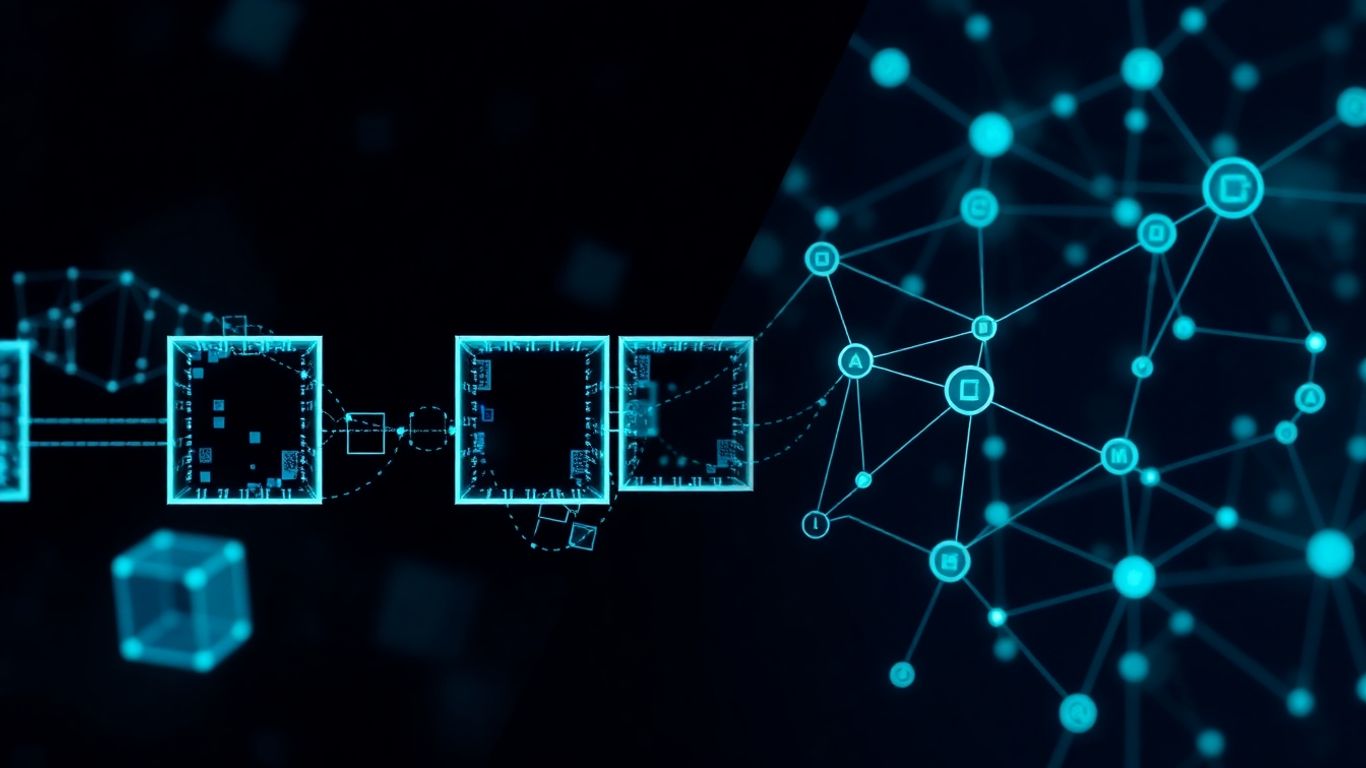
While blockchain is a well-known type of Distributed Ledger Technology (DLT), they aren’t exactly the same thing. Think of DLT as the broader category, and blockchain as a specific, very popular implementation within that category. Understanding these distinctions is important because it can affect how a system performs, who controls it, and what it’s best suited for. It’s not just a technicality; it has real-world implications for businesses looking to adopt these technologies.
Data Structure Flexibility
One of the most significant differences lies in how data is structured. Blockchains, by definition, organize data into blocks that are then linked together chronologically, forming a chain. This linear structure is a hallmark of blockchain. However, other DLTs can employ different data structures. For instance, some DLTs use Directed Acyclic Graphs (DAGs), which allow for more flexible arrangements and potentially parallel processing of transactions. This can lead to different performance characteristics compared to a traditional blockchain.
Sequencing and Ordering of Data
Related to data structure, the way data is ordered also varies. Blockchains enforce a strict, sequential order of blocks. Each new block is added to the end of the chain, creating an undeniable historical record. Some other DLTs might not require this rigid chronological sequencing. They might have different mechanisms for ordering transactions or data entries, which can impact how quickly new information is processed and validated across the network. This difference is quite important when considering applications that need very fast transaction finality.
The Role of Tokens and Permissions
Public blockchains, like Bitcoin or Ethereum, often feature native digital tokens or cryptocurrencies. These tokens are integral to their operation, often used for incentives or transaction fees. Many DLTs, especially those designed for enterprise use, are intentionally built without these native tokens. Their focus is purely on secure and efficient data management among known participants. Furthermore, permissioning differs. While blockchains can be public (permissionless) or private (permissioned), many DLTs are designed from the ground up as permissioned systems. This means access and participation are controlled, which is often preferred in business environments where privacy and regulatory compliance are key. For example, tracking the provenance of goods in the fashion industry often requires a permissioned system to ensure only authorized parties can update the ledger, as discussed in fashion industry solutions.
The choice between a blockchain and a more general DLT often comes down to the specific needs of an application. If a strict, chronological, and immutable chain is paramount, blockchain is a strong candidate. If flexibility in data structure, potentially faster transaction speeds through parallel processing, or a token-less, permissioned environment is desired, other DLTs might be more suitable. It’s about matching the technology’s characteristics to the problem you’re trying to solve.
Here’s a quick look at some key distinctions:
- Data Structure: Blockchain uses a linear chain of blocks; other DLTs can use different structures like DAGs.
- Ordering: Blockchains enforce strict chronological order; other DLTs may have more flexible ordering.
- Tokens: Public blockchains often have native tokens; many enterprise DLTs do not.
- Permissions: DLTs are frequently permissioned, designed for controlled environments, whereas blockchains can be permissionless or permissioned.
Shared Foundations: Where DLT and Blockchain Converge
While we’ve explored the distinctions, it’s equally important to recognize the common ground that DLT and blockchain share. These shared principles are what make both technologies so powerful and adaptable for a wide range of applications. Think of them as the bedrock upon which many innovative systems are built.
Distributed Architecture and Data Replication
At their core, both DLT and blockchain operate on a distributed model. Instead of a single, central database holding all the information, the data is spread across multiple computers or nodes in a network. This distribution means that copies of the ledger are held by many participants. When new information is added, it’s replicated across these nodes, creating a synchronized and consistent view for everyone involved. This redundancy is a key factor in their resilience.
- No Single Point of Failure: If one node goes offline, the network continues to function because other nodes have the data.
- Data Consistency: All participants see the same, up-to-date information, fostering a shared source of truth.
- Increased Security: Tampering with data on one node is unlikely to affect the entire network, as other nodes will hold the correct version.
The Power of Cryptography
Cryptography is the secret sauce that gives both DLT and blockchain their security and integrity. Complex mathematical algorithms are used to secure transactions, link data together, and verify the identity of participants. This cryptographic foundation makes it incredibly difficult for unauthorized individuals to alter records or introduce fraudulent data. The use of cryptographic hashing, in particular, is what allows for the creation of tamper-evident records.
Potential for Disintermediation
One of the most exciting aspects of DLT and blockchain is their ability to reduce or eliminate the need for intermediaries. In many traditional systems, third parties (like banks or clearinghouses) are required to facilitate transactions and build trust. DLT and blockchain can create a trusted environment directly between participants, allowing for more direct and efficient interactions. This can lead to:
- Reduced transaction costs.
- Faster processing times.
- Increased transparency in dealings.
The ability to establish trust directly between parties, without relying on a central authority, is a transformative capability. It opens doors for more peer-to-peer interactions and streamlined processes across various industries. This shift can redefine how businesses and individuals interact and transact.
Real-World Applications and Use Cases
DLT and blockchain technologies are moving beyond theoretical discussions and into practical, impactful applications across various sectors. Their ability to create secure, transparent, and immutable records is solving real problems and streamlining complex processes.
Transforming Financial Services
The financial industry, with its reliance on trust and complex transaction chains, is a prime area for DLT adoption. Cross-border payments, for instance, can become significantly faster and cheaper by reducing the need for multiple intermediaries. Imagine sending money internationally with the same ease and speed as a domestic transfer. DLT can digitize and automate trade finance workflows, placing all necessary documentation and approvals onto a secure, shared platform accessible to all parties involved – importers, exporters, and banks alike. This creates a single source of truth, simplifying reconciliation and reducing errors.
- Faster Settlements: Near real-time transaction finality.
- Reduced Costs: Eliminating intermediaries cuts down on fees.
- Improved Transparency: All authorized parties can view transaction status.
- Streamlined Compliance: Easier auditing and regulatory reporting.
Platforms like R3 Corda are specifically built for regulated environments, addressing friction points in trade finance and interbank processes where privacy and security are paramount. This technology is also paving the way for decentralized finance (DeFi), aiming to recreate traditional financial services like lending, borrowing, and trading using smart contracts, thereby cutting out traditional banks and brokers. Decentralized exchanges (DEXs) and automated market makers are already changing how assets are traded.
The potential for DLT to disintermediate traditional financial structures is immense, offering greater efficiency and accessibility, though regulatory frameworks are still evolving to keep pace with innovation.
Enhancing Supply Chain Management
Tracking goods through complex global supply chains has always been a challenge. DLT provides a shared, secure digital ledger that acts like an immutable shipping list. Every movement, certification, and handoff can be recorded and verified in real-time by authorized participants. This transparency helps in:
- Authenticity Verification: Proving the origin and legitimacy of products, from organic food to luxury goods.
- Improved Traceability: Pinpointing the exact location and history of items, which is vital for recalls or quality control.
- Reduced Paperwork: Automating processes and digitizing documentation.
- Increased Efficiency: Faster dispute resolution and smoother logistics.
Companies like Walmart have explored DLT for food safety, enabling farm-to-fork traceability. Initiatives like IBM Food Trust, built on Hyperledger Fabric, allow partners to track products, identify issues quickly, and build consumer trust. Similarly, platforms like VeChain allow brands to provide consumers with verifiable information about a product’s journey by simply scanning a QR code. This is particularly useful for fighting counterfeits and verifying ethical sourcing claims. For those looking to purchase quality vehicle parts, exploring options on boodmo.com can be a good starting point.
Securing Healthcare Data
Healthcare data is sensitive and highly regulated. DLT offers a way to manage patient records securely, giving individuals more control over their information. Instead of data being siloed in various hospital systems, a DLT could provide a secure, auditable trail of access and updates. This could:
- Improve Data Integrity: Ensuring medical records are accurate and haven’t been tampered with.
- Enhance Patient Privacy: Allowing patients to grant specific permissions for accessing their data.
- Streamline Research: Facilitating secure data sharing for clinical trials and research, with patient consent.
- Prevent Fraud: Making it harder to falsify medical histories or prescriptions.
While widespread adoption is still developing, the potential for DLT to create a more secure and patient-centric healthcare system is significant.
Innovations in Governance
DLT can bring new levels of transparency and accountability to governance. Public records, such as land titles or academic credentials, could be recorded on an immutable ledger, reducing fraud and simplifying verification. Some research is also exploring DLT for voting systems, aiming for greater transparency and auditability, though significant challenges related to voter privacy and identity verification remain. The ability to create tamper-proof records can fundamentally change how trust is established in various governmental and administrative processes.
Navigating the Landscape: Trends and Considerations
Interoperability and Evolving Trends
The world of DLT and blockchain is moving fast, and one of the biggest shifts we’re seeing is the focus on how different systems can talk to each other. It’s not about one single technology ruling everything anymore. Instead, the trend is towards making various blockchains and DLT networks work together. Think of it like different countries needing ways to communicate and trade – interoperability is the digital equivalent. This means assets, data, and even users can move more freely between these separate systems. Tools like specialized bridges and protocols designed for cross-chain communication are getting better, aiming to make these connections smoother. This interconnectedness is key to avoiding a fragmented digital future.
Cost-Effectiveness and Business Needs
When businesses look at DLT and blockchain, the initial excitement about new tech is often followed by a practical question: what’s the real return on investment? The days of investing just because it’s the ‘next big thing’ are fading. Companies are now concentrating on DLT solutions that clearly show tangible benefits, like cutting down on operational costs, making processes more efficient, or improving how they track goods. It’s not a one-size-fits-all situation. A private, permissioned DLT might be the smart choice for a company needing tight control and predictable costs, while a public blockchain could be better for open, collaborative projects. The important thing is to look closely at what you want to achieve and pick the technology that actually helps you get there, rather than just chasing trends.
Choosing the Right Technology for Your Business
So, how do you pick the right tool for the job? It really comes down to understanding your specific goals and the environment you operate in. Are you looking for maximum transparency and open access, or do you need strict controls and privacy? The structure of the ledger, who gets to participate, and whether you need tokens all play a part. For instance, if your business involves sensitive data and a limited set of trusted partners, a permissioned DLT might be more suitable and cost-effective. On the other hand, if you’re building a decentralized application that needs to be accessible to anyone, a public blockchain might be the way to go. It’s about matching the technology’s capabilities to your business requirements, not the other way around.
The landscape of distributed ledger technologies is maturing rapidly. As the initial hype subsides, a more pragmatic approach is emerging, focusing on practical applications, measurable results, and the ability of different systems to interact. Businesses are increasingly evaluating these technologies based on their specific needs, cost-effectiveness, and the potential for real-world impact, rather than simply adopting them for their novelty. This shift towards thoughtful implementation is paving the way for more sustainable and impactful uses of DLT and blockchain.
Wrapping It Up: DLT, Blockchain, and Your Next Steps
So, we’ve looked at Distributed Ledger Technology (DLT) and its most famous child, blockchain. Remember, DLT is the big umbrella, the general idea of a shared, synchronized digital record. Blockchain is a specific way to do that, using linked blocks in a chain. They share a lot, like being distributed and secure, but they aren’t the same. Think of it like vehicles and cars – all cars are vehicles, but not all vehicles are cars. Knowing this difference is key when you’re thinking about what tech might work for your business or project. The world of DLT is growing, with new ideas and uses popping up all the time. It’s not just about hype; it’s about finding the right tool for the job. Whether you’re leaning towards a flexible DLT or a structured blockchain, the important thing is to understand what you need and how these technologies can help you get there. Keep exploring, and don’t be afraid to ask questions as you figure out your path in this exciting digital landscape.
Frequently Asked Questions
What is the simplest way to understand the difference between DLT and blockchain?
Think of Distributed Ledger Technology (DLT) as a big family of ways to keep records. Blockchain is just one member of that family, like a specific type of car. It’s special because it organizes information in linked blocks, like pages in a diary that are all connected in order. Not all DLTs work this way!
Does ‘blockchain’ always mean public networks with digital money?
No, not at all. While famous blockchains like Bitcoin use digital money and are open to everyone, blockchains can also be private, meaning only certain people can join. Also, many DLT systems, including some private blockchains, are made for businesses and don’t use any digital money.
Is DLT or blockchain better for a business?
There isn’t one ‘best’ choice for every business. It really depends on what you need. If your business needs a private and efficient way to share information with trusted partners, a specific type of DLT might be perfect. If you need an open system for many users, a public blockchain might be better. It’s important to look at your goals and what you want to achieve.
How does blockchain keep information safe?
Blockchain keeps information safe by linking records together in a chain using special math codes called cryptography. Each new record is tied to the one before it, making it very hard to change past information without everyone noticing. It’s like a digital seal that shows if anything has been tampered with.
Can DLT and blockchain help businesses save money?
Yes, they can potentially save money in a few ways. Because everyone on the network has a copy of the same information, there’s less need to check and compare records between different groups. This can speed things up and reduce the work needed. Also, by making transactions more secure and transparent, they can help prevent fraud and mistakes.
What are some real-world uses for DLT and blockchain?
These technologies are being used in many areas. In finance, they can make sending money faster and cheaper. For businesses that make and sell products, they can track items all the way from where they are made to when they are sold. They can also be used to securely store important medical records or even help make voting systems more trustworthy.











