The workplace is changing fast. Artificial intelligence is showing up everywhere, and it’s got a lot of people wondering what’s next. Will computers take over all the jobs? Or will we find a way to work alongside them? This article looks at how AI is changing things and what that means for us, the humans. We’ll explore the good, the bad, and how we can all keep up.
Key Takeaways
- AI is getting really good at handling repetitive tasks and processing lots of information quickly, which can free up people for other work.
- While AI can do many things, it still can’t match human creativity, empathy, and complex decision-making.
- The future likely involves humans and AI working together, with AI acting as a tool to help people do their jobs better.
- People will need to learn new skills to work effectively with AI, focusing on things AI can’t do.
- It’s important to think about the ethical side of AI and make sure its development helps people, not the other way around.
Understanding The AI Revolution In The Workplace
The Evolution Of AI: From Concept To Reality
Artificial intelligence, once a concept confined to science fiction and academic labs, has rapidly become a tangible force in our daily professional lives. It’s not just a futuristic idea anymore; AI systems are actively reshaping how we work, communicate, and create. Think back just a few years – AI was mostly about simple automation. Now, it’s about systems that can learn, adapt, and even generate novel content. This shift from theoretical possibility to practical application has been swift, driven by advances in computing power, data availability, and sophisticated algorithms.
AI’s Impact On Today’s Job Market
The presence of AI in the workplace today is undeniable and growing. We see it in customer service chatbots handling routine queries, in software that helps draft emails or reports, and in tools that analyze vast amounts of data far quicker than any human team could. This isn’t about AI taking over entirely, but rather about it becoming a partner in many tasks. For instance, AI can process thousands of documents in minutes, freeing up human workers to focus on more complex problem-solving and creative thinking. This has led to a noticeable change in job roles, with some tasks becoming automated while new opportunities arise in areas like AI management and data interpretation.
| Area of Impact | Examples |
|---|---|
| Customer Service | AI chatbots handling 80% of routine inquiries |
| Content Creation | AI generating initial drafts and suggesting improvements |
| Data Analysis | Real-time analysis of complex datasets |
| Internal Communication | Summarizing emails, scheduling meetings |
Can AI Truly Replicate Human Cognition?
This is the million-dollar question, isn’t it? While AI can perform specific tasks with incredible speed and accuracy, replicating the full spectrum of human cognition remains a significant challenge. AI excels at pattern recognition and data processing, but it lacks the nuanced understanding, emotional intelligence, and subjective experience that define human thought. AI can process information, but it doesn’t ‘understand’ in the way humans do. It can mimic creativity based on existing data, but genuine originality and intuitive leaps are still firmly in the human domain. The current state of AI is more about sophisticated calculation and prediction than true consciousness or self-awareness.
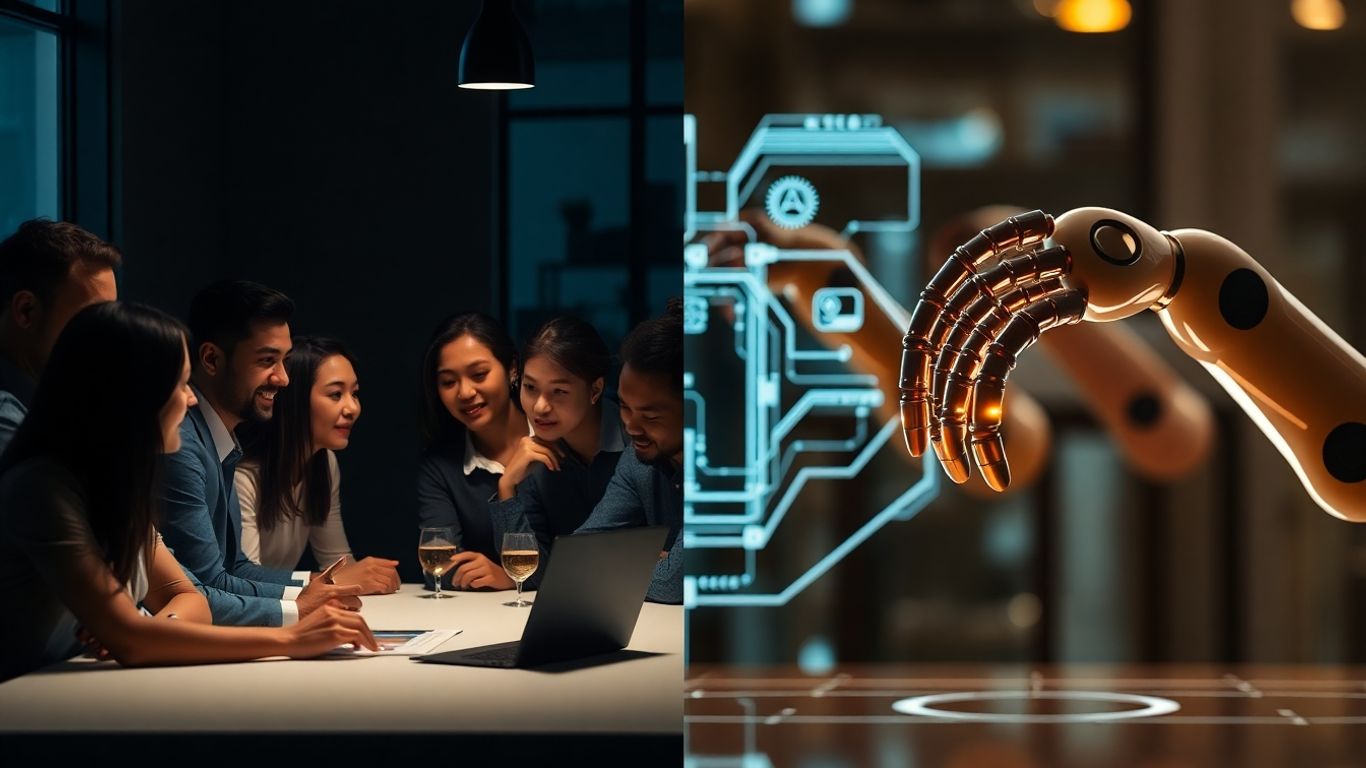
The rapid integration of AI into the workplace presents both opportunities and challenges. While AI offers unprecedented efficiency in handling repetitive tasks and analyzing data, it is not yet capable of replicating the full breadth of human cognitive abilities, particularly in areas requiring empathy, complex judgment, and true creativity. The focus, therefore, is shifting towards how humans and AI can work together, each contributing their unique strengths.
Humans Or AI: The Strengths And Limitations
When we look at the capabilities of Artificial Intelligence and human intelligence, it’s not really about one being ‘better’ than the other. Instead, it’s more about understanding where each shines and where they might stumble. Think of it like comparing a super-fast calculator to a seasoned artist – both are incredibly skilled, but in very different ways.
Human Adaptability Versus AI’s Data-Driven Learning
Humans have this amazing knack for learning from just a little bit of information. We can see something once, maybe hear a story, and then figure out how to do it ourselves. Our learning isn’t confined to a classroom or a specific set of instructions; it’s a constant, flexible process shaped by everything around us – our friends, our culture, and our own life experiences. This makes us really good at figuring things out in new or tricky situations.
AI, on the other hand, usually needs a whole lot of data to learn. It’s like a student who needs to read hundreds of books to understand a single concept. While AI can get really good at specific tasks very quickly when it has enough data, it often struggles when faced with something it hasn’t seen before. It’s not as good at taking what it learned in one area and applying it to a completely different one without a lot of retraining.
Where Human Intelligence Remains Unmatched
There are certain areas where humans are still way ahead of AI, and probably will be for a long time. One of the biggest is creativity and genuine innovation. While AI can generate art or music based on patterns it’s learned, it doesn’t have the spark of original thought that comes from personal experience, intuition, or a desire to express something unique. It’s like the difference between a perfect copy and an original masterpiece.
Another key area is emotional intelligence and empathy. AI can be programmed to recognize emotions in text or speech, but it can’t actually feel them. It can’t understand the subtle nuances of human interaction, build deep relationships, or make decisions that truly consider the emotional impact on others. This ability to connect and understand on a human level is something AI simply can’t replicate.
AI’s Superiority In Speed And Precision
Now, let’s talk about where AI really blows us out of the water. When it comes to processing massive amounts of information and performing repetitive tasks with incredible speed and accuracy, AI is the undisputed champion. Think about analyzing millions of financial records in seconds or performing complex calculations without a single error – AI does this effortlessly.
Here’s a quick look at some areas where AI excels:
- Data Analysis: Processing and finding patterns in huge datasets far faster than any human.
- Repetitive Tasks: Performing routine jobs with consistent accuracy, reducing human error.
- Complex Calculations: Executing mathematical operations that would take humans hours or days.
- Pattern Recognition: Identifying subtle patterns in images, sounds, or data that might be missed by the human eye.
AI’s strength lies in its logical, data-driven approach. It doesn’t get tired, bored, or distracted. This makes it perfect for tasks that require unwavering focus and a high degree of precision, especially in fields like scientific research, quality control, and complex simulations.
While AI can perform tasks with remarkable speed and accuracy, it often lacks the context and understanding that humans bring. Human judgment, especially in ambiguous or ethically complex situations, remains a vital component that AI cannot yet replicate. The goal isn’t to replace humans, but to find ways for these different strengths to work together.
The Future Of Work: Collaboration, Not Competition
It’s becoming clear that the conversation around AI in the workplace isn’t about humans versus machines. Instead, the most productive path forward involves a partnership. Think of AI as a really smart assistant that can handle the heavy lifting, freeing up human workers to focus on what they do best.
AI As A Tool To Amplify Human Capabilities
AI’s ability to process vast amounts of data and perform repetitive tasks at incredible speeds is a game-changer. This doesn’t mean jobs disappear; it means job roles evolve. For instance, in customer service, AI can handle initial queries and gather information, allowing human agents to step in for complex issues requiring empathy and problem-solving.
- Automating routine tasks: AI can manage scheduling, data entry, and basic report generation.
- Providing insights: AI can analyze trends and patterns in data that humans might miss.
- Personalizing experiences: AI can help tailor content and recommendations for customers and employees.
The real advantage comes when AI handles the predictable, allowing humans to focus on the unpredictable.
Finding The Optimal Balance Between Humans And AI
Striking the right balance is key. It’s not about letting AI take over completely, nor is it about ignoring its potential. It’s about creating workflows where AI and human intelligence complement each other.
Organizations are learning that the most effective approach isn’t to let AI run unchecked but to create hybrid workflows where AI handles the heavy lifting while humans provide strategic direction and quality control. This balance is crucial for maintaining both efficiency and excellence.
Consider these points for achieving that balance:
- Define clear roles: Understand which tasks are best suited for AI and which require human oversight.
- Implement feedback loops: Allow human workers to correct and refine AI outputs, improving accuracy over time.
- Prioritize human judgment: For critical decisions, especially those involving ethics or complex human factors, human input remains indispensable.
The Rise Of Hybrid Workflows
Hybrid workflows are the natural outcome of this collaborative approach. They blend automated processes with human oversight, creating systems that are both efficient and adaptable. This might look like:
- AI-powered research followed by human analysis: AI can gather and summarize information, but a human analyst provides context and strategic interpretation.
- Automated content generation with human editing: AI can draft reports or marketing copy, which a human then reviews for tone, accuracy, and brand alignment.
- AI-assisted design with human creativity: AI can generate design options based on parameters, but a human designer makes the final creative choices and refinements.
This integration means that the future of work is less about competition and more about creating a synergistic environment where both human and artificial intelligence contribute to greater productivity and innovation.
Navigating The AI-Augmented Workforce
The Skills Evolution For An AI-Integrated Future
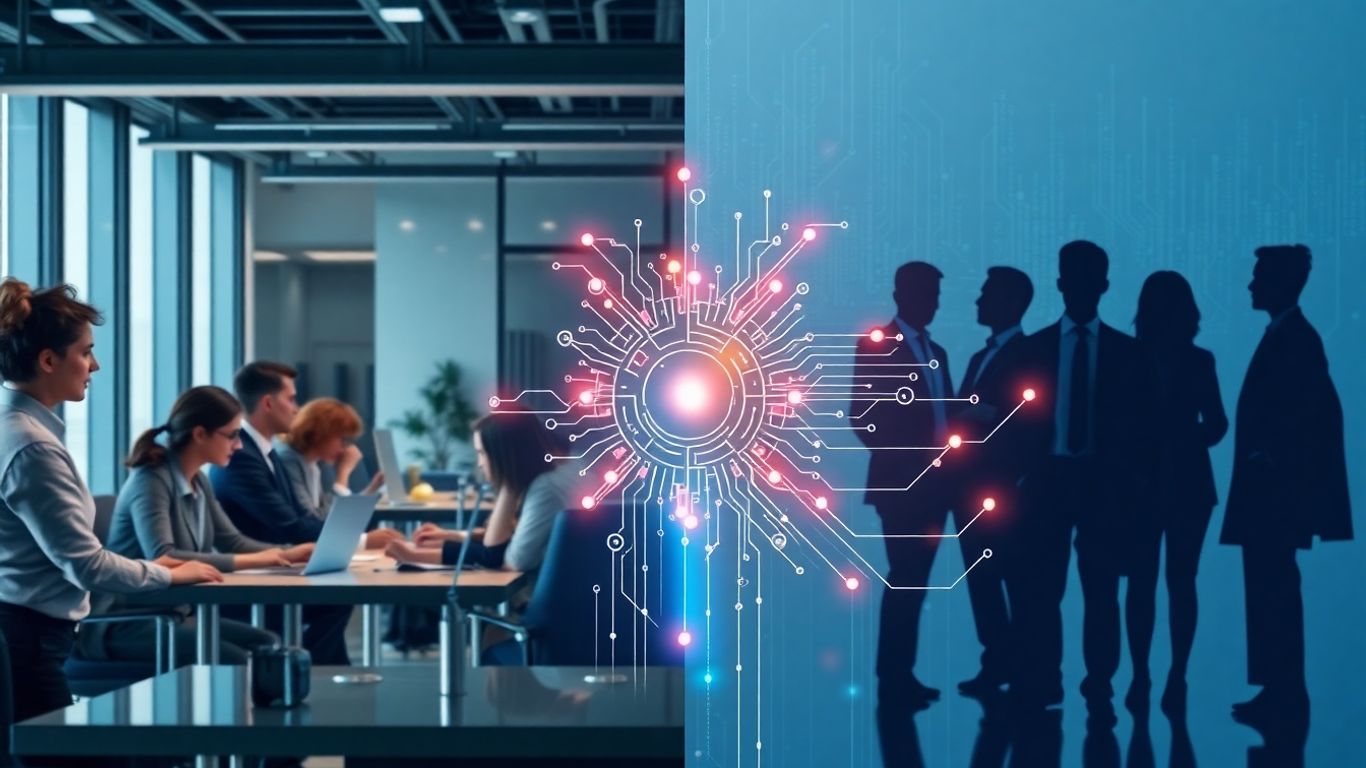
As AI becomes more common in our work lives, the skills we need are changing. It’s not about competing with AI, but learning to work with it. Think of it like this: AI can do the heavy lifting, like sorting through huge amounts of data or writing a first draft of a report. But humans are still needed for the thinking part – the strategy, the creative ideas, and making sure everything makes sense.
The most successful people will be those who can guide AI effectively and bring their unique human talents to the table. This means understanding how to ask AI the right questions (sometimes called prompt engineering) and knowing what AI is good at and where it falls short.
Upskilling And Reskilling For The Modern Worker
To keep up, workers need to learn new things. Many companies are offering training programs to help people get comfortable with AI tools. These aren’t just about learning to click buttons; they’re about understanding how AI works and how to use its results wisely.
Here are some ways workers can adapt:
- Continuous Learning: Use online platforms that offer short courses on new skills. These platforms can even suggest what you should learn next based on job trends.
- Be Open to New Tasks: Try working on different kinds of projects, even if they seem challenging at first. Experimenting with new tools helps you learn.
- Use AI for Your Own Growth: Some AI tools can help you figure out what skills are in demand and what career paths might be good for you.
Adapting to new tools and ways of working isn’t just a good idea anymore; it’s becoming necessary for staying relevant in the job market.
Cultivating Essential Human Skills Alongside AI
While learning to use AI is important, we also need to remember what makes us human. Skills like creativity, problem-solving, and understanding how other people feel are things AI can’t easily replicate. These are the skills that will help us do the jobs AI can’t.
For example, AI can write a report, but a human needs to decide if the report’s conclusions are sound and if they align with the company’s goals. AI can help with customer service, but a human is often needed to handle a really upset customer with empathy.
It’s about finding a balance. We use AI for its speed and efficiency, but we rely on human judgment, creativity, and emotional intelligence for the things that truly matter.
Ethical Considerations And The Human Element
As we bring AI more into our daily work, we have to stop and think about the bigger picture. It’s not just about what AI can do, but how it affects us and the world around us. We need to make sure AI helps us, not harms us.
Maintaining Quality In An Age Of AI-Generated Content
AI can churn out text, images, and even code at an incredible speed. This is great for getting things done quickly, but it also brings up questions about quality. When AI creates content, it’s based on patterns it learned from huge amounts of data. This means it might miss the subtle nuances, the personal touch, or the deep understanding that a human brings. Think about a news article written by AI versus one written by a journalist who has actually investigated the story. The AI might get the facts right, but it might lack the human perspective that makes the story truly meaningful.
- Accuracy Checks: AI-generated content needs a human eye to verify facts and context.
- Originality Concerns: We must be mindful of AI potentially repeating biases or unoriginal ideas from its training data.
- Authenticity: Does the content feel genuine, or does it sound like a machine wrote it?
The Importance Of Human Judgment And Empathy
AI is really good at processing data and following rules. But when it comes to making decisions that involve feelings, ethics, or complex social situations, humans are still way ahead. AI doesn’t feel empathy or understand the emotional weight of a decision. For example, an AI might suggest the most statistically efficient way to handle a customer complaint, but a human can understand the customer’s frustration and offer a more compassionate solution.
Human judgment involves more than just logic; it includes intuition, lived experience, and the ability to connect with others on an emotional level. These are qualities that AI currently cannot replicate.
Ensuring AI Development Aligns With Human Values
As AI gets more powerful, it’s important that the people building it are thinking about what’s right and wrong. AI learns from the data we give it, and if that data has unfairness or prejudice in it, the AI can learn those bad habits too. This can lead to AI systems making unfair decisions in areas like hiring or loan applications. We need to be careful and thoughtful about how AI is developed and used, making sure it reflects the best of human values, not the worst.
Here’s a look at some key areas:
- Bias Detection: Actively looking for and removing bias from AI training data.
- Transparency: Understanding how AI makes its decisions.
- Accountability: Knowing who is responsible when an AI makes a mistake.
- Fairness: Making sure AI systems treat everyone equitably.
The Road Ahead: Humans and AI Working Together
So, where does all this leave us? It’s pretty clear that AI isn’t going to completely take over. Instead, think of it more like a really smart assistant. AI is fantastic at crunching numbers, spotting patterns, and handling those repetitive tasks that nobody really enjoys. This frees us up to do the stuff that really matters – the creative thinking, the problem-solving that needs a human touch, and building those important relationships. The future of work isn’t about picking sides; it’s about finding that sweet spot where AI’s speed and our human insight can work hand-in-hand. The real winners will be those who learn to use AI as a tool to make their own abilities even stronger, keeping the human element at the heart of everything we do.
Frequently Asked Questions
Will computers that think, called AI, take away all our jobs?
AI is really good at doing tasks that are the same over and over, like sorting information or doing math really fast. This means some jobs might change or disappear. But, AI is also helping create new jobs, especially in areas like building and managing AI. Plus, AI can help people do their jobs better, not just replace them. Think of it like a helpful tool.
What are humans better at than AI?
Humans have special skills that AI can’t easily copy. We’re great at being creative, understanding how others feel (that’s empathy!), and figuring out what’s right and wrong (ethics). We can also learn new things from just a little bit of information and handle situations that are totally new or confusing. AI needs lots of data and clear rules.
How can people and AI work together in the future?
The best way for people and AI to work together is by playing to their strengths. AI can handle the boring, repetitive stuff and crunch lots of numbers quickly. This lets people focus on the exciting parts like coming up with new ideas, making important decisions, and connecting with others. It’s like having a super-smart assistant.
What new skills will people need for jobs with AI?
As AI becomes more common, people will need to learn how to work with it. This means understanding how to tell AI what to do (like giving good instructions), knowing how to check the work AI does, and getting even better at those human skills like creativity, problem-solving, and understanding emotions. Learning how AI works, even a little, will be important.
Is it possible for AI to make mistakes or be unfair?
Yes, AI can make mistakes. Since AI learns from the information we give it, if that information has mistakes or shows unfairness, the AI can learn those bad habits too. That’s why it’s super important for people to watch over AI, make sure it’s fair, and use their own good judgment, especially when making big decisions.
Will AI make work less interesting if it does all the hard parts?
While AI can handle many tasks, the goal isn’t to make work boring. Instead, AI can take away the dull, repetitive parts, allowing people to spend more time on the parts of their job that are creative, strategic, and more rewarding. This can actually make work more interesting by letting people use their unique human talents more often.