Tired of bad decisions? You make 35,000 choices daily, but your brain is riddled with biases. Here we have mentioned 10 critical thinking exercises that boost cognition, slash errors, and future-proof your career. Outsmart uncertainty and master the top skill CEOs demand.

Ever made a quick decision that felt right at the time and then later thought, “What was I thinking?” The gap between instinct and insight is where critical thinking exercises become valuable.
It’s less about being clever and more about being curious. It involves noticing assumptions, asking better questions, and testing ideas before committing to them.
Research suggests the average person makes about 35,000 conscious decisions each day, from what to eat to how to vote. Meanwhile, a 2024 Deloitte survey found that 62% of business leaders feel “analysis fatigue.” They feel overwhelmed by the amount of information they have to evaluate before making a choice.
Adding to that, the World Economic Forum’s 2025 Future of Jobs report ranks critical thinking and problem-solving as the top two skills employers will want through 2030.
Critical thinking exercises help cut through this noise. It makes a difference between reacting on instinct and reasoning with evidence, as well as between chasing every flashy new idea and focusing on what really matters. The good news is that, like any muscle, it gets stronger with regular practice.
What is critical thinking, and why does it matter?
Critical thinking isn’t just being doubtful of everything or arguing for the sake of arguing. At its core, it’s about using logic and staying open-minded about the world around you. It involves questioning assumptions, evaluating evidence, recognising bias (including your own), and forming strong arguments. Mainly, it helps you to:
- Make better decisions
- Solve tough problems
- Identify faulty logic and misleading claims
- Think creatively and flexibly
It’s like keeping your body fit; the more you exercise your mind, the sharper it becomes.
10 Critical Thinking Exercises
1) The Ladder Check
Time: about 10 minutes | Best for: solo reflection, quick decisions
Do this:
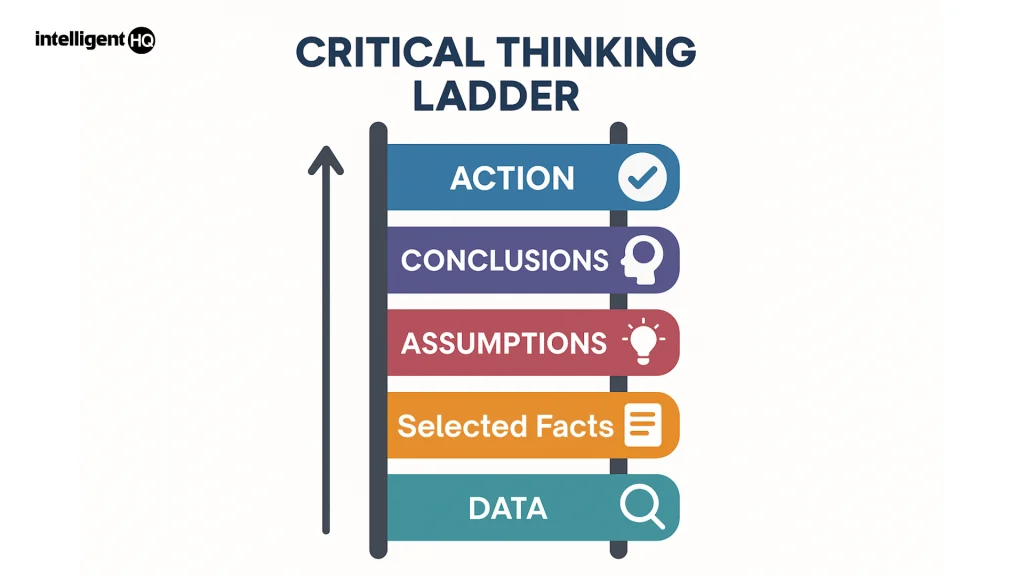
Draw five rungs on a sheet of paper, labelling them Data → Selected Facts → Assumptions → Conclusions → Action.
- Data: Write only what you directly observe (numbers, quotes, raw events).
- Selected facts: Note which pieces of data you paid attention to.
- Assumptions: List the hidden beliefs or inferences you made (“the client is unhappy”, “they ignored my email”).
- Conclusions: State the decision or judgment you reached.
- Action: Record what you plan to do next.
Why it works: Most flawed decisions come from jumping straight from raw data to action. The ladder slows you down and makes invisible thinking visible.
Reflection prompt: Which assumption, if disproved, would overturn your conclusion? How could you check it?
2) The Five Whys
Time: about 10 minutes | Best for: solo analysis or small teams
Do this:
- State the problem in one sentence, using neutral language.
- Ask “Why?” and answer with evidence.
- Take that answer and ask “Why?” again.
- Continue at least five rounds—or until you reach a cause you can control.
Example: Renewals are falling → Why? → Usage down 20% → Why? → New feature confusing → Why? → No onboarding update → Why? → Training budget cut.
Why it works: Each “why” strips away surface symptoms and gets you to the root cause.
Reflection prompt: At which “why” did you first feel defensive or uncomfortable? That’s often the real source of the issue.
3) Inversion Hour
Time: 15–30 minutes | Best for: strategic planning
Do this:
Flip the objective. Instead of asking “How do we succeed?”, ask “How could we guarantee failure?” Brainstorm every disaster scenario, from minor slip-ups to full-scale collapse. Once the list is long, invert each entry into a safeguard or action step.
Why it works: By looking for ways to fail, you surface hidden risks and blind spots you might otherwise miss.
Reflection prompt: Which single “failure move” feels most plausible? What immediate action could neutralise it?
4) Argument Mapping
Time: around 25 minutes | Best for: preparing presentations or debates
Do this:
- Write the conclusion on the far right of a page or digital canvas.
- To the left, add premises, each reason supporting the conclusion.
- Under each premise, add evidence (data, citations, examples).
- Draw arrows to show how the premises connect.
- Use a different colour to add counter-arguments or rebuttals.
Why it works: Seeing the structure exposes weak links, missing evidence and circular reasoning.
Reflection prompt: Which premise relies on a single source or personal anecdote? How can you strengthen or drop it?
5) Fact vs Opinion Sort
Time: 10 minutes | Best for: news reading, report analysis
Do this:
Take a short article, email, or meeting note. Highlight:
- Facts (verifiable statements),
- Opinions (value judgements),
- Inferences (interpretations that may or may not hold).
Why it works: It sharpens your information filter so you don’t mistake someone’s viewpoint for objective truth.
Reflection prompt: Which statement looked factual at first but turned out to be an opinion? What evidence would you need to confirm or reject it?
6) Decision Tree Lite
Time: 20–30 minutes | Best for: medium-stakes choices
Do this:
- Draw branches for each option you’re considering.
- Under each branch, list likely outcomes and rough probabilities.
- Note the upside, downside, and reversibility of each path.
Why it works: It forces you to picture tomorrow’s consequences today, making trade-offs clearer.
Reflection prompt: Which option has the smallest downside, meaningful upside, and is easiest to reverse? That’s usually the sensible default.
7) Socratic Circle
Time: 30–45 minutes | Best for: group exploration of a text or issue
Do this:
- Sit in a circle with a short text, question, or case study.
- For the first 10 minutes, only questions may be asked, no answers or statements.
- Afterwards, move to discussion, grounding each point in the text or agreed-upon evidence.
Why it works: Curiosity replaces quick opinions and teaches people to listen before asserting.
Reflection prompt: Which question shifted your own understanding the most?
8) Reverse Brainstorm
Time: about 15 minutes | Best for: team risk assessment
Do this:
Instead of asking “How do we solve this problem?”, ask “How could we make it worse?” Collect every mischievous idea. Once the list is full, reverse each suggestion into a preventative measure or creative solution.
Why it works: It normalises talking about failure and highlights weak spots early.
Reflection prompt: Which single preventive step from your reversed list offers the biggest reduction in risk?
9) Dilemma Lab
Time: 20–30 minutes | Best for: ethics, policy, or leadership issues
Do this:
- Present a real or hypothetical ethical conflict (e.g., privacy vs. personalisation).
- Identify the values in tension and the stakeholders affected.
- Map possible actions, listing pros, cons, and non-negotiables for each.
- Discuss acceptable side-effects and safeguards.
Why it works: You practise principled reasoning where there is no simple “right answer”.
Reflection prompt: Could you explain your chosen option to a neutral outsider or in public without embarrassment?
10) Pros / Cons / Unknowns
Time: about 10 minutes | Best for: everyday decisions
Do this:
Create three columns: Pros, Cons, and Unknowns & How to Learn. Fill them quickly and honestly. For each unknown, note the cheapest way to gather evidence—an email, a quick test, a data pull.
Why it works: It turns uncertainty into an action plan and stops analysis paralysis.
Reflection prompt: What single experiment would most reduce the biggest unknown?
Why are critical thinking exercises important?
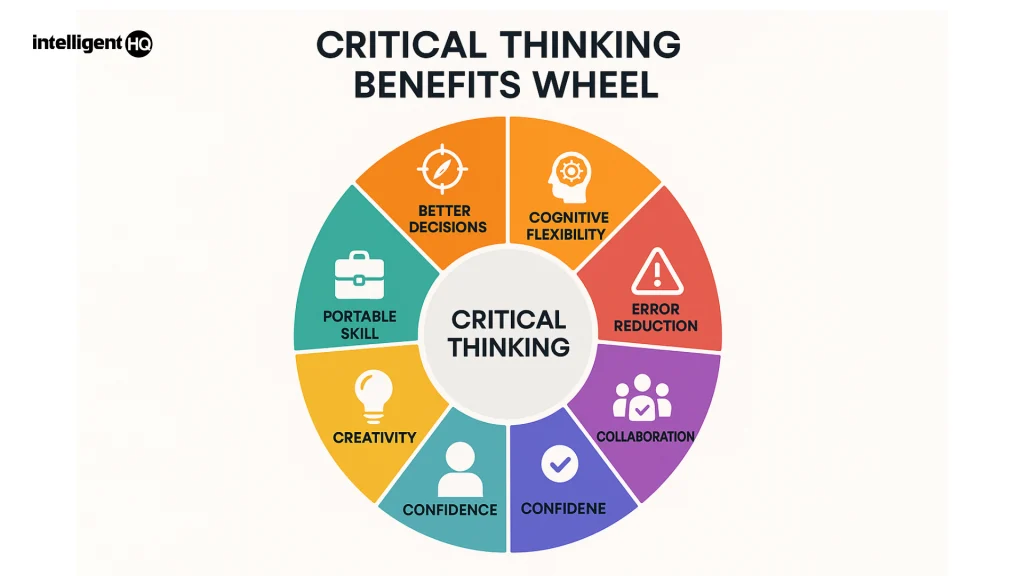
- They make thinking visible. Once ideas leave your head and hit the page, you can test them. Methods like argument maps or decision trees reveal leaps, gaps, and biases you can’t spot mentally.
- They create cognitive flexibility. Switching roles, flipping problems, or arguing the opposite stretches how you frame issues, vital when conditions change quickly.
- They reduce costly errors. Pre-mortems, inversions, and Five Whys uncover failure modes early, when fixes are cheap and reputations intact.
- They improve collaboration. Shared tools (Socratic Circles, Dilemma Labs) give teams a common language for evidence, values, and trade-offs, less grandstanding, more progress.
- They build confidence without arrogance. When you can show your working, you’re open to being wrong without feeling threatened. That’s a powerful cultural shift.
- They strengthen creativity. Constraint-based tasks (Reverse Brainstorm, Inversion) break stale patterns and surface unusual, often better, solutions.
- They travel well. Whether you’re a student, founder, manager, or parent, the same habits help: clarify, test, decide, learn.
How to develop critical thinking skills
Think of this as a training plan: small, consistent sets beat one-off heroics.
1) Adopt two daily micro-habits (under two minutes each)
- One-Sentence Summary: After any meeting or article, summarise the core point in one sentence. If you can’t, you didn’t quite get it.
- Evidence Tag: When making a strong claim, add: “My evidence is…”. If it’s thin, pause or label it as opinion.
2) Pick a weekly deep exercise
Choose one from the ten above, rotate them:
- Week 1: Ladder Check on a decision that matters.
- Week 2: Decision Tree Lite for a medium-risk choice.
- Week 3: Reverse Brainstorm with your team.
- Week 4: Dilemma Lab on a live policy or product question.
3) Build a shared toolkit at work or study
- Light templates: One-page decision tree, Five Whys sheet, pros/cons/unknowns table.
- Shared glossary: Define slippery terms like “quality”, “security”, “impact”.
- Norms: Celebrate good questions; separate ideas from identities; write before debate.
4) Journal your learning (10 minutes weekly)
Note: the decision, the tool used, what changed, and what you’d do differently next time. Reflection is where skills compound.
5) Practise bias awareness without blame
Run a monthly “bias clinic”: choose one bias (confirmation bias, sunk-cost fallacy, halo effect), share a short explainer, and invite examples from real work. Focus on systems, not shaming.
6) Calibrate effort to stakes
Don’t bring a sledgehammer to a thumbtack. Use quick drills for low-stakes choices; deploy full mapping and trees for high-impact, hard-to-reverse decisions.
7) Combine feelings and facts
Borrow from Six Thinking Hats: do a quick pass for facts (White), feelings (Red), risks (Black), benefits (Yellow), ideas (Green), and process (Blue). You’ll cover more ground, faster, and reduce “we forgot to ask…” moments.
Final thoughts
Critical thinking exercises are not about being the smartest person in the room; they focus on clarity. The exercises mentioned above are simple, repeatable, and surprisingly satisfying. They help you slow down enough to understand what is really happening, consider it carefully, and act with purpose.
Start small. This week, try Ladder Check, Pros/Cons/Unknowns, and one team drill. Reverse Brainstorm is a crowd-pleaser. Record what you learn. Then keep practising. With some effort, you will notice fewer avoidable mistakes, stronger arguments, calmer decisions, and, best of all, a mind that is harder to deceive, especially by itself.