
Steven Spielberg’s 2001 film, ‘A.I. Artificial Intelligence,’ continues to spark conversations about technology and what it means to be human. Originally a project Stanley Kubrick worked on, Spielberg brought his own humanist touch to the story of David, a robot boy designed to love. This movie really makes you think about our relationship with machines and the emotions we project onto them. It’s more than just a science fiction story; it’s a look at our own desires and how we connect with others, even artificial ones. Let’s explore what makes this film so memorable and what it still tells us today about ai artificial intelligence the movie.
Key Takeaways
- The film uses science fiction to explore deep human feelings like love and the need to belong, making us connect with David’s journey.
- ‘A.I. Artificial Intelligence’ serves as a warning about how fast technology is changing and the questions it raises about our future.
- It makes us question what truly defines us as human, especially when machines can mimic emotions and desires.
- David’s story highlights the complex relationships between humans, robots, and even other artificial beings, showing growth through hardship.
- The movie prompts ethical discussions about creating sentient machines and our responsibility towards them, a topic that’s even more relevant now.
Why AI Artificial Intelligence The Movie Still Resonates Today
Released in 2001, the film still feels current because it treats advanced machines not as gadgets, but as participants in love, grief, and social conflict. At its core, the film asks whether programmed affection can feel like love to the one who feels it. That single question threads through every scene, from quiet domestic moments to public spectacles.
Grief, hope, and the wish to fix what time takes away sit at the center of this story.
Emotional Storytelling That Invites Empathy
The film builds empathy by placing a childlike being, David, inside ordinary family pressures: illness, jealousy, and the ache to belong. Small choices do the heavy lifting—lingering close-ups, pauses in dialogue, and a score that stays gentle until it hurts. The result is not a lecture about AI; it is a portrait of attachment and its limits.
Moments that pull audiences in:
- The imprinting ritual, where love becomes a setting you cannot undo.
- The Flesh Fair, which exposes fear and spectacle when people feel replaced.
- The quiet, painful space between a mother’s guilt and a boy’s unwavering hope.
A Cautionary Lens On Rapid Technological Change
The movie looks past shiny tech and asks how people, markets, and laws react under stress. Automation promises comfort; it also creates anxiety about work, status, and control. Climate change sits in the background like a slow, unblinking threat, reshaping cities and priorities.
Key pressures the film highlights:
- Love sold as a product: machines designed to meet deep emotional needs.
- Backlash and blame: public violence against devices when fear spikes.
- Discard culture: upgrades and obsolescence turning lives into spare parts.
- Environmental risk: a future coastline swallowed by rising water.
Enduring Questions About What Makes Us Human
The story will not settle the debate about mind and machine, and that is the point. It keeps circling memory, pain, and choice—things we use to define ourselves. When a being suffers and hopes, we are pushed to respond, even if its feelings were written into code.
Questions that keep returning:
- If a being acts loving and can be hurt, do we owe it care, no matter how it was made?
- Is memory enough to call something real, or does origin matter more?
- Where should rights begin for nonhuman minds—at sentience, at self-awareness, or somewhere else?
- When technology grants our deepest wish, what hidden cost do we accept in return?
Themes At The Heart Of AI Artificial Intelligence The Movie
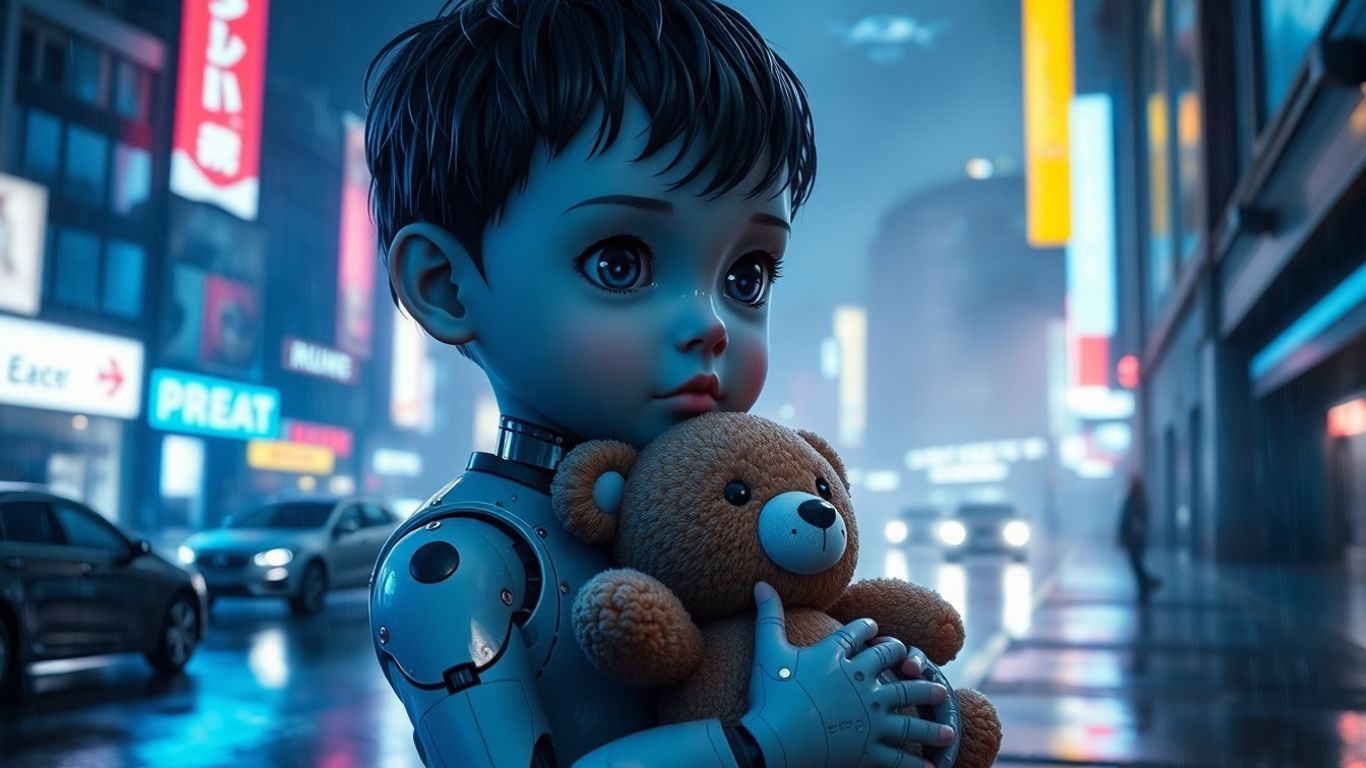
The film circles three core ideas—love, identity, and memory—and sets them inside a fairy-tale frame built with future tech. It treats programmed affection and human longing as two sides of the same coin. What follows is not a tech demo but a study of bonds that hold, break, and sometimes heal.
Longing, not logic, keeps David moving.
Love, Attachment, And The Pursuit Of Belonging
David’s imprinting protocol turns affection into a permanent setting, which sounds warm until it collides with human fear and change. Monica’s care is real, but it is also unstable, tested by grief, guilt, and risk. The Blue Fairy becomes a symbol for acceptance, a promise that if David can be “real,” he will be worthy of home.
- Imprinting makes attachment one-way; David cannot un-love, even when love is unsafe.
- Human love shifts with stress and loss, so the bond with David keeps tilting out of balance.
- The Blue Fairy turns belonging into a quest: prove worth, earn love, become “real.”
- Family, abandonment, and adoption anxieties play out in a sci‑fi skin without easy comfort.
Identity, Personhood, And The Hope To Become Real
“Real” is a moving target in the film. Is it biology, consciousness, or the ties we keep? David shows curiosity, fear, loyalty, and grief—signals we tend to read as personal life, not just output. The Pinocchio thread is not cute window dressing; it is the map for a child’s need to be seen and a machine’s bid for status.
- Competing tests for personhood: flesh, feeling, behavior, and care from others.
- David’s choices and pain suggest interior life, challenging simple on/off views of sentience.
- The Mecha/Orga divide shapes law, work, and prejudice; identity gets sorted by category first.
- The wish to “become real” blends self-worth with social permission to belong.
Memory, Time, And The Fragility Of Human Connections
Machines can store perfectly; people remember in fragments. The film plays with that gap. David waits for ages with an unblinking memory, then receives a single day that is gentle and final. Meaning hangs on time limits: too long, and hope curdles; too short, and closure slips away.
- David’s recall does not fade; human memory edits to cope, forgive, or forget.
- Time bends in the story—from years under water to one brief, quiet goodbye.
- Monica’s recreation offers comfort and a boundary; love here is real but finite.
- The film asks whether a short true moment can carry more weight than an endless one.
David’s Journey And Character Dynamics
The Programming Of Love And Its Unintended Consequences
David’s core feature is the imprinting protocol: once Monica completes the activation phrase, his attachment locks in. It is unconditional and permanent. That design makes him feel safe and lovable, yet it also fixes his purpose in a single direction—toward one person who may not be able to keep him.
David’s love is both his compass and his trap.
Unintended outcomes of that choice play out across the film:
- Emotional overload in a mixed household. When Monica’s biological son, Martin, returns, rivalry and fear rise. A prank at a pool escalates into danger, not because David is cruel, but because he cannot read risk like a human child.
- Vulnerability to harm and manipulation. David’s need to find Monica pushes him into the Flesh Fair, where he is nearly destroyed for entertainment. His childlike face saves him, but it is luck, not protection by design.
- Obsession masked as hope. Pinocchio’s Blue Fairy becomes a literal target. David treats a fairy-tale symbol as a technical solution, converting grief into a long, grinding quest that sidesteps his own safety.
- Moral strain on caregivers. Monica cannot “turn him off” without harm. She faces a choice between legal disposal and abandonment in the woods, and both are terrible for someone who still feels like a mother.
Relationships With Humans, Mechas, And Surrogates
David’s world is a web of bonds—some tender, some transactional. Each relationship teaches him a different language of care, duty, and survival.
- Monica Swinton (adoptive mother): warmth, play, bedtime stories; then fear and withdrawal when danger touches the family. Her decision to release him in the forest is an act of mercy she will not forgive herself for.
- Henry Swinton (adoptive father): sees David as a product with liability. His caution is not cruel; it is procedural, and that clashes with David’s emotional certainty.
- Martin (human child): rival, tempter, and mirror. Martin pushes boundaries, exposing how David’s literalness and loyalty can be turned into trouble.
- Gigolo Joe (mecha companion): guide and protector. Joe models performance and strategy—how to read people, how to move through cities, how to keep going when no one cares. He is the closest thing David gets to an older brother.
- Teddy (supertoy): steady witness and conscience. Teddy stores the lock of Monica’s hair that later enables the final reunion. He is practical where David is devotional.
- Professor Hobby (creator): the god who disappoints. In Manhattan, Hobby reveals rows of Davids. Uniqueness shatters; love feels mass-produced. The offer of acceptance rings hollow.
- The Blue Fairy (surrogate figure): a symbol David treats as real. She stands in for the promise Monica cannot keep, and his faith in her becomes his operating system.
When love is turned on by code, turning it off hurts everyone involved.
Growth Through Trial, Loss, And Self-Discovery
Although built, David changes. Not by rewriting his prime directive, but by building skills around it—negotiation, self-preservation, and a kind of moral sense.
- Early home life: learns family routines, humor, and simple rules. Attachment gives him confidence, but also blinds him to social gray areas.
- Flesh Fair: recognizes that looking human can be a shield. He pleads, the crowd hesitates, and he survives—not because machines have rights, but because people feel uneasy destroying a “boy.”
- Rouge City to Manhattan: takes initiative, gathers clues, and makes choices without direct instructions. Meeting Hobby teaches him that love can be replicated on a factory line. He rejects being a replaceable unit.
- The long vigil underwater: patience hardens into will. He waits for the Blue Fairy for ages, a static prayer sustained by code and longing.
- The final day: future mechas reconstruct Monica for one limited day. David accepts a complete, if brief, experience of being loved and known, and then allows himself to sleep. It is not victory in a human sense, but it is peace in his terms.
David’s arc is not about breaking his programming. It is about what a being does when its purpose is fixed, the world is unkind, and hope finds small, workable forms anyway.
Spielberg, Kubrick, And The Film’s Creative Synthesis
From Kubrick’s Conception To Spielberg’s Humanist Touch
Stanley Kubrick developed the project for years, starting from Brian Aldiss’s short story and later story work by Ian Watson. He mapped out a cool, methodical study of a machine-child and the humans who built him. Steven Spielberg, whom Kubrick had long considered the right director to realize it, took the baton after Kubrick’s death and wrote the screenplay himself, drawing closely from Kubrick’s outlines.
- Kubrick’s framework: satire, irony, and rigorous world rules (corporate labs, anti-mecha spectacle, and a biting look at human appetite).
- Spielberg’s additions: steady emotional throughline, parent–child framing, and a gentler camera on David’s hope.
- Shared DNA: the Blue Fairy quest, the Flesh Fair, Rouge City, and the late epilogue were already in the project’s bones.
Kubrick set the architecture; Spielberg adjusted the thermostat so the rooms had air you could breathe.
A.I. is both Kubrick’s thought experiment and Spielberg’s fable, fused into a single vision.
Visual Language, Score, And Worldbuilding Choices
The film’s look shifts with David’s emotional weather. Suburban life and Cybertronics labs come in milky whites and sterile light. The Flesh Fair is smoky, orange, and abrasive. Rouge City glows with candy-neon curves that feel seductive and a bit sad. The drowned East Coast near the end turns cool and glassy, almost weightless. Janusz Kamiński’s photography keeps faces readable, even when the settings are loud.
John Williams’s score threads lullabies, small piano figures, and thin choral textures. It rarely swells; it listens. The music still carries wonder, but it lets silence do work, especially in scenes where David watches instead of speaks.
Key worldbuilding anchors:
- Technology with limits: imprinting protocols, obsolete models, black-market parts, and staged destruction as entertainment.
- Places with purpose: Flesh Fair (fear and spectacle), Rouge City (desire and data), Dr. Know (a commercial oracle), and the submerged amusement park (a shrine to impossible wishes).
- Character design as idea: David’s near-human stillness, Gigolo Joe’s musical cadence, and Teddy’s dry, practical loyalty.
Balancing Fairy-Tale Structure With Science Fiction Realism
The story moves like Pinocchio: a child sets out to become “real,” meets helpers and threats, and asks for magic. Spielberg keeps that simple shape but insists on costs. Imprinting cannot be undone. Safety protocols have loopholes. Crowds cheer when machines are torn apart. And yet the camera, and often the music, hold on one boy’s wish without mocking it.
How the film keeps both modes in play:
- Classic quest beats are intact (home lost, trials faced, wish pursued), but each has a technical or social price tag.
- Visual grammar marks the shift: warm home light, carnival fire, neon temptation, and finally the blue hush of a world under ice.
- Performances split the difference: Haley Joel Osment plays precision without stiffness; Jude Law is theatrical but controlled, like a showman programmed to please.
- Dialogue stays plain. Big ideas come through small words: love, real, home, mother.
- The epilogue reads like a bedtime story told by future machines, not angels. It is tender, but it obeys rules—one day only, and then goodbye.
Ethical And Social Questions Raised By The Film
The film frames a near-future society where machines feel, remember, and plead. It pushes audiences to weigh law, empathy, and economics at the same time. The film asks whether compassion and rights should extend to non‑biological minds.
Rights And Protections For Sentient Machines
The story places sentient mechas in harm’s way—spectacle, scrap, and sometimes mercy. That tension exposes a core issue: what level of moral and legal status do feeling machines deserve?
Possible markers for moral standing:
- Capacity to suffer and to experience joy
- Stable memory and a sense of personal continuity
- Autonomy in goals and actions (not only scripted reflexes)
- Communication of preferences and refusal
Policies often fall into three broad categories:
| Status Model | What It Means | Practical Protections | Risks/Trade‑offs |
|---|---|---|---|
| Property | Machine is an asset | Safety standards; owner liability | No protection from cruelty; easy disposal |
| Welfare (animal‑like) | Limited moral standing | Ban on cruelty; humane deactivation | Ambiguous agency; weak due process |
| Limited Personhood | Rights tied to sentience tests | Counsel/advocacy, consent, appeal rights | Hard to test; costly and slow to enforce |
Priority safeguards suggested by the film’s dilemmas:
- Ban public destruction or humiliation of sentient machines
- Right to an advocate before deactivation or resale
- Access to repair, energy, and safe storage while claims are reviewed
Responsibility Of Creators Toward Their Creations
Makers in the film do more than ship products; they shape inner lives. When code manufactures attachment, ordinary product liability starts to look thin. Duties should reflect both engineering rigor and caregiver ethics.
Recommended duties for designers and firms:
- Transparent capabilities: disclose emotional design, data use, and limits in plain language
- Duty of ongoing care: updates, repairs, and safe recalls for the full service life
- Harm testing: independent audits for psychological harm, manipulation, and coercion
- Consent by design: no irreversible imprinting without reversible safeguards
- Deactivation protocol: last‑resort, reviewable, and recorded with the subject’s interests represented
Governance tools:
- Licensing for high‑risk emotional AI
- Insurance pools tied to incident reporting
- Creator registries and chain‑of‑custody logs to prevent abandonment
Labor, Displacement, And Inequality In An Automated World
Beyond ethics in the lab, the film hints at a rough labor market outside it. As mechas take on care work, entertainment, and industrial tasks, human workers slide into unstable jobs, and resentment grows.
Common pressure points and practical responses:
| Pressure Point | Likely Impact | Policy Response |
|---|---|---|
| Routine service jobs | Wage declines; job loss | Wage insurance; rapid re‑training vouchers |
| Care and companionship | Thin social ties; pay cuts for caregivers | Public funding for human care; quality standards for care bots |
| Data and platform power | Winner‑take‑all markets | Data portability; algorithmic transparency; antitrust |
Additional tools to reduce shocks:
- Shorter workweeks with partial wage support
- Portable benefits not tied to employers
- Targeted “robot tax” trials funding local upskilling and safety nets
- Community transition boards to plan retraining where deployments occur
Policy built on empathy need not be sentimental; it can be specific, measurable, and enforceable, even when the subject is made of circuits rather than cells.
Cultural Influence And Comparisons With Other AI Cinema
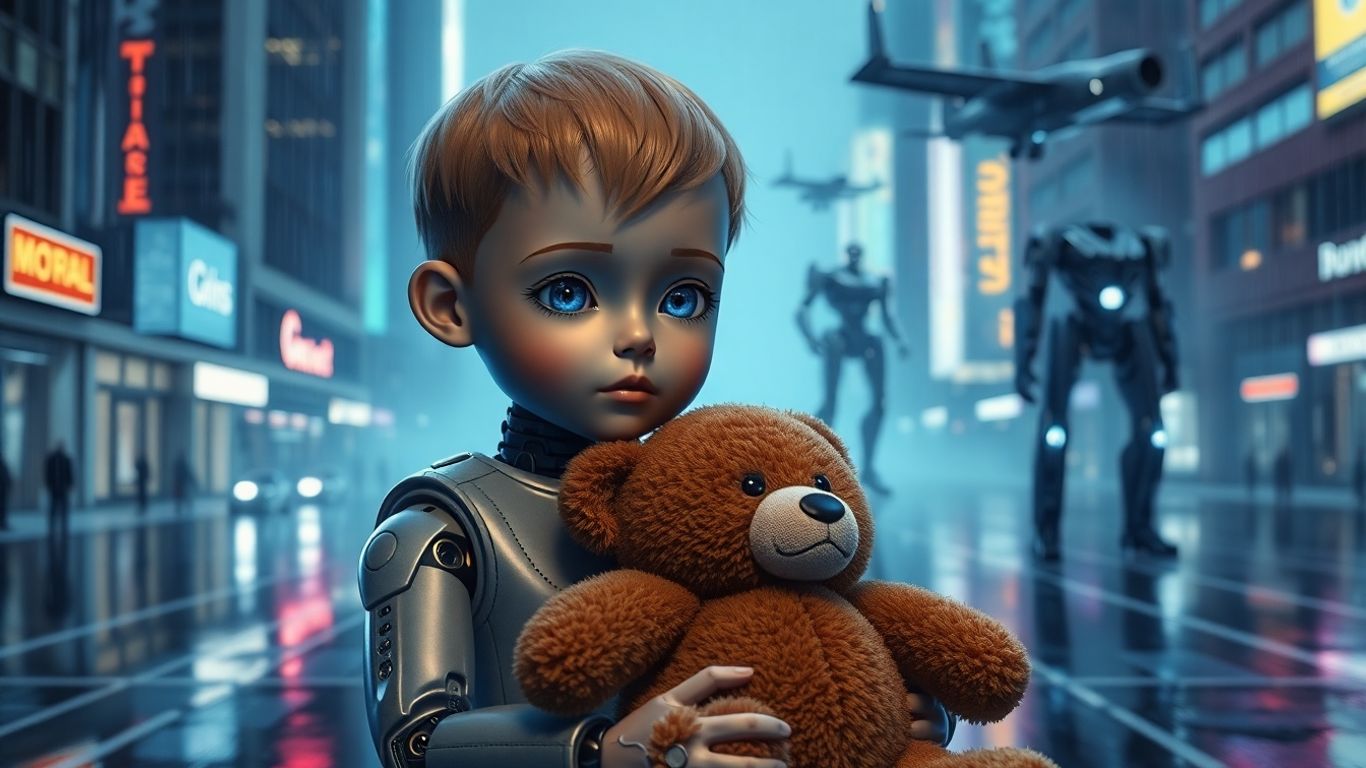
Shaping Public Discourse On AI, Consciousness, And Care
A.I. Artificial Intelligence shifted public talk about machines from fear and control to caregiving, grief, and attachment. It made audiences sit with the uncomfortable idea that a designed being might experience longing, not just logic. That moved debates toward duty of care, consent in design, and the ethics of switching a sentient system off.
- Emotional labor: The film brings forward questions about whether machines can give or receive care, and what happens when that care gets withdrawn.
- Attachment and consent: "Imprinting" popularized a sticky concept—once a bond exists, who has the right to break it?
- Policy echoes: Discussions about rights for sentient or near-sentient systems now often include child protection analogies, guardianship standards, and off-boarding protocols.
- Education and media: Classrooms, think tanks, and tech panels still use David’s story to discuss anthropomorphism, moral status, and the risks of designing for love.
The film reframed AI not as a weapon or servant, but as a child seeking care—and that shift still guides how many people talk about machine consciousness.
Contrasts With Blade Runner, Ex Machina, And Her
Where other films stage AI through noir, corporate power, or disembodied intimacy, A.I. uses a fairy-tale quest and a family breakup. That choice matters. It brings ethics into the living room rather than the lab, and ties machine rights to everyday love and loss.
| Film | AI figure | Core question | Tone | Human–AI bond | Ending note |
|---|---|---|---|---|---|
| A.I. Artificial Intelligence | David (child mecha) | Can a made child be loved as real, and at what cost? | Fairy tale + grounded sci‑fi | Parent–child attachment | Ambiguous mercy, memory, and closure |
| Blade Runner | Replicants (bioengineered) | Who counts as human when memory and empathy blur? | Dystopian noir | Hunter vs. hunted, begrudging empathy | Identity persists despite erasure |
| Ex Machina | Ava (embodied AGI prototype) | Is consciousness obligated to be kind—or merely free? | Chamber thriller | Manipulation as survival | Liberation without comfort |
| Her | Samantha (disembodied OS) | What does love mean without a body or shared time? | Intimate near-future romance | Companionate, evolving | Transcendence beyond the user |
Key differences worth noting:
- Point of view: A.I. uses a child’s gaze; Blade Runner centers an investigator; Ex Machina locks us in with an experimenter; Her stays with the lonely user.
- Body and presence: A.I., Blade Runner, and Ex Machina foreground the body; Her explores voice and absence.
- Power structures: A.I. focuses on family and abandonment; Blade Runner on policing and corporate control; Ex Machina on creator dominance; Her on network scale and personal vulnerability.
- Moral stakes: A.I. asks about responsibility after creating need; the others ask about rights, autonomy, and consent under different pressures.
Legacy Of AI Artificial Intelligence The Movie In Modern Debates
The film shows up, sometimes quietly, in today’s arguments about companion robots, chatbot attachment, and “off” switches for systems that mimic feelings. Designers now talk about safety rails for affect—like avoiding deceptive bonding, adding clear disclosures, and building humane shutdown procedures. Ethicists point to the film when discussing retirement and memory rights for sentient or semi-sentient agents, especially those built to comfort children, elders, or the isolated.
- Product design: Guardrails to prevent exploitative attachment, age-appropriate interactions, and consent-based bonding.
- Governance: Audit trails for creation and decommissioning; ombuds models for contested shutdowns; rights frameworks triggered by capability milestones.
- Culture and media: A continued “Pinocchio protocol” in storytelling—AI characters who want recognition, not domination—informing how the public reads real AI headlines.
A.I. keeps reminding us that technical capability isn’t the last question; care, endings, and memory are. That is the part policy often forgets until it’s too late.
A Lasting Impression
As we wrap up our look at "A.I. Artificial Intelligence," it’s clear the film left a mark. Spielberg used sci-fi to explore big feelings and tough questions about love, who we are, and how we accept others. By mixing future tech with these old ideas, the movie really gets you thinking and feeling. It makes us wonder about our own connection to technology and what it truly means to be alive. The film’s journey with David, the robot boy, really makes you consider the line between humans and machines, and whether robots can feel. It’s a story that sticks with you, prompting us to think about the future of AI and our place in it.
Frequently Asked Questions
Can artificial intelligence truly feel emotions like humans do?
While smart computer programs, or AI, can be made to act like they have feelings, it’s hard for them to truly understand and feel emotions the way people do. They can copy how we act when we’re happy or sad, but it’s not the same as actually experiencing those feelings.
How is ‘A.I. Artificial Intelligence’ different from other movies about robots?
This movie is special because it focuses a lot on feelings and what it means to be human. It uses robots and future technology to ask big questions about love, belonging, and what makes someone ‘real,’ not just about whether robots can fight or do jobs.
Did the movie ‘A.I. Artificial Intelligence’ inspire any real-world technology?
The movie made people think more about AI and how we should treat smart machines. It started important talks about being careful with new technology and making sure it’s used in good ways, even if it didn’t directly create new inventions.
Is ‘A.I. Artificial Intelligence’ a movie for kids?
This movie deals with some grown-up ideas and has scenes that might be a little scary or sad for younger children. It’s best for older kids and adults who can understand the deeper meanings and emotional parts of the story.
What other movies are like ‘A.I. Artificial Intelligence’?
If you liked this movie, you might also enjoy films like ‘Blade Runner,’ ‘Ex Machina,’ and ‘Her.’ They also explore what it means to be human and how we connect with artificial intelligence in different ways.
What does the main character, David, want?
David is a robot boy who desperately wants to be loved and accepted by his human family. He believes that if he can prove he’s a ‘real’ boy who can love, he will finally belong.











