Building a blockchain that’s fast, secure, and run by everyone is a tough puzzle. Think of it like trying to create a perfect neighborhood watch program. You want everyone involved and making decisions (that’s decentralization), you need to be able to handle lots of people reporting issues quickly (scalability), and you have to make sure no one is faking reports or causing trouble (security). It’s hard to get all three exactly right at the same time. This challenge, known as the blockchain trilemma, is a big deal for anyone working with this technology. We’ll explore what makes it so tricky and how people are trying to solve it.
Key Takeaways
- The blockchain trilemma describes the difficulty of achieving decentralization, scalability, and security all at once.
- Decentralization means no single entity controls the network, promoting trust and resilience.
- Scalability is about handling more transactions quickly to support widespread use.
- Security protects the network from attacks and ensures data integrity.
- Different blockchains prioritize these aspects differently, leading to various design choices and trade-offs.
Understanding the Core Components of the Blockchain Trilemma
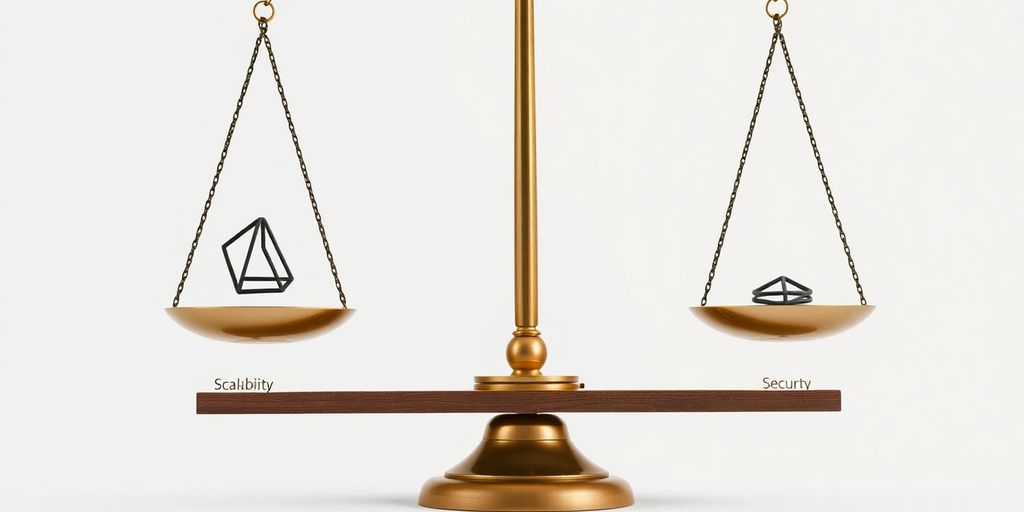
Think of building a blockchain like setting up a neighborhood watch. You want everyone to have a say in how it operates, be able to handle a lot of activity, and, most importantly, be safe from any trouble. This is the essence of the blockchain trilemma: the challenge of balancing three key features – decentralization, scalability, and security – all at once. It’s a bit like trying to make a cake that’s healthy, delicious, and quick to bake; improving one aspect often means compromising on another.
Decentralization: The Foundation of Trust
At its heart, decentralization means that no single person or group has complete control over the network. Instead, power and decision-making are spread across many participants, often called nodes. This distributed nature is what gives blockchain its inherent trust and transparency. Imagine a town square where everyone can see what’s happening and has a voice in local matters, rather than a single mayor making all the decisions. This setup prevents any one entity from manipulating the system or creating a single point of failure. However, having so many voices involved can sometimes slow down the process of reaching agreements or implementing changes.
- Transparency: All transactions are visible to participants.
- Resilience: The network can continue operating even if some nodes go offline.
- Censorship Resistance: It’s difficult for any single entity to block or reverse transactions.
The distributed ledger ensures that information is shared and validated by a network of participants, rather than being held by a central authority. This shared responsibility is key to the integrity of the system.
Scalability: Enabling Widespread Adoption
Scalability refers to a blockchain’s ability to handle an increasing volume of transactions quickly and efficiently. As more people use a blockchain network, the demand for processing transactions goes up. If a network can’t keep up, it becomes slow and expensive to use, much like a popular coffee shop with only one barista during the morning rush. To achieve widespread adoption, blockchains need to be able to process thousands, or even millions, of transactions per second without breaking a sweat. This is where innovations like Layer 2 scaling solutions come into play, aiming to improve throughput.
- Transaction Speed: How quickly transactions are confirmed.
- Transaction Cost: The fees associated with processing transactions.
- Network Throughput: The total number of transactions a network can handle in a given time.
Security: Protecting the Network’s Integrity
Security is arguably the most critical component. It’s about safeguarding the network from attacks, fraud, and unauthorized access. Blockchains use sophisticated cryptographic techniques and consensus mechanisms (like Proof-of-Work or Proof-of-Stake) to ensure that transactions are legitimate and that the ledger remains immutable – meaning once a transaction is recorded, it cannot be altered or deleted. Maintaining robust security is vital, especially as networks grow and become more attractive targets for malicious actors. The challenge lies in ensuring that security measures don’t unduly hinder the network’s speed or decentralization.
- Immutability: Once data is added, it cannot be changed.
- Data Integrity: Transactions are accurate and have not been tampered with.
- Network Availability: The network remains operational and accessible.
The Inherent Trade-offs in Blockchain Design
Building a blockchain is a bit like trying to create the perfect neighborhood gathering spot. You want it to be a place where everyone feels welcome and has a say in how things are run (decentralization), but you also need it to be able to handle a huge crowd without getting bogged down (scalability). And, of course, it needs to be safe and sound, protected from any trouble (security). The tricky part is that focusing too much on one of these goals often means compromising on another. It’s a constant balancing act.
When Decentralization Slows Things Down
Think about how decisions are made in a very democratic group. If every single person needs to agree on every little thing, progress can be incredibly slow. Blockchains are similar. When a network has thousands of computers (nodes) spread all over the world, each one needs to agree on the validity of transactions. This distributed agreement is what makes blockchains secure and resistant to single points of failure. However, getting consensus among so many independent participants takes time and computational effort. This is why many highly decentralized blockchains, like Bitcoin, process transactions at a much slower rate compared to centralized systems.
- More nodes mean more communication overhead.
- Reaching agreement across a distributed network is inherently slower than a single authority making decisions.
- Ensuring every node has the most up-to-date ledger requires significant data synchronization.
The very nature of distributing power and decision-making across a vast network introduces inherent delays in processing and confirmation times.
Scaling Security: A Delicate Balance
Security in a blockchain is often achieved through complex cryptographic methods and consensus mechanisms, like Proof-of-Work (PoW) or Proof-of-Stake (PoS). These systems are designed to make it prohibitively expensive or difficult for malicious actors to attack the network. However, as networks grow and transaction volumes increase, maintaining this high level of security while also improving speed becomes a significant challenge. For instance, some methods to speed up transactions might involve reducing the number of validators or simplifying the verification process, which could potentially open up new avenues for attack or reduce the overall decentralization.
The Cost of Enhanced Speed
When developers try to boost a blockchain’s transaction speed, they often face difficult choices. One common approach is to increase the block size, allowing more transactions to be included in each block. However, larger blocks require more storage and bandwidth for nodes to download and process, which can lead to fewer individuals being able to run a full node. This, in turn, can lead to a more centralized network, as only those with powerful hardware and internet connections can participate effectively. Another strategy involves using faster consensus mechanisms, but these might sometimes sacrifice some degree of decentralization or introduce new security considerations that need careful management.
Real-World Examples of the Blockchain Trilemma in Action
Bitcoin: Prioritizing Security and Decentralization
Bitcoin, the first major cryptocurrency, was built with a strong emphasis on security and decentralization. Its Proof-of-Work (PoW) consensus mechanism requires significant computational power, making it incredibly difficult and expensive for any single entity to gain control of the network. This robust security, combined with a vast network of globally distributed nodes, ensures a high degree of decentralization. However, this focus comes at a cost to scalability. Bitcoin can currently process only a limited number of transactions per second, leading to slower confirmation times and higher fees during periods of high network activity. It’s a system that values immutability and resistance to censorship above all else.
Ethereum: Balancing Decentralization with Evolving Scalability
Ethereum, while also starting with a Proof-of-Work system, has always aimed to be more than just a digital currency; it’s a platform for decentralized applications (dApps). This ambition necessitates a greater degree of flexibility and programmability, which can sometimes conflict with extreme decentralization and security. Initially, Ethereum faced similar scalability issues to Bitcoin. However, its ongoing transition to Proof-of-Stake (PoS) and the planned implementation of sharding are significant steps towards improving its transaction throughput. This evolution shows a conscious effort to find a better balance within the trilemma, aiming to support a wider range of applications without unduly compromising its decentralized nature. The network is a prime example of a project actively working to address its trilemma challenges.
Solana: A Focus on High Throughput
Solana takes a different approach, prioritizing speed and scalability. It utilizes a unique consensus mechanism called Proof-of-History (PoH) in conjunction with Proof-of-Stake (PoS). PoH creates a historical record that proves an event occurred at a specific moment in time, allowing for much faster transaction processing and higher throughput, potentially reaching tens of thousands of transactions per second. This makes Solana attractive for applications requiring high performance, such as decentralized finance (DeFi) and gaming. However, this high throughput is achieved through a more centralized network architecture, with fewer validators and higher hardware requirements for running a node. This has led to discussions about its level of decentralization compared to networks like Bitcoin or Ethereum. It’s a clear trade-off: speed and efficiency gained at the expense of broader decentralization.
The choices made in designing a blockchain’s architecture directly reflect its intended use case and the priorities of its creators. Each project must decide which aspects of the trilemma to emphasize, understanding that optimizing one often means making concessions in another.
Innovations Aiming to Solve the Blockchain Trilemma
Layer 2 Scaling Solutions Explained
Layer 2 solutions are a big deal when we talk about making blockchains faster and cheaper to use. Think of the main blockchain, like Bitcoin or Ethereum, as a busy highway. When too many cars (transactions) try to use it at once, traffic jams happen, and it gets slow and expensive. Layer 2 solutions build smaller, faster roads next to the main highway. These roads handle a lot of the traffic, only sending the final results back to the main highway when needed. This keeps the main highway less congested.
There are a few main types of these "side roads":
- State Channels/Payment Channels: These are like private agreements between two or more people. They can make tons of transactions between themselves off-chain, only recording the final outcome on the main blockchain. It’s super fast for frequent, small transactions.
- Rollups: These are really clever. They bundle up many transactions happening off-chain into one big package. This package is then sent to the main blockchain for verification. It’s like sending a summary report instead of every single detail. There are two main kinds: Optimistic Rollups and Zero-Knowledge (ZK) Rollups, each with its own way of proving the transactions are valid.
- Sidechains: These are separate blockchains that are connected to the main chain. They have their own rules and can process transactions independently, offering more flexibility and speed. Think of them as specialized tracks that can still interact with the main railway.
These Layer 2 approaches are key to making blockchain technology practical for everyday use, allowing for more transactions without sacrificing too much of the original network’s security or decentralization. It’s a way to get more done without breaking the bank or the system.
The Role of Sharding in Enhancing Performance
Sharding is another major innovation, particularly being implemented by networks like Ethereum 2.0. Imagine a massive database that’s getting too big and slow to manage. Sharding breaks this huge database into smaller, more manageable pieces called "shards." In blockchain terms, this means the network is split into smaller groups of nodes, each responsible for processing only a portion of the transactions or smart contracts.
This approach has a few big benefits:
- Increased Throughput: Instead of every node having to process every single transaction, nodes only need to process transactions for their specific shard. This dramatically increases the number of transactions the network can handle per second.
- Reduced Network Load: By distributing the workload, sharding lessens the burden on individual nodes, making the network more efficient overall.
- Improved Scalability: As the network grows, more shards can be added, allowing the system to scale almost infinitely.
Sharding essentially parallelizes the work that needs to be done on a blockchain. Instead of one long queue, you get multiple queues working at the same time, which is a much more efficient way to handle a large volume of activity. This is a significant step towards making blockchains capable of supporting global-scale applications.
While sharding is powerful, it also introduces its own complexities, especially in ensuring that communication between shards is secure and that the overall network remains decentralized and robust. It’s a complex engineering feat, but one that holds immense promise for the future of blockchain technology. You can find more about these developments on sites like IntelligentHQ.
Exploring New Consensus Mechanisms
The way a blockchain network agrees on the validity of transactions and the order in which they are added to the ledger is called its consensus mechanism. The original, Proof-of-Work (PoW) used by Bitcoin, is very secure and decentralized but incredibly slow and energy-intensive. To tackle the trilemma, researchers and developers are exploring and implementing new consensus mechanisms that aim to be faster, more energy-efficient, and still maintain a high degree of security and decentralization.
Here are a few examples:
- Proof-of-Stake (PoS): Instead of miners solving complex puzzles, validators are chosen to create new blocks based on the amount of cryptocurrency they "stake" or lock up in the network. This is much more energy-efficient and can be faster than PoW. Ethereum’s transition to PoS is a prime example.
- Delegated Proof-of-Stake (DPoS): In DPoS, token holders vote for a limited number of delegates who are then responsible for validating transactions and creating blocks. This can lead to very high transaction speeds but might reduce decentralization as power is concentrated among fewer delegates.
- Proof-of-Authority (PoA): This mechanism relies on a set of pre-approved validators whose identities are known and trusted. It’s very fast and efficient but is inherently less decentralized, often used in private or consortium blockchains.
Each of these mechanisms represents a different approach to balancing the trilemma. The ongoing research and development in this area are vital for creating blockchains that can support a wide range of applications and widespread adoption.
Future Directions and Emerging Solutions
The quest to solve the blockchain trilemma is far from over, and the future looks bright with several innovative approaches on the horizon. These aren’t just theoretical ideas; many are actively being developed and tested, promising to reshape how we think about blockchain capabilities.
The Promise of Zero-Knowledge Proofs
Zero-knowledge proofs (ZKPs) are a fascinating cryptographic technique that allows one party to prove to another that a statement is true, without revealing any information beyond the truth of the statement itself. Think of it like proving you have the key to a lock without showing the key. In the context of blockchains, ZKPs can be used to verify transactions privately and efficiently. This means we could potentially scale blockchains by processing many transactions off-chain, then submitting a single, compact ZKP to the main chain to prove the validity of all those off-chain transactions. This could dramatically boost transaction speeds and reduce costs while maintaining a high degree of privacy and security. It’s a complex area, but the potential for scaling without sacrificing decentralization or security is immense. Many projects are exploring how to integrate ZKPs, and it’s a key area to watch for future blockchain advancements.
Interoperability and Cross-Chain Solutions
Another significant area of development is interoperability – the ability for different blockchains to communicate and share information with each other. Currently, many blockchains operate in silos. Imagine trying to send money from a bank in one country to a bank in another, but they use completely different systems that can’t talk to each other. That’s often the case with blockchains today. Cross-chain solutions, like bridges and specialized interoperability protocols, aim to fix this. They allow assets and data to move between different blockchain networks. This not only expands the utility of individual blockchains but also helps to distribute the load. If one blockchain becomes congested, users might be able to move their activities to another, more available chain. This interconnectedness could lead to a more robust and flexible blockchain ecosystem, indirectly helping to manage the trilemma by providing alternatives and spreading usage.
Quantum-Resistant Cryptography’s Impact
While not directly a solution to the trilemma in terms of scalability or decentralization, quantum-resistant cryptography is a vital future direction for blockchain security. As quantum computers become more powerful, they pose a potential threat to current cryptographic methods that secure blockchains. Quantum computers could, in theory, break the encryption that protects our transactions and digital identities. Therefore, developing and implementing new cryptographic algorithms that are resistant to quantum attacks is crucial for the long-term viability and security of blockchain technology. This is about future-proofing the network’s integrity against unforeseen technological advancements. It’s a proactive step to ensure that the security pillar of the trilemma remains strong for decades to come, even as other areas like scalability and decentralization continue to evolve. The transition to quantum-resistant cryptography will likely be a complex process, requiring careful planning and widespread adoption across different blockchain networks.
The ongoing research and development in areas like zero-knowledge proofs, cross-chain communication, and quantum-resistant cryptography highlight a dynamic and adaptive approach to overcoming the blockchain trilemma. These innovations are not just about incremental improvements; they represent potential paradigm shifts in how decentralized systems can operate efficiently and securely on a global scale. The goal is to build a future where blockchain technology can support a vast array of applications without compromising its core principles. This continuous innovation is what makes the blockchain space so exciting, suggesting that a truly balanced solution might be closer than we think, potentially leading to a future economy where decentralized systems are the norm, much like the visions of a post-work society where automation handles many tasks [aaf1].
The Road Ahead: Embracing the Trilemma
So, we’ve looked at this blockchain trilemma thing – it’s basically a balancing act between making things fast, keeping them safe, and making sure everyone has a say. It’s not easy, and different blockchains try to solve it in their own ways. Some are super fast but maybe not as spread out, while others are really open but can get a bit slow when lots of people use them. It’s a bit like trying to build a perfect gadget; you often have to pick what’s most important. But the good news is, people are working on new ideas all the time, like different ways to speed things up without messing with the core safety or fairness. It’s an ongoing puzzle, and figuring it out is what keeps this whole space exciting. We’re still learning, and the next big breakthrough could come from anywhere.
Frequently Asked Questions
What is the blockchain trilemma?
The blockchain trilemma is a challenge that makes it hard for blockchains to be good at three things at once: letting lots of people use it (scalability), keeping it safe from bad guys (security), and making sure no single person or group is in charge (decentralization). It’s like trying to build a treehouse that’s huge, super strong, and owned by everyone in the neighborhood – tricky to get all three perfect!
Why can’t blockchains just be fast, safe, and run by everyone?
Making a blockchain super fast often means fewer people need to check things, which can make it less decentralized. If you want everyone to have a say (decentralization), it takes more time for decisions, slowing it down. Making it super secure might also add extra steps that reduce speed. It’s a balancing act where improving one part can make another part weaker.
How do blockchains like Bitcoin and Ethereum handle this problem?
Bitcoin mostly focuses on being very secure and decentralized, which means it’s slower. Ethereum aims for a balance, allowing for more complex uses like apps, but it has faced issues with slow speeds and high costs when many people use it. Both are trying new ways to improve without losing their core strengths.
What are ‘Layer 2’ solutions?
Layer 2 solutions are like adding a fast lane or a special express service to a busy highway. They help process many transactions off the main blockchain, making things quicker and cheaper. Then, they send a summary back to the main blockchain. Examples include the Lightning Network for Bitcoin and various ‘rollups’ for Ethereum.
Are there other ways blockchains are trying to solve the trilemma?
Yes, developers are exploring many ideas! One is called ‘sharding,’ which is like splitting a big blockchain into smaller, faster pieces that work together. Others are looking at new ways for computers to agree on what’s true (consensus mechanisms) and using advanced math (like zero-knowledge proofs) to speed things up securely.
What does the future look like for solving the blockchain trilemma?
The future looks exciting! Innovations like zero-knowledge proofs could allow for very fast and private transactions. Making different blockchains able to talk to each other (interoperability) will also help. Plus, scientists are working on making blockchains safe from future super-powerful computers (quantum-resistant cryptography).