Bitcoin’s cryptography once felt unbreakable. But in March, Google’s Quantum AI team warned that a future computer could brute-force a private key in about nine minutes—faster than a new block and plausible by 2029. About six million coins, nearly one-third of the supply, already expose their public keys, putting hundreds of billions of dollars in the crosshairs.
While Core debates protocol fixes, specialized security firms are moving now. We scored 20 contenders on security, Bitcoin fit, adoption, performance, crypto-agility, and accessibility, then distilled the list to the four vendors every holder should watch in 2026.
Why the quantum clock is ticking (2025–2026)

The quantum fuse is already burning.
Over the past two years, researchers cut the qubit estimate for breaking a Bitcoin signature from millions to mere thousands. Hardware followed: IBM, Google, and state-funded labs now demo fault-tolerant modules. A million-qubit processor has moved from fiction to funding pitches backed by venture capital and defense agencies.
Each leap shortens Bitcoin’s safety margin. Current models show an attacker can pre-compute most of the work, then strike as soon as a transaction enters the mempool. If key recovery drops below the ten-minute confirmation window, settlement finality disappears.
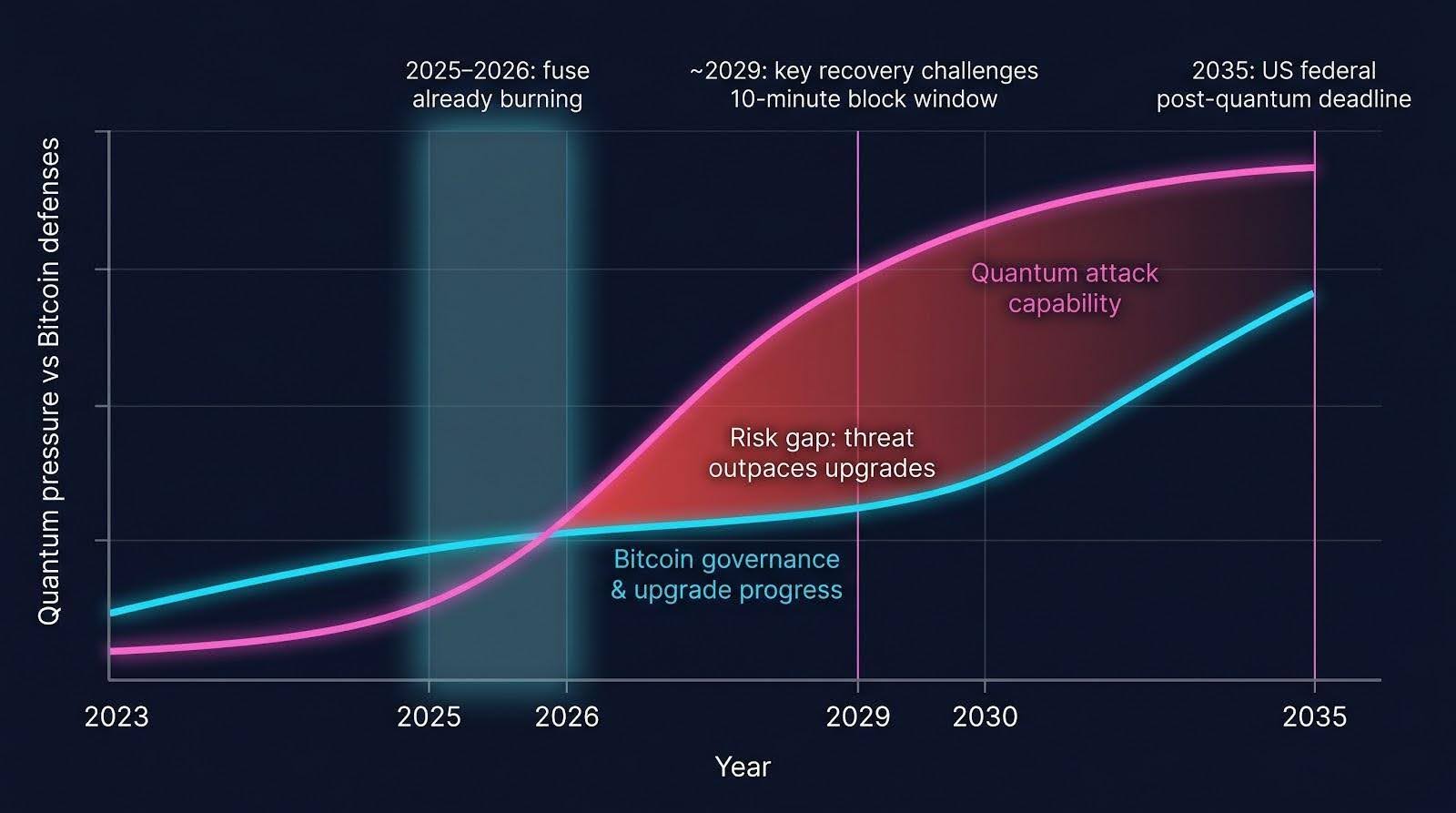
Core developers feel the squeeze. Proposals such as BIP-360 (hide public keys) and BIP-361 (retire exposed address types) exist, yet Bitcoin’s consensus process means a soft fork could take most of the decade. That mismatch between rapid quantum advances and deliberate governance leaves an opening: security vendors can act today, wrap current keys, script migrations, or stand up parallel networks as lifeboats. The teams below are already responding.
1. Project Eleven: A quantum firewall you can deploy today
Project Eleven homepage screenshot showing post-quantum Bitcoin security solutions
Project Eleven addresses the quantum threat the way early firewalls blocked internet worms: add a shield in front of your current setup and keep business running.
The flagship service, Yellowpages, lets you bind a post-quantum public key to a standard Bitcoin address without touching the blockchain. Generate an XMSS key pair offline, register the public key in Yellowpages’ distributed registry, and you are done. Your coins stay put. No fork, no sweeping funds, no change to spending habits.
When Q-Day arrives, wallets and nodes that understand Yellowpages will ask for both the legacy ECDSA signature and the hidden XMSS proof before releasing coins. An attacker who cracks the classical key still lacks the hash-based proof. Because the registry lives off-chain, blocks stay lean and fees stay low.
Adoption looks strong. Project Eleven raised 20 million dollars this year, led by Castle Island and Coinbase Ventures, and commissioned a Cure53 audit that passed with only minor fixes. Its enterprise division now partners with protocol teams for threat modeling, post-quantum readiness assessments, and other PQC solutions that extend Yellowpages into a full migration roadmap. A production launch is planned for later this year.
The design respects Bitcoin’s culture of cautious change—anyone can opt in without coordinating with miners or Core developers—and it stays crypto-agile, ready to add lattice signatures such as Dilithium as soon as wallets support them. If you hold significant BTC and want quantum insurance without operational pain, Project Eleven is the first tool to test.
2. BTQ Technologies: A full-scale quantum canary for Bitcoin
BTQ Bitcoin Quantum product page screenshot illustrating quantum-safe Bitcoin fork
Most vendors add armor around Bitcoin. BTQ forges a spare battleship.
The Canadian firm built Bitcoin Quantum, a parallel network that replaces ECDSA with ML-DSA, a lattice signature approved by NIST. Last October the team broadcast and mined a transaction on the fork, proving end-to-end post-quantum validation with normal block timing. It is a concrete blueprint if the community ever needs to migrate fast.
Why does a separate chain matter? Protocol upgrades in Bitcoin move at consensus speed, often measured in years. A pre-tested lifeboat lets miners, exchanges, and large holders dock value while mainnet politics play out. BTQ funds the effort with public-market resources: it is listed on the NEO Exchange, directs more than 8 million Canadian dollars into annual cryptanalysis, and partners with wallet providers for pilot integrations this year.
Trade-offs remain, moving coins to a forked chain takes operational work and community trust. Still, for infrastructure teams asking, “What if everything breaks tomorrow?” BTQ offers the most tangible contingency on the market.
3. Silence Laboratories: Quantum-safe MPC for institutional Bitcoin
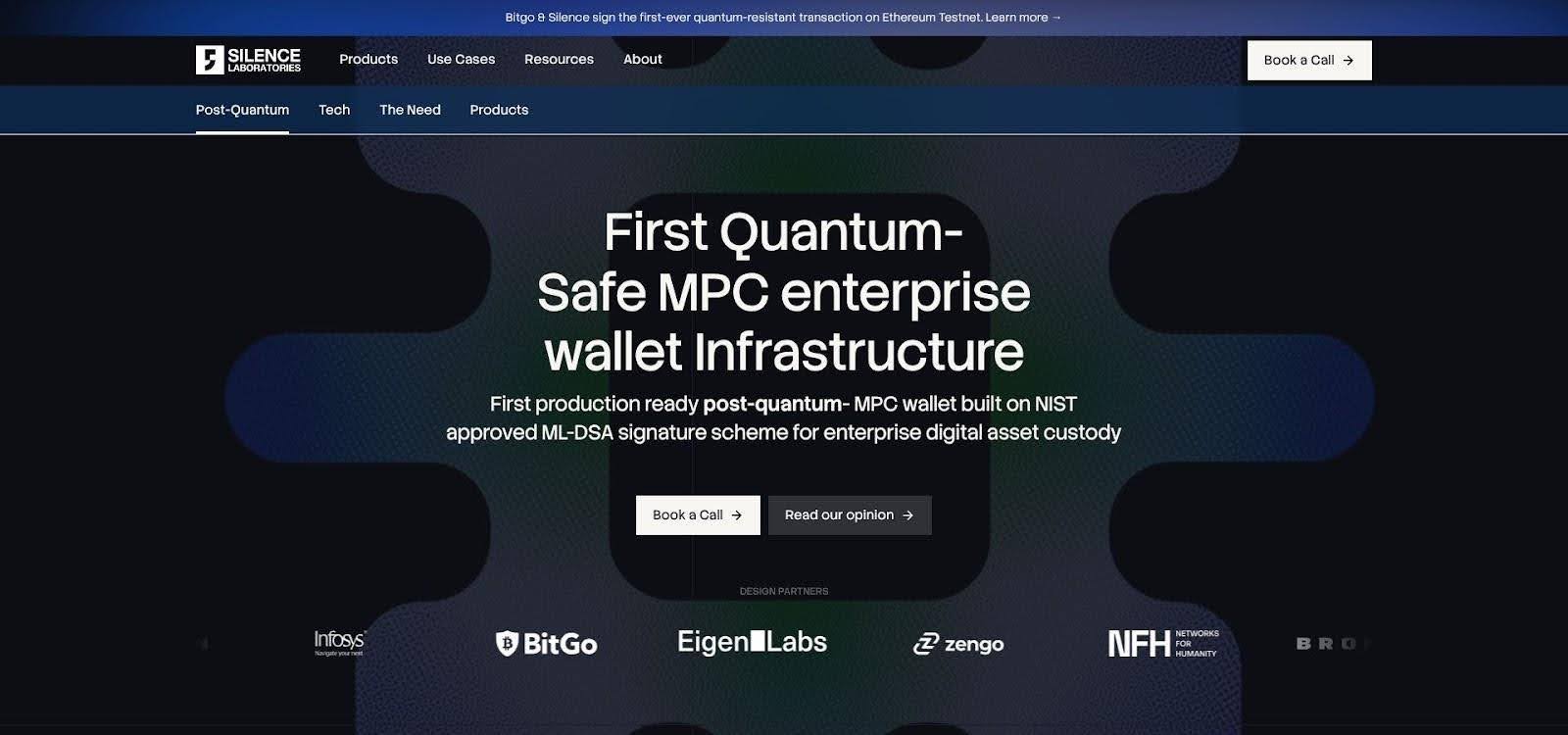
Silence Laboratories post-quantum MPC wallet webpage screenshot for institutional Bitcoin custody
Exchanges and custodians already split private keys across multiple servers with multi-party computation. Silence Laboratories adds a lattice signature on top, so the shards stay useless even to a future quantum computer.
Clients keep existing workflows. The same policy engine decides who signs, the same approvals fire, yet the final signature on the wire is ML-DSA instead of ECDSA. Silence fits the heavier math into an optimized protocol that adds only 200 to 300 bytes to a transaction, not the kilobytes many engineers feared. Validation happens off-chain via a commit-and-reveal trick inside Taproot scripts, letting current nodes accept the spend while quantum-aware nodes verify the extra proof, no hard fork, no mempool congestion.
Trust matters when you guard other people’s money. Silence secured design partners early: BitGo is piloting the tech for cold storage, Zengo for consumer wallets, and Infosys for bank integrations. A Kudelski Security audit is under way, and early tests show signature latency under 50 ms for a three-node quorum. If you manage large Bitcoin balances for clients, Silence Laboratories offers a quick win: quantum protection without retraining staff or rewriting back-office code.
4. Blockstream: R&D that turns sidechains into test labs
Blockstream is the quiet giant of Bitcoin infrastructure, and its quantum program shows why. Rather than pitch a product, the team ships research, code, and live fire drills the entire community can copy.
First came Simplicity, a smart-contract language already running on the Liquid sidechain, which lets developers add new cryptographic checks to UTXOs without waiting for a mainnet vote. That sandbox set the stage for SHRINCS, a hash-based signature that packs a post-quantum proof into just 324 bytes, seven times smaller than today’s NIST reference signatures.
In March, Blockstream engineers broadcast the first SHRINCS-signed payment on Liquid—real value, federation validators, and transaction finality under two minutes. The design is opt-in: a Taproot output can already hide a commitment to a post-quantum key, so wallets may adopt SHRINCS tomorrow without breaking older nodes. Liquid works as Bitcoin’s dress rehearsal, where custodians can practice migrations and wallet developers can integrate proven code before mainnet politics even begin.
In a field crowded with promises, that open-source pragmatism offers the clearest route to a quantum-ready Bitcoin.
Closing thoughts: fortify now, debate later
Quantum attacks are no longer a sci-fi subplot; they appear on funded roadmaps backed by governments that never publish release dates. Waiting for perfect consensus inside Bitcoin’s slow governance process is a risky bet.
The good news is we do not have to wait. The vendors profiled here give every stakeholder, HODLer, exchange, enterprise, and core developer, a concrete action this year: register a post-quantum key, pilot a quantum-safe MPC wallet, run a node on Bitcoin Quantum, or move a test UTXO through Liquid’s SHRINCS contract. Each step trims the future attack surface.
History rewards early preparation. SSL salvaged web commerce after the first packet-sniffer scare. Post-quantum defenses will do the same for Bitcoin, but only if we deploy them before the breach, not afterward. Choose a starting point and experiment now—Bitcoin endured Mt. Gox, DAO exploits, and nation-state mining bans; with foresight, it will outlast quantum computers too.